

If you were to scour local news publications across the US, you'd be hard-pressed not to find an article or two on the potential and real impacts data centers have had on water security.
"Surging data centers could lead to Great Lakes water shortages."
"Dry wells and water supply fears surround Amazon's massive Indiana data center."
"Texans urge action on AI data centers amid water woes."
These headlines from the Chicago Tribune, Indystar, and KTRE News, respectively, reflect a broader shift in public opinion toward data centers, increasingly casting them as pantomime villains.
As a result, whether they like it or not, water usage has now become a key boardroom conversation for most data center operators, as increasingly negative coverage has cast them as pantomime villains across the country. Developers now face a choice: drastically revise their deployment plans or pursue a technical solution to data centers' perceived water problem.
Cost of cooling
Data centers' reliance on water is tied to the vast cooling apparatus required to keep their facilities running efficiently.
Most cooling technology, from evaporative cooling towers to liquid cooling systems, needs clean potable water to operate. As a result, a typical medium-sized facility today can use upwards of 300,000 gallons (1.1 million liters) daily, while large hyperscale facilities consume up to 5 million gallons (18.9 million liters) a day.
As data centers continue to proliferate in scale and number, water demand seems only likely to rise. Projections from the International Energy Agency (IEA) project that water use in the sector will more than double from current levels by 2030, which stand at around 560 billion liters (148 billion gallons) per year.
DCD Magazine #62 - The coming wave
Will compute at sea sink or swim?
Concerns have been exacerbated by a continued focus on land and power over water accessibility, which has led to data centers being increasingly planned and built in more arid areas. According to the World Resources Institute, around 66 percent of data centers built or planned recently in the US are concentrated in high-water-stress states and drought-prone regions like California, Arizona, Texas, Illinois, and Virginia.
For many in environmental circles, this is perpetuating an already existing water-scarcity crisis.
“Even before we started building data centers, we were facing water scarcity concerns in the United States,” says Jim Walsh, policy director at environmental group Food and Water Watch (FWW).
This commitment to reduce water use, coupled with the proliferation of planned and operational AI data centers and growing angst amongst local officials and communities, has driven interest in the technology across the sector, and several companies have emerged to capitalize on this opportunity.
One player to emerge in recent years is Gradiant, which has leveraged its experience in developing closed-loop water reuse systems for the fracking and semiconductor sector to become a key player in the data center market.
From MIT to water circularity
Founded in 2013, Gradiant is the brainchild of Anurag Bajpayee and Prakash Govindan, who met as students at the Massachusetts Institute of Technology (MIT), where they were researching water treatment and desalination as PhD students.
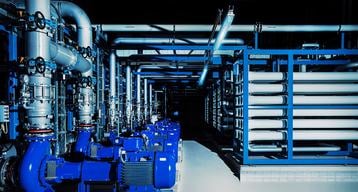
Govindan invented the technology's backbone at MIT, combining closed-loop water reuse with a zero-liquid-discharge system to capture industrial wastewater, purify it using advanced membrane and chemical processes, and recycle it back into the facility.
The system differs from the more nascent closed-loop systems pursued by companies like Microsoft, which work within a larger cooling system to minimize reliance on new water withdrawals. This lets it work across cooling systems, unlike closed-loop systems that replace evaporative cooling with an entirely new approach.
Although data centers are now the company's fastest-growing market, it initially targeted the fracking sector. According to Bajpayee, the decision established a fruitful proving ground for Gradiant's technology because fracking uses large amounts of water and carries a high risk of aquifer contamination.
While fracking offered an opportunity to prove its technology, Bajpayee says the company decided to expand its horizons and become an end-to-end provider after realizing its clients wanted a true partner to own their water challenges entirely, not a vendor selling one component they'd have to integrate themselves.
The pivot coincided with the explosion of the digital infrastructure sector, with Gradiant first gaining clients in the semiconductor space before gaining a foothold in the data center sector. To support the pivot, Gradiant relied heavily on its R&D capabilities, which led to the launch of its proprietary data center platform in May of this year.
Rather than pursuing academic careers, Bajpayee and Govindan sought to build a company that could put the research they were pursuing at MIT into practice. "We're just practical people by nature. We wanted to see science being implemented for the benefit of society." Bajpayee tells DCD.
The company that emerged from the science was founded on a simple premise, says Bajpayee, to develop a system that could clean heavily contaminated water and recycle it.
HyperSolved
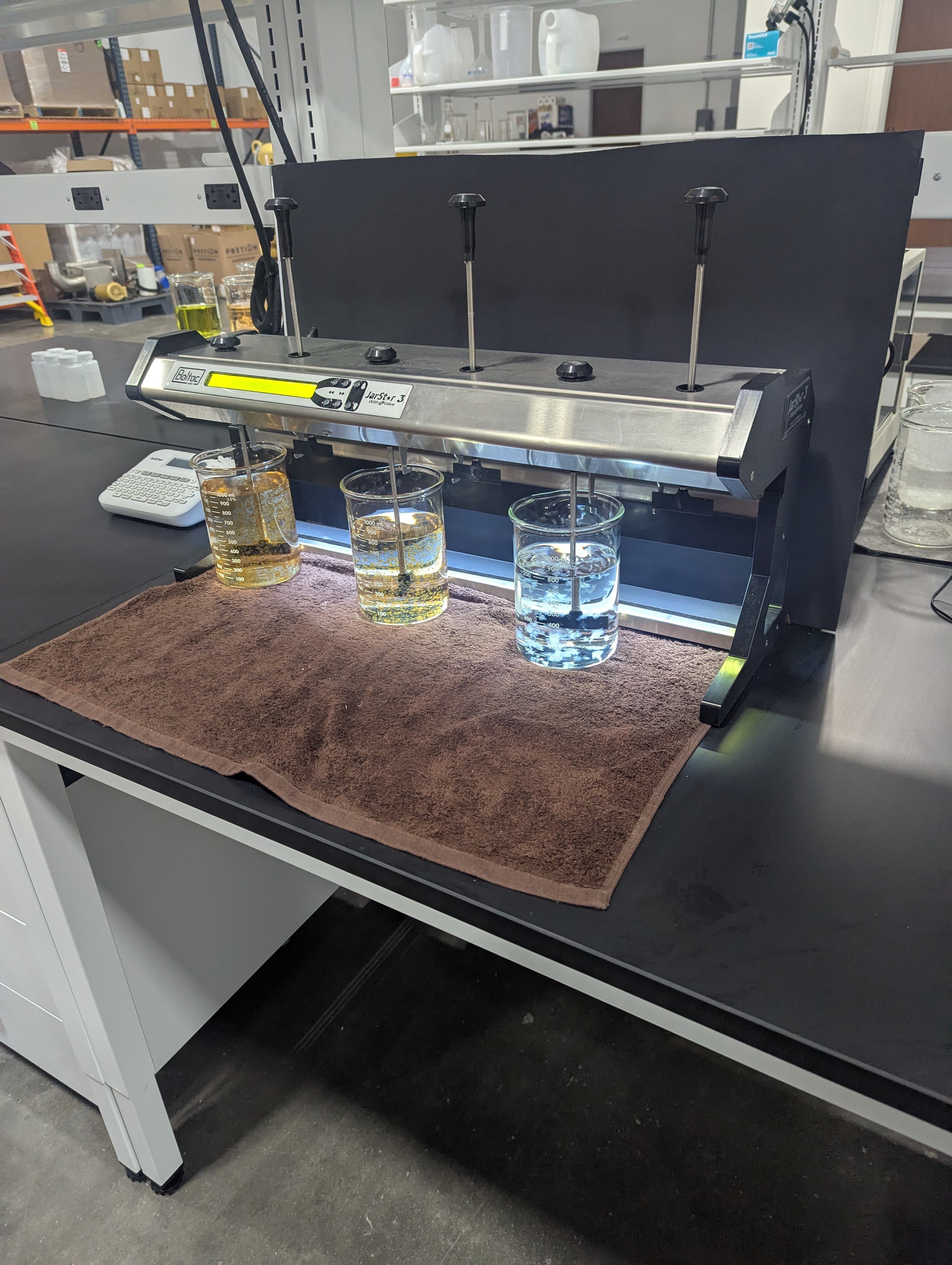
Gradiant’s R&D center in Houston, which opened in November 2025, is one of three research labs the company operates, alongside Abu Dhabi and Singapore.
While the other labs work across multiple sectors, the Houston lab focuses mainly on data centers and semiconductors. However, the center is not merely for R&D; it also plays a crucial role in Gradiant’s fully integrated service.
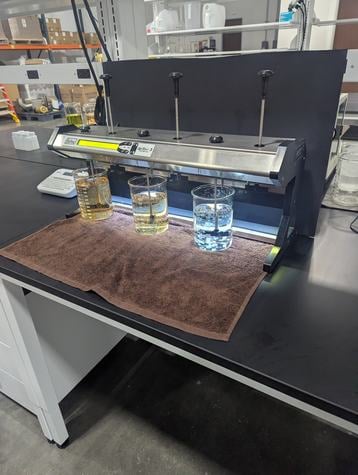
The service starts before a deal is signed, with the lab offering in-house analysis of water samples to determine how to treat them for use in the closed-loop reuse system. The lab typically processes samples in two days, compared with the industry standard of one to three weeks.
"If there's a big proposal, say a big data center, we can optimize, take samples, and give them the best proposal that is both cost-competitive and technically compliant," Aaron U, manager, NPI at Gradiant, told DCD during the tour.
The bespoke testing service feeds directly into its proprietary data center solution, known as HyperSolved. The end-to-end water platform is built around what Bajpayee calls "source agnostic" treatment, allowing it to take almost any input water - such as wastewater - and make it usable for cooling within data centers.
"We can find wastewater from the community that isn't readily usable and make that pure enough and good enough for data center operations," he says.
This is achieved through a proprietary "cure" chemical line developed at the Houston lab, comprising more than 100 products, including antiscalants and membrane cleaners, mapped to each stage of the HyperSolved process.
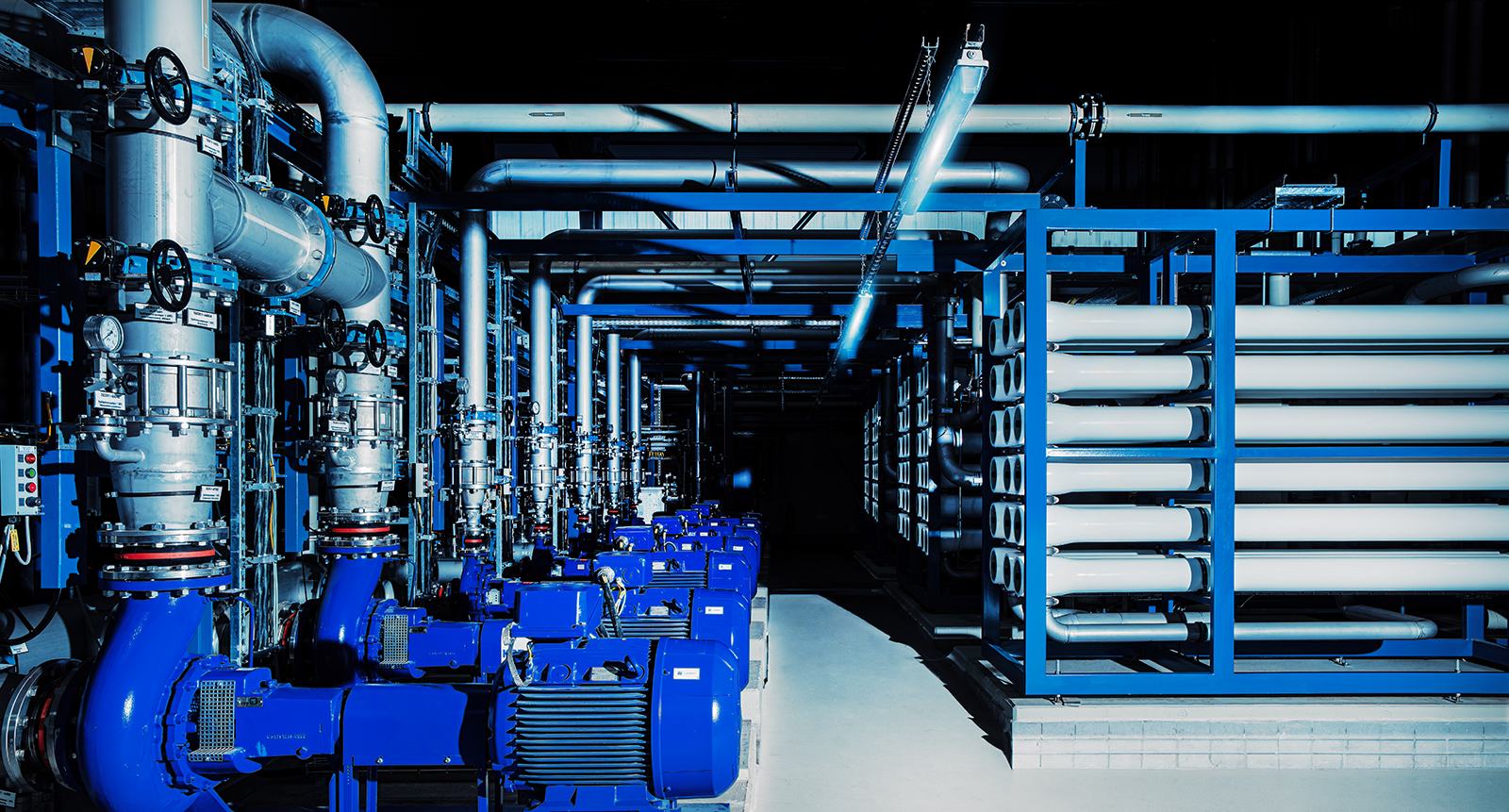
The HyperSolve system itself is built around three stages that mirror a data center's water lifecycle. The first is pretreatment, where incoming water, whatever the source, is prepared for use. The second covers cooling tower operation, where water is treated and chemically managed for reuse over multiple cycles. The third covers discharge, where the platform can run at minimum liquid discharge or scale up to zero liquid discharge, converting brine into a smaller volume of solid waste rather than releasing liquid effluent.
"We can take and recycle 95-plus percent of what comes out... reducing what you require at the front end," says Bajpayee.
To ensure economies of scale, the platform is built with modularity in mind, says Bajpayee, using containerized, plug-and-play configurations that match how data centers are typically built in phases rather than as single monolithic builds. "When we are building at scale, we're not necessarily building bigger; we're building more of the same," Bajpayee says. "So the risk of deployment and performance goes down because of the modularity of the solution."
An AI layer underpins the system. Known as Smart Ops, it continuously monitors incoming water conditions and adjusts chemical dosing and treatment levels in real time to avoid the cost and performance penalties of over- or under-treating.
"The AI suite ensures the highest efficiency at every given time point," Bajpayee says. "It ensures the lowest cost at every given time point, and it ensures reliability across your system."
Gradiant has already deployed its system across several data centers, signing a high-profile deal with an unnamed hyperscaler earlier in the year. This has spurred a rush of financial backing, with the company recently completing a Series E fundraise that valued it at $2 billion.
While the company already has a foothold in the sector, Bajpayee says its potential impact is still to be seen, adding that alongside supporting greater water sustainability, it could also help drive data center growth in the very locations where water use has become a concern.
Diversifying data center developments
Many concerns about data center water use focus on impacts to potable water supplies. Bajpayee contends that Gradiant's solution addresses this problem by instead treating contaminated wastewater at the source. This helps operators avoid competing with surrounding communities for drinking water, a key concern environmental groups cite.
"What happens if you get water from a source and then over time that source either goes away because of public opposition, policy changes, climate change, or the price of that source goes up massively? Suddenly your business may no longer make sense," Bajpayee claims.
Through the system, Gradiant believes data centers won't only reduce water use and the friction with local communities, but also open up greater siting optionality, with locations that would otherwise be off-limits now open for development.
"You cannot build data centers in the desert in the Middle East without having a proactive water strategy, and you can't really build data centers in the desert in the US without one either," he claims.
Gradiant asserts that its system’s flexibility lets it avoid the energy intensity of other closed-loop systems increasingly deployed by hyperscalers, since it can work with a range of technologies, including evaporative cooling, the most common in the data center market.
Bajpayee contends the company will continue to improve its product's energy efficiency. "If you compare even to where we first started, I can tell you we are at least twice as cost-effective and at least twice as efficient as where we started," he says.
In doing so, the company claims it can avoid one of the major concerns of closed-loop cooling systems. That the systems themselves require significantly more energy to operate than more water-intensive systems. This has led critics to contend that this will merely push water use upstream into energy generation, ultimately displacing the water saved by the closed-loop system.
"Closed-loop systems use a lot more energy, and also require various inputs and chemicals to be put into them, and can create a litany of other problems and challenges," says FWW’s Walsh.
Despite the notable advances in technology, public opinion is turning against data centers. Negative press and growing community opposition have led more than 39 states to introduce bills targeting data center water use, putting the sector on crisis footing.
Already a crisis?
Food and Water Watch is one of the US' largest environmental pressure groups and has tracked water stress across the US for years. While water scarcity has long been an issue in some places, its policy director, Jim Walsh, contends that data centers have pushed it to previously unseen levels, adding urgency to a crisis that predates the industry.
Walsh argues that the impacts of data center water use are not theoretical and are already being felt across communities within the US.
In Georgia, he says, a community "wound up experiencing wells with tremendous amounts of sediment, likely from overpumping and from construction and from the data center." Walsh also explicitly mentioned a Rolling Stone report published in November of last year that revealed that an agricultural water reuse system in Oregon began seeing spikes in nitrate levels after an Amazon data center began using the same water.
A crucial issue causing friction is the general secrecy around water use in the data center sector, with non-disclosure agreements (NDA) commonplace between water utilities and data center operators, leaving local communities often unaware of water supply deals until much later.
"There should not be secret agreements between your company and a public official,” Walsh says. “I would argue that it's actually critical information for a community to have, to adequately understand these projects and the impacts they will have.”
NDAs remain commonplace nationwide, leading FWW, along with others, to call for a nationwide moratorium on new data center construction to allow time to develop the frameworks needed to manage data center water use. "The only logical thing we could do would be to call for a moratorium on data centers, so we can understand the full impacts on water and other areas," says Walsh.
Walsh also wants greater regulatory oversight of water use, including moving from annual to real-time or monthly water-consumption reporting, comprehensive regional water planning that accounts for cumulative multi-project impacts rather than single-project permitting, and an end to NDAs between data center developers and public officials on water-usage disclosure.
To ease secrecy concerns, Microsoft has ended its use of NDAs and now publishes a site-by-site water and electricity table in its sustainability report. "Communities will be able to see the permitting information and understand what we're looking at and how we're scoping our projects," says Kelsey Grey, senior manager of cloud operations and innovation sustainability at Microsoft.
Despite this, the debate over data center water usage is beginning to permeate US society and, alongside energy use, has become one of the most hot-button topics for legislators looking to regulate the sector. To date, lawmakers in at least eight states have introduced bills to strip away the industry's traditional water secrecy.
Most recently, in July, Pennsylvania Governor Ben Shapiro signed a state budget bill that legally requires data centers to report their exact water and power usage annually, and in August followed up with an executive order mandating that data centers submit a sustainability plan detailing advanced technologies to limit water consumption.
A hyperscale response
While support for greater regulatory oversight has grown at the local and state levels, data center developers, especially the hyperscalers, have pushed back against the need for a moratorium, arguing they have already made significant progress on water sustainability measures.
Microsoft is the self-proclaimed leader in the clubhouse, claiming it became water positive at the enterprise level in its fiscal 2025 sustainability report, five years ahead of the 2030 target most major cloud and AI firms, including Google, Amazon, and Meta, have committed to. "That doesn't mean we're done," says Microsoft's Grey.
Central to this has been its deployment of closed-loop cooling systems. Its research culminated in 2024, when it announced a closed-loop, zero-water-evaporation cooling design for data centers. The design has now become a standard for all its new data centers, claims Grey, who says the system "effectively uses zero water for cooling" and makes only a "very nominal impact on PUE." The company claims it has saved more than 125 million liters (33 million gallons) of water per facility annually by deploying the technology.

While Microsoft claims it has already reached its target and begun deploying its closed-loop cooling systems at scale, the latest water reports from other major hyperscalers tell a different story.
Amazon, for instance, only began disclosing its global data center water footprint in June, after an October report by Source Material revealed it had deliberately planned to keep its water use confidential, calling it "a one-way door." The June disclosure reported 2.5 billion gallons (9.5 billion liters) withdrawn in 2025 and said it returned roughly three-quarters of that volume to local communities. This excludes "secondary" water use, leading critics to argue it did not provide the full picture. The company has committed to use recycled or closed-loop/water-saving designs in over 120 data centers by 2030.
Google, on the other hand, reported a significant rise in water use in 2025, with the company reportedly consuming 10.9 billion gallons (41.3 billion liters) in 2025, a 34 percent jump from the year before and more than double what it used in 2021, even as it replenished 78 percent of that total through water stewardship projects. Google attributed the rise to growing cooling needs across its expanding AI data center fleet. While it has deployed some closed-loop systems, the hyperscaler has admitted that the majority of its facilities rely on standard cooling systems.
Therefore, while the hyperscalers claim significant progress, overall water use continues to rise, ultimately undermining their arguments in the public sphere and fomenting even more discord.
Can water use ever be sustainable?
To supplement their technological efforts, many of the hyperscalers have engaged in water replenishment and sustainability initiatives.
In more arid regions, the firms claim to adapt their strategy based on where they site facilities. For example, in Phoenix and Cape Town, two notably water-stressed regions, Amazon has opted for air-cooled chillers over water-based cooling, at the cost of its efficiency metrics. "We use a little bit more energy, but we use no water for cooling," says Brandon Oyer, AWS's energy and water lead for the Americas.
Microsoft, on the other hand, says it cross-references its highest-withdrawal sites against the most water-stressed basins using the WRI Aqueduct tool across more than 40 locations. It also says that it fully funds any related water utility infrastructure upgrades itself rather than passing costs to local ratepayers.
The companies have also invested heavily in recycled water use. Amazon, for instance, has invested in extensive recycled-water supply systems across Virginia and Mississippi, using what it calls a "playbook" originally developed in Loudoun County.

Another crucial part of the hyperscalers' water sustainability toolkit centers on nature-based projects that restore wetlands and water basins. Microsoft has more than 110 active water initiatives globally, across 75+ targeted water and wastewater projects, while Amazon has more than 50 global water replenishment projects across 14 countries.
While impressive, critics such as Walsh compare these efforts to Renewable Energy Credits, noting that many projects aren't located in the watersheds where the hyperscalers operate, limiting their direct impact on water use.
Despite clear progress, questions about transparency in water use remain a hot-button topic. Microsoft doesn't dispute the premise. "A lot of it just comes from the lack of information that has been traditionally available to communities," Grey says. AWS' Schilz supports this point, attributing public concern to "fear, uncertainty and doubt around what data centers are actually using in terms of water."
This point ties into a larger misconception that has led many in the sector to complain that data centers are being unfairly singled out compared to other industries for their water use. An August study by AECOM, funded by Amazon, compared data centers with eight other major industrial sectors and found that data centers accounted for an estimated 0.7 percent of total US industrial water withdrawals in 2024, the lowest share of any sector studied. The study has limitations, however, as it excludes water tied to electricity generation entirely; Walsh and other critics contend that greater adoption of closed-loop systems would simply be shifted to the energy sector, another larger consumer of water.
Despite the criticisms, closed-loop systems do offer a technical solution to excessive water use and, coupled with extensive water replenishment measures, could greatly improve the sector's water sustainability credentials. However, the risk now is that public opinion has shifted so dramatically that data center firms will struggle to escape the perception that their facilities pose an existential threat to water supplies, not only in the US but worldwide.




Comments