
Networking company Ciena has outlined its view that hollow core fiber (HCF) is the future generation of fiber technology.
Jürgen Hatheier, chief technology officer, EMEA, at Ciena, told DCD during Mobile World Congress (MWC) that he expects HCF to play a key role in the coming years.
Hollow core fiber: What is it and why does it matter?
The technology is growing in popularity, but can it ever replace traditional single mode fiber?
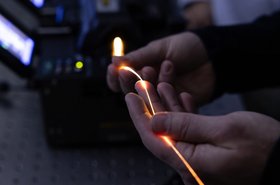
HCF is a type of optical fiber that features an air-filled center channel that is surrounded by a ring of glass tubes, akin to a honeycomb pattern.
The design allows for higher capacity with minimized chromatic dispersion. The only glass involved is on the outside structure of the cable itself.
Ciena is actively testing the technology for low-latency applications such as data center interconnects (DCI) and AI networking.
"It is hard to manufacture, but it is the future," noted Hatheier. "I personally believe that hollow core fiber is going to be the next generation of fiber that we're going to deploy on terrestrial networks very soon."
The technology is tipped to provide 33 percent lower latency than traditional single-mode fiber, while light is able to travel 50 percent faster with HCF.
He notes that HCF is an upgrade across every parameter when compared to traditional single model fiber.
It's this latency that is vital for data center interconnect, Hatheier adds, noting that "the one currency in data centers is latency."
"As soon as the capacity ramps up, there's a 30 percent improvement on latency, and then you can literally launch much higher power into the fiber," he adds.
Ciena previously worked with HCF specialist Lumensity, which was acquired by Microsoft, to demonstrate the transmission of 45 wavelengths, each at 400G, over 1,000km of hollow-core fiber.
Separately, this week at OFC, Ciena and Meta reported a "world record" for subsea transmission speed on a single wavelength connecting Asia-Pacific (APAC) and the US West Coast.


Comments