
Ciena and Meta reported a "world record" for subsea transmission speed on a single wavelength connecting Asia-Pacific (APAC) and the US West Coast.
The firms claimed to have transmitted 800 Gbps (800G) across an unregenerated, point-to-point undersea optical link spanning approximately 10,319 miles (16,608 kilometers) between Singapore and California. The trials were conducted on a Meta‑owned fiber pair within the Bifrost cable system, which carries high‑capacity data traffic linking Singapore, Indonesia, the Philippines, Guam, and the US West Coast.
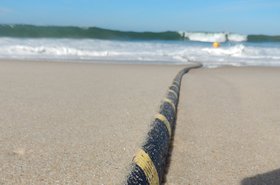
What is a submarine cable? Subsea fiber explained
Our wireless world depends on a few hundred fiber cables laid on the ocean floor
Underpinning the effort was Ciena’s GeoMesh Extreme, which incorporates the WaveLogic 6 Extreme (WL6e) coherent optics solution, as well as the 6500 Reconfigurable Line System (RLS). Those offerings were tapped last year by Trans Pacific Networks to boost undersea connectivity for the APAC region, Norway’s Altibox for a 1.6-Tbps subsea transmission, and Trans America Fiber System for a fiber network linking the US with Central America and the Caribbean.
“Establishing a world-record distance for a single-carrier 800G wavelength, this achievement reinforces the ‘800G everywhere’ value of WL6e, demonstrating that ultra-high-capacity wavelengths can perform reliably across the longest and most demanding subsea routes,” said Brian Lavallée, senior director for market and competitive intelligence at Ciena.
Ciena added that the trial achieved a total fiber pair capacity of 18 Tbps with excess operating margin, all within a submarine line terminal equipment (SLTE) setup made up of a tightly compact 10 rack units (RU). This represented a reduction in power consumption per bit by half compared to Ciena’s previous generation of coherent modems.
“The results are not only exceptional from a scale perspective, but also remarkable in terms of space and power efficiency — a critical advantage in subsea landing stations where every rack unit and watt matters,” Lavallée claimed.
For Meta, the venture was framed as helping the tech giant manage an AI-ready infrastructure across long distances with a reduced carbon footprint through a reduction in both power consumption and space requirements.
Ciena recently posted record revenue of $1.43 billion in its fiscal first quarter, up 33 percent year over year, in a showing CEO Gary Smith called “unprecedented” while laying out what he saw as the AI opportunity for the firm.
“Opportunity continues to build in waves, from our traditional and expanding WAN business to multiple applications in and around the data center,” Smith told investors. “Furthermore, to monetize AI for both training and inference workloads, the latter of which represents another significant growth vector still in its infancy, the foundational requirement is again high-speed connectivity.”




Comments