
A Chinese satellite company has launched the first tranche of a planned 'space data center' satellite constellation.
At 12:12 on May 14, Chengdu Guoxing Aerospace Technology Co., Ltd, also known as Adaspace, successfully orbited 12 Xingshidai satellites intended to comprise an “AI Cloud” of high-throughput satellite computing aboard a Long March 2D launch vehicle at the Jiuquan Satellite Launch Center.
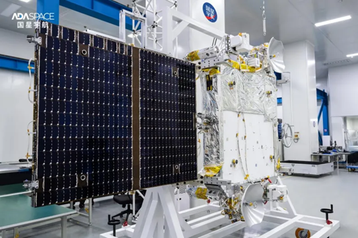
In claims made via social media, the company says inter-satellite optical links transmit data at 100 Gbps speeds. The satellites are reportedly able to run an 8 billion parameter AI model to assist with astronomical observations recorded through instruments, including a cosmic X-ray polarimeter developed by Guangxi University and the National Astronomical Observatory of the Chinese Academy of Sciences. The constellation also enables remote sensing capabilities and support for emergency services.
“Artificial intelligence cannot be absent from space because we lack the computing power,” said Wang Jian, a famed computer scientist who serves as CTO of Alibaba Group, and president of ZJ Lab (Zhijiang Laboratory), a non-profit AI research organization (translated from original Chinese by DCD). He explained that as higher volumes of data of superior quality were extracted in space, in-orbit processing to disseminate it was becoming essential.
The claims strike an ambitious note in a similar vein to those made in January by Dr. Long Lehao of the Chinese Academy of Engineering that China’s ambitions in space-based solar power would amount to “another Three Gorges Dam above the Earth” by 2035, referencing the planet’s largest power station by installed capacity.
Adaspace’s ambitions
Founded in May 2018, and recently listed on the Hong Kong Stock Exchange this February, Adaspace started out as a designer of low-Earth orbit satellites for remote sensing, but has since pivoted to a specialism in satellites for AI technologies, notably a constellation called Xingshidai, intended to comprise 2,800 satellites, each capable of processing 744 trillion operations per second.
The company successfully raised $55.6 million in Series B funding in late 2021, led by Hengjian Holding, an investment vehicle of the Guangdong Provincial People’s government, followed by Shenzhen Oriental Fortune Capital and Dongguan Financial Holdings, and Qingchuang Bole in Beijing.
That followed an A+ funding round raise of $21.37m in 2020 led by Aplus Capital and Galaxy Holding Group.
Adaspace did not immediately respond to calls for comment.
The developments are a fraction of China’s moves to open its traditionally state-dominated space sector to private capital in 2014. In the years since, hundreds of companies have emerged on the shoulders of unwavering subsidy support and the cooperation of the military.
Speaking to Via Satellite earlier this month, Dr. Brendan Mulvaney, director of the China Aerospace Studies Institute, a division of the US Air Force, said he ‘absolutely’ expected accelerating commercial cooperation's between China and its BRICS peers, including Egypt, Ethiopia, Indonesia, Iran, and the United Arab Emirates.
“This will provide economic benefits to both China and their client states,” Mulvaney explained. “When there isn’t an active armed conflict occurring, there is a lot of money to be made in space in the coming decades, and all nations are going to want to take part. China has positioned itself to be in the leading pack.”





Comments