
Broadcom is looking to help data center operators scale their AI infrastructure across multiple data centers with its new Jericho4 Ethernet fabric router.
The semiconductor giant unveiled the latest in its Jericho product line at the Open Compute Project (OCP) APAC Summit in Taiwan to scale AI infrastructure to millions of GPUs – a feat it contends can only be achieved through distributed computing.
Jericho4 is designed to interconnect AI hardware across multiple data centers, with a single unit capable of scaling up to 36,000 of Broadcom’s HyperPorts (four 800GE links tied to a single logical port), each of which operates at around 3.2Tbps.

Broadcom touts its new Ethernet fabric router as a way for firms to scale out across multiple data centers – with the firm claiming it can support lossless interconnections across distances over 100km.
That means operators could potentially run AI workloads in different facilities that are miles apart. Given that the infrastructure required to train foundational AI models is increasingly growing in both scale and cost, Broadcom wants Jericho4 to help meet those training needs by enabling operators to support training workloads across multiple facilities.
Pete Del Vecchio, Broadcom’s product line manager for Tomahawk switch products, told SDxCentral that the maximum training hardware they have seen in one facility is around 100,000 to 200,000 GPUs – or around the size of xAI’s Colossus site in Memphis.
“You've completely maxed out what you could do in a site … the power you can get from a utility. In that case, you have to distribute your workload across regions. And this is really the only way to do that. You have to have something that's purposeful, that you can distribute your AI workload.”
Instead, Broadcom’s new Ethernet fabric router is geared to supporting lossless RDMA Over Converged Ethernet (RoCE) between facilities.
Preventing packet drops and congestion
It’s not just scale, too, with Jericho4 also designed to help keep data secure and on the move.
Speaking to SDxCentral, Amir Sheffer, Broadcom’s associate product line director, outlined that the new Jericho technology helps to solve Priority Flow Control (PFC) propagation – where network traffic is halted due to congestion in order to prevent data drops.
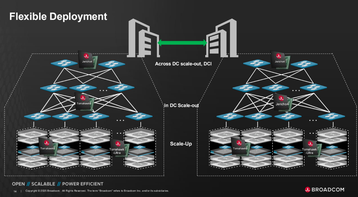
“Congestion that creates PFC in one building or one Jericho device is being buffered on one side of a deployment, doesn’t propagate through another facility, and traffic inside that data center continues as normal without any impacts from the other part of the cluster.”
The newly unveiled router also supports MACsec encryption, which encrypts data at the Media Access Control (MAC) layer to secure Ethernet links between network devices. Jericho4 employs MACsec encryption when running data loads at full speed, meaning packets that flow from one data center to another are kept secure.
Sheffer explained: “When you have to travel the distance, you no longer [have] control; it's not private infrastructure anymore. The service provider gives you the optical fiber so you want to encrypt your data end to end, so it is secure and no one can see it.
He added that its embrace of MACsec encryption comes as Broadcom looks to add functionality from generation to generation, saying: “We are already doing higher network layers and protocols and applications” when asked if there’s future potential to support post-quantum cryptography (PQC).
Rounding out the stack
The Jericho4 unveiling comes hot on the heels of Broadcom launching Tomahawk Ultra and Tomahawk 6 switches, as the semiconductor giant looks to solidify its grasp on the interconnect market.
With its Tomahawk Ultra launch last month, Broadcom touted how its Ethernet-based offerings were above and beyond rival scale-up systems. Its Jericho4 launch was no different, with executives proclaiming how its product portfolio covers everything from rack scale to cross-facility.
“Imagine if you had one car that's going to solve all your issues, it’s like having an F1 car that’s going to be used as a moving van,” Del Vecchio said. “Here we have purpose-built chips, fully optimized from anywhere from scale up with tens or hundreds of nodes, to Jericho4 with hundreds of thousands of nodes.
“From the design point for the chips, if you want them to be efficient, as far as silicon area, power, and performance of the network, you really need to have something that’s custom-built for that part of the network.”
“Scale Up Ethernet (SUE), Tomahawk Ultra, Tomahawk 6, and Jericho4 all play a very important role in enabling large-scale distributed computing systems within a rack, across racks, and across data centers in an open and interoperable way,” said Ram Velaga, SVP and general manager of Broadcom’s Core Switching Group.






Comments