
US fuel cell developer Bloom Energy has signed a $5 billion AI infrastructure partnership with global investment firm Brookfield.
The partnership will see Brookfield invest up to $5bn to support the deployment of Bloom’s Solid Oxide Fuel Cell (SOFC) technology in AI data centers worldwide.
According to the partners, they are already actively collaborating on the design and delivery of ‘AI factories’ globally. A site in Europe is expected to be formally announced before the end of 2025.
KR Sridhar, founder, chairman, and CEO of Bloom Energy, said: “Unlike traditional factories, AI factories demand massive power, rapid deployment, and real-time load responsiveness that legacy grids cannot support. The lean AI factory is achieved with power, infrastructure, and compute designed in sync from day one. That principle guides our collaboration with Brookfield to reimagine the data center of the future. Together, we are creating a new blueprint for powering AI at scale.”
The partnership is Brookfield’s first under its dedicated AI Infrastructure strategy. The strategy focuses on investments into large AI factories, power solutions, compute infrastructure, and strategic capital partnerships.
“Behind-the-meter power solutions are essential to closing the grid gap for AI factories,” said Sikander Rashid, global head of AI infrastructure at Brookfield. “Bloom’s advanced fuel cell technology gives us the unique capability to design and construct modern AI factories with a holistic and innovative approach to power needs. As the world’s largest AI infrastructure investor, this partnership adds a powerful new tool to our global growth strategy, especially in a grid-constrained market environment.”
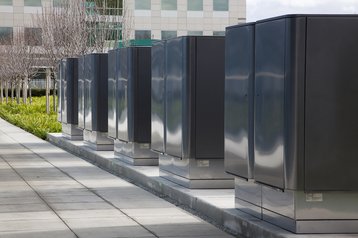
Bloom is the leading company specializing in fuel cell solutions for the data center industry. The company’s SOFC fuel cells work by converting fuel into electricity via an electrochemical reaction, rather than combustion, which Bloom claims results in much higher efficiency and lower emissions. The cells are fuel agnostic. “Our platform works with natural gas, biogas, and hydrogen,” Aman Joshi, CCO at Bloom, told DCD.
It has already signed several agreements to power data centers with the solution. In July, it inked its first direct supply contract with a hyperscaler, signing a deal with Oracle to deploy fuel cells across “select data centers,” with deployment expected within three months of the deal's announcement.
Bloom has also signed deals with Equinix for deployments across 19 data centers, with a capacity exceeding 100MW. As well as an agreement with US utility American Electric Power for up to 1GW of SOFCs to power AI data centers off-grid.
As a result of the uptake, in its latest earnings report, Bloom said that it is seeking to double manufacturing capacity from 1GW to 2GW annually by the end of 2026, which would require an investment of around $100 million.
The company sees itself as a direct competitor to natural gas turbine providers, which have also seen significant interest from the data center sector. Bloom claimed that, at present, SOFCs have capex on par with natural gas turbines, with 15-20 percent lower fuel consumption and easier permitting due to their reduced emissions profile.
Despite this, there have been some concerns over the sustainability of the solution, with the cells predominantly being powered via natural gas due to the cost of hydrogen and the lack of a reliable supply chain. This fact scuppered a deal with Amazon last year, as the hyperscaler canceled a contract to power three of its data centers in Oregon with Bloom fuel cells.
Brookfield Asset Management, which manages more than $1 trillion in assets, is a major global investor in digital and energy infrastructure. Its portfolio includes stakes in data center and tower companies such as Centersquare, Compass, Data4, Ascenty, Digital Connexion, and DCI.





Comments