
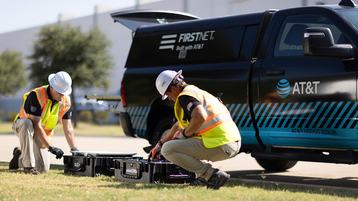
AT&T extended its First Responder Network Authority (FirstNet) platform to run on the carrier’s 5G standalone (SA) network, bolstering the performance of the FirstNet service and allowing for more services to be offered to the public safety community.
The updated FirstNet service uses “dedicated” infrastructure running on the AT&T 5G SA core that can support enhanced public safety features. AT&T will offer those services through its Adaptive Mission Performance platform that can “optimize network performance for different public safety applications and use cases.”
A 5G SA core differs from a non-standalone (NSA) core in that it is not tied to a legacy 4G LTE core infrastructure. This allows for a dedicated services underpinning with more network efficiencies to support potentially higher network speeds and can tap into more 5G-specific services like network slicing, automation, orchestration, and mobile Edge computing (MEC).
“With this approach, public safety isn’t just getting access to a single slice of a commercial network; the whole network core will be customized for their connectivity needs,” the carrier noted.
FirstNet users will need 5G SA-enabled devices to access the network, with AT&T noting users have already begun to connect to that network “at no additional cost to them.”
The move takes advantage of AT&T’s paced 5G SA deployment, which hit nationwide status late last year. That network supports current AT&T customers with compatible devices and underpins some new service features.
One of those new features is an IoT platform that AT&T launched with Cisco that allows IoT services running through Cisco’s Mobility Services Platform to take advantage of the 5G SA network's advanced capabilities like networking slicing and application-aware performance.
AT&T’s FirstNet service was born out of the 9/11 terrorist attacks that showed a crippling lack of network robustness and the need for a unified communications network. AT&T was awarded the FirstNet contract in early 2017, which included 20 megahertz of spectrum in the 700 MHz band and $6.5 billion in government funding to be used to construct a nationwide 4G LTE network.
AT&T at that time said it would spend around $40 billion over the 25-year term of the contract to build and support the FirstNet network. AT&T has since migrated service access to its 5G network.
AT&T’s 5G SA move comes nearly two years after rival T-Mobile US launched its own public-safety-focused T-Priority service that has run on the carrier’s 5G SA network since its launch. The T-Priority service uses network slicing and priority access technology to segment dedicated network capacity to users as opposed to FirstNet’s dedicated spectrum resources.





Comments