

In an uncharacteristic move, Amazon shared some details about its approach to data center infrastructure in an open-house event the company held this week. This part of Amazon has traditionally been behind a veil of secrecy.
Like many other companies that deploy servers at massive scale, Amazon has come to the conclusion that scaling in pre-fabricated container-size (or thereabouts) modules is an effective way to scale. Examples of other giants that have gone the modular route include Google and Microsoft.
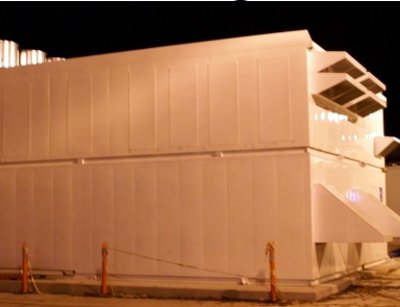
The module Amazon uses is called "Perdix", according to Amazon Web Services VP and distinguished engineer James Hamilton’s presentation at the event. The factory-built module uses airside economization to supplement cooling capacity.
It is not clear whether the company takes the Perdix approach to deploy all of its capacity. Hamilton did not respond to a request for comment in time for publication.
What is clear is that capacity demand of the company’s cloud-services business, AWS, is growing lightning fast.
The organization currently adds as much capacity every day as it used to need to support all global infrastructure of Amazon.com in the company’s first five years. At that time, Amazon’s annual revenue was about US$2.76bn.
The need for capacity has driven a lot of innovation in the data center sector over the past few years. According to Hamilton’s presentation, more innovation took place in the sector in the last five years than in the preceding 15.
And most of this innovation was driven by providers of cloud-based services and high-scale internet applications, such as Google’s or Yahoo!’s (both known for having leading-edge data center designs).
Key drivers of innovation have been the desire to drive up reliability and drive down resource consumption and cost.
So how does Amazon spend its infrastructure cash? Hamilton shed some light on some of the basic assumptions the company makes about its infrastructure spend.
About $88m goes to facilities infrastructure to support about 8MW of critical power. This capacity will support about 46,000 servers, costing about $1,450 each.
Hamilton’s presentation mentions a power cost of about $0.07 per 1kWh, although that cost is sure to be different in each location Amazon has a data center.
Here's a pie chart from Hamilton's presentation that provides a rough cost break-down of Amazon's monthly infrastructure spend:
