
Amazon Web Services (AWS) is planning a new subsea cable linking the US to Japan.
The cloud company this week announced Sta'O'Nuk, a new subsea cable connecting Washington in the US to an unspecified location in Japan, expected to be operational in 2029.
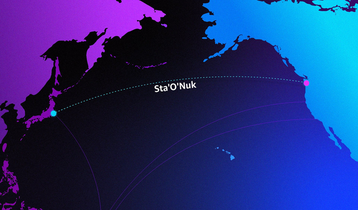
The new cable, billed as the first international subsea cable to land in Washington state in nearly 30 years, will offer 420Tbps of capacity across 20 fiber pairs.
Amazon is partnering with Toptana Technologies on the Washington portion of the project, which will provide the cable landing station (CLS) and backhaul network services.
"Building resilient, high-capacity connectivity requires trusted infrastructure partners and a long-term commitment to the communities where that infrastructure is developed," said David Selby, director of global network planning and acquisition at Amazon. "We're pleased to partner with Toptana on the Sta'O'Nuk cable system and to see the Toptana cable landing station move toward construction."
Toptana has separately announced that it has broken ground on a new cable landing station in Ocean Shores, Washington. The new facility is designed to accommodate up to four subsea cable systems, with the company saying it is the first new CLS in the state of Washington in more than 25 years.
Details of the Japanese landing have not been shared, though an image shared by Amazon suggests Tokyo. DCD asked for more information, with Amazon only saying the Japan landing point will “provide geographical diversity relative to traditional cable corridors.”
Founded in 2022 and owned by the Quinault Indian Nation, Toptana is the only Indigenous-owned cable landing station and backhaul network provider on the West Coast of the United States.
"This groundbreaking represents an investment in the future of the Quinault Indian Nation," said Jeff Capoeman, chairperson of the board of directors of Toptana Technologies. "Through Toptana, we're building infrastructure that creates long-term economic opportunity while strengthening Washington's role in the global digital economy."
Assured Communications serves as Toptana's strategic partner, program manager, and operations service provider on the new landing station. Assured will support the planning, development, construction, and long-term operation of the facility.
The name Sta'O'Nuk means "lightning serpent" in the Quinault language. The Quinault are a group of Native American peoples from western Washington in the US. Toptana said the Quinault Indian Nation (QIN) granted AWS permission to “use the name for the cable system while preserving its cultural and linguistic significance.”
"Projects like this succeed because of long-term collaboration," added Joel Ogren, CEO, Assured Communications. "Working alongside Toptana and the Quinault Indian Nation, we're helping deliver infrastructure that expands international connectivity while creating lasting benefits for the region."
Toptana first announced plans to develop a CLS back in 2022, originally hoping to break ground in 2023 for a 2025 launch. At the time, the site was set to offer 1MW across 17,700 sq ft (1,650 sqm).
QIN is a sovereign Indian Nation covering approximately 210,000 acres of land within Washington, including 27 contiguous miles of coastline. QIN is self-governed, and its population consists of the Quinault and Queets tribes and descendants of five other coastal tribes: Quileute, Hoh, Chehalis, Chinook, and Cowlitz. Though there are various telecom operators owned by tribal nations, the QIN said this would be the first indigenous-owned CLS.
Founded in 1855, the Quinault reservation is located in Grays Harbor and Jefferson counties, around 45 miles (72 km) north of Hoquiam. Located on the coast, Taholah is the largest settlement on the reservation.
The last two cables to land in Washington were both laid in 1999. The US-Japan Pacific Crossing-1 (PC-1) lands in Washington’s Harbour Pointe, while the Alaska United East (AU-East) cable runs from Lynnwood north to various points in Alaska.






Comments