
Amazon is set to massively expand its ground infrastructure to support its satellite fleet.
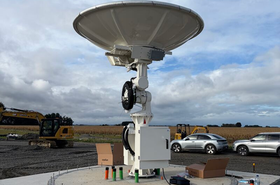
At a recent Amazon Web Services (AWS) re:Invent event, Amazon mentioned plans to install more than 300 ground stations to maintain connections with its Amazon Leo, the low-Earth orbit (LEO) constellation formerly known as Project Kuiper.

Amazon Leo’s networking engineer, Nick Matthews, said the constellation’s ground stations would include satellite dishes in remote areas, which can interface with terrestrial connections and AWS services.
These ground stations will be in communication with a second facility called a Point of Presence (POP), which connects into fiber Internet, where it can interface with the AWS service, a cloud service already adopted by leading brands Netflix and Twitch.
In 2024, Johannesburg-based mining group Gold Fields declared its intention to adopt AWS services on the understanding it would soon become part of a package of tools including LEO satellite services through Amazon’s constellation.
“There are a number of low-Earth orbit satellite solutions already available, but Kuiper (Leo) is working to bring an enterprise-grade solution to market, which is what we need,” Strini Mudaly, group ICT vice president, said at the AWS Summit in South Africa.
Leo is currently running a select beta program for enterprise customers offering connectivity services, although many applications are still under development.
“There are a lot of use case that we’ve really not uncovered yet,” Dr Hisham Elshaer, head of B2B business development at Amazon, explained in a recent presentation. “What can gigabit speeds all the time and everywhere enable? That’s what we’re about to discover.”
Leo is preparing to manufacture millions of dishes for commercial and consumer broadband. These terminals offer 1Gbps, 400Mbps, and 100Mbps depending on user needs. Matthews explained these terminals will offer latency at under 50 milliseconds, slower than Starlink’s specs at 30 milliseconds. Experts speculate Leo will present an affordability advantage over Starlink.
At present, Leo spans around 150 satellites, with an intention to launch in Q1 2026, up against a behemoth in Starlink with 9100+ satellites serving over eight million customers. SpaceX itself possesses more than 100 gateways in the United States alone, comprising 1,500+ antennas serving in excess of two million US users.
Both companies racing to verticalize at the ground segment could take players in the sector by surprise, many of whom were hoping to leverage ground-station-as-a-service in order to maintain profitability in a choppy economic period. With both LEO giants planting their flags, the threats of acquisition and redundancy grow starker in the market.




Comments