
Defense and aerospace company Airbus has launched a 5G radio unit into orbit.
Airbus UpNext, a subsidiary of the company, has launched a prototype SpaceRAN (Space Radio Access Network) system with the mission to explore advanced 5G Non-Terrestrial Network (NTN) capabilities, with initial results expected to be reported by 2028.
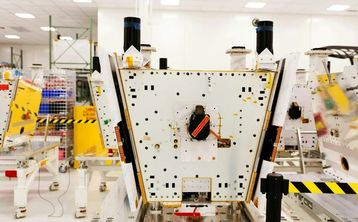
“The successful exploration of this technology will unlock advantages across various sectors,” said Michael Augello, CEO of Airbus UpNext. “For commercial aviation, it holds the potential to boost operational efficiency and simplify interoperability, all while enabling enhanced passenger experiences. Similarly, for the military and government sectors, it aims to provide more resilient and secure communications, supporting improved situational awareness and accelerating real-time decision-making.”
The system will make use of existing Airbus software-defined satellite technologies to optimise signals in orbit, processing data spaceside with onboard processing to downstream critical information instead of relaying the entirety of the raw information collected.
Airbus has announced a consortium of partners to experiment with its SpaceRAN demonstrator, including the likes of Eutrelsat, Deutsche Telekom, and Keysight Technologies.
These partners will assist in the operation of ground and in-orbit testbeds, mimicking low-Earth orbit (LEO) satellite behaviors, inter-satellite routing, and terrestrial networking, earthside and airborne.
“Participating in the Airbus UpNext SpaceRAN demonstrator is a testament to our commitment to advancing the future of satellite-enabled 5G,” said Eric Taylor, vice president of aerospace, defense, and government solutions at Keysight. “Our test and measurement solutions are designed to ensure the reliability and performance of next-generation networks, and we’re proud to support Airbus in this pioneering step toward standardized 5G NTN from LEO.”
The system was developed as part of the Air!5G project, which is supported by the French Government through the France 2030 investment plan under the Future Networks Strategy. The technology is thought to be integral to France’s contributions to the development of 6G wireless technologies, and reducing the costs of orbital transmission.






Comments