
As AI continues to redefine data center operations and infrastructure, power distribution is under increasing pressure to innovate. The high-density workloads driving AI training and inference demand flexible, high-capacity electrical systems that adapt as quickly as the technology they support.
Traditional remote power panel (RPP) architectures, once well-equipped to handle conventional IT environments, are struggling to keep pace with increasingly dense, high-performance compute.
With pressure rising on all fronts, modern track busway systems – open-channel, overhead plug-in power distribution – are emerging as the more efficient, scalable alternative. Designed for flexibility and rapid deployment, busway solutions are specially designed to meet the complex demands of the AI era.
Starline’s Track Busway exemplifies this shift – delivering power when and where it’s needed with speed and precision.
Chris Osian, product manager at Starline, outlines the decisive differences between traditional RPP-based power distribution and modern overhead busway for supporting today’s mission-critical operations, and why busway is emerging as the go-to solution for high-density data centers.
AI’s impact on the new frontlines
“Four or five years ago, we were seeing sub-ten-kilowatt racks, and today we're being asked for between 100 and 150 kilowatts, which makes a whole magnitude of difference,” says Osian. “And this trend is going to continue to rise, meaning we have to mobilize for tomorrow’s power challenges, today.”
Rising power demands also require higher available fault currents to safely handle larger, more dynamic surges in the circuit. Supporting equipment must be more resilient and reliable to maintain safe and efficient distribution.
With change happening so quickly, adopting a long-term strategy is essential. This requires building critical infrastructure with adaptability and flexibility at its core.
“Take busway for example,” says Osian. “Previously, 250-amp and 400-amp infrastructure was a very common setup. Since the AI boom hit and almost doubled the rating required, adopting a forward-thinking approach now requires assessing how long that data center is going to be in operation, and planning accordingly.”
In practice, this means anticipating increases in demand and designing systems that can scale without disruption, to ensure operational continuity in an unpredictable environment.
Staying ahead of advancing high-density workloads
From day one installation, RPPs and busway may appear similar in operation. Both solutions are specified via a similar route, but where they diverge is in overall performance and, crucially, future-proofing capabilities.
“One of the key advantages of open-channel busway is that you can customize plug-ins and essentially add circuits on the fly,” explains Osian. “If a customer is adopting a long-term view of capacity by speccing something higher in amperage in advance of when it’s required, it’s simple to scale up without any downtime.”
By contrast, adding circuits to an RPP after installation requires a system shutdown – a costly risk for mission-critical operations. AI workloads make scheduling downtime even more difficult, as training cycles can run for weeks, and inter-server connectivity increases the risks associated with disruption.
By nature of its design, the busway supports consistent uptime, even when scaling up for greater densities. Designed for live insertion, custom-built plug-ins can be inserted into the overhead system in minutes.
“We make custom solutions on the spot and have over 40,000 variations of plug-ins already in our product fleet,” adds Osian. “We’re coming across new design requirements every day and being asked for a range of new solutions such as a combination of multi-circuit, 32amps, or 30amps, plus breakers with shunts and auxiliaries, for instance.”
As the AI boom continues to march ahead at full speed, a key shift inside data centers is the rising necessity for liquid cooling capacity. For power distribution, this is driving demand for greater visibility and control over the breaker, including remote shut-off capabilities.
“We've tailored a plug-in to include not only a breaker but also accessories like a shunt trip, which allows the breaker to be tripped remotely if something goes wrong. If a liquid cooling issue arises, users can shut down the rack immediately,” says Osian.
With flexibility and scalability built in from the start, busway is quickly emerging as a critical tool in the data center arsenal for supporting today’s operations and scaling with confidence in the face of future transformations.
The might of modular
For RPPs, rack location matters. For power to flow properly, the wiring and the RPP need to be positioned low down in relation to the rack so they can connect the source to the load across two separate physical locations via a whip or cord. Osian expands:
“You can imagine that if you had a 40 or 50 rack setup, you have to align 40 or 50 cords across two different locations. This adds a level of complexity that we’ve tried to remove with the busway by implementing a purely modular design.”
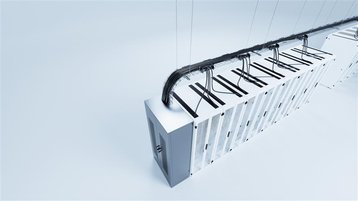
Slotting together like Legos, Starline’s Track Busway system consists of straights, joints and end feeds installed overhead. Plug-in modules sit directly above the rack they power, creating a backbone for the server row and running short, standardized cables from the plug-in to the rack.
Circuits can be added or removed directly at the point of use in any location, meaning the day one design can be expanded with ease.
A modular approach offers another tactical advantage: speed. With a traditional RPP setup, getting power physically hooked up from A to B on a per-rack basis is time and resource-consuming, especially at first installation.
By reducing complexity with a plug-and-play modular design slotted in directly over the racks, the busway delivers the swift reinforcements modern facilities need to stay ahead.
“Getting power up and running from the busway to the rack takes just a few minutes for a seasoned installer,” says Osian. “When directly comparing the time and resources it takes to install a full busway system versus the RPP – busway takes the win every time.”
Safety built in, readiness out of the box
The ability to connect a plug-in to the busway, whether it’s a 10kW or 150kW connection, via live insertion is a core advantage, delivering fast flexibility while maintaining uptime. But speed is nothing without safety.

With an established ground-fault path, Osian explains that safety comes built into Starline Track Busway. The company is taking safety a step further by introducing additional features designed specifically for high-density environments:
“One of the advancements we've made in the last year is creating a way for users to add a circuit from outside the arc flash boundary. While the Starline busway is already rated for live insertion – meaning it’s safe out of the box – we’ve taken safety to the next level with a device called the Remote Plugin Actuator. It allows a user to add a circuit to the busway without engaging any of the electrical contacts directly.”
This innovation enables high-density power circuits to be added quickly and easily, with greater peace of mind. Operators can maintain distance from the busway and engage the circuit remotely from outside the arc flash boundary.
“We’re continuing to add new safety features to our existing portfolio while meeting rising power demands, helping users scale with confidence,” adds Osian. “In the near future, we’ll also look to optimize both the open-channel and plug-in offerings to support the even higher densities on the horizon.”
As AI-driven densities accelerate, each and every corner of data center infrastructure must strengthen its defenses and evolve its tactics. For power distribution, this means shifting away from legacy approaches and deploying systems built for agility, scale, and resilience.
The Starline Track Busway delivers this decisive advantage through a modern, modular, strategically placed infrastructure that helps operators expand at pace, maintain uptime, and stay firmly in front of the next wave of high-density demands.
For more information please visit starlinepower.com/Rpps-vs-Busway
Comments