
The advent of generative AI and the rise of hyperscale computing has redefined the data center from the inside out. This dramatic shift has brought about an interwoven set of challenges – from managing the rate of technological change and rethinking facility architecture, to sourcing more and more power while increasing efficiency across the board.
Connectivity demands have skyrocketed, driving the need for higher bandwidth, communication links, transceivers, and the rise of data center interconnection.
When it comes to producing the volume and quality of connections modern operations require, the twin challenges of delivering more connectivity within increasingly compact footprints must be solved in tandem via a tightly knit, seamless network.
That’s where meshing comes in: a network design approach that creates a many-to-many interconnected fabric, providing multiple fiber paths between nodes that supports consistent performance, built-in redundancy, and scalable growth without major architectural rework.
AFL, a global leader in high-density, high-count fiber, is paving the way in making mesh networks the must-have solution for AI-ready facilities looking to unravel networking complexities and keep pace in the race to get connected.
Against this backdrop, senior technical advisor at AFL, Dr. Alan Keizer shares the must-haves for building future-ready, scalable networks, and why meshing is a crucial strategy for creating a resilient fabric of connectivity.
Stitched for strength: Creating a mesh network
Commonly used in hyperscale facilities, Clos networks – a non-blocking, multistage switching architecture that efficiently connects a large number of ports using smaller switches – are connected via a series of interconnected switches. This system is typical of data centers with a lot of east-west traffic based on the location of the content server.
Within this traditional setup, each server is likely to have one to four ports, while every network switch typically has sixteen to sixty-four. Developing a mesh network essentially means opening up this basic structure by dividing single ports into multiple channels. As a result, more endpoints can connect to one another along multiple possible paths within the same switch and server. Keizer explains further:
“Every set of independent paths you create when constructing a mesh network is called a plane. They’re all self-sustaining and completely independent. So, if one plane dies for any reason, you can still support traffic via another, and there’s no chance of congestion or blockage.
“A single port can be broken up into four or more planes and together, all of these interconnected fibers create a mesh. To minimize rack space used for passive connection, the ideal way to arrange the network is with the mesh implemented as a cable. These are called ‘shuffle cables.’
Central to delivering these high fiber-count cables are ribbon fibers: a collection of optical fibers bonded to one another in a flat strip that resembles a ribbon. Modern rollable ribbon, or SpiderWeb Ribbon (SWR), solutions are ultra-flexible, meaning they can be packed together tightly, and also opened up to separate individual fibers if required.
“Previously, you had to protect groups of fibers individually,” adds Keizer. “And stiff ribbons had to be stacked on top of one another. Now, rollable ribbons are allowing us to build these very dense cable assemblies, plus the ability to route individual fibers, which is a distinct advantage for delivering high-performance mesh and shuffle designs.”
Weaving high-performance connectivity in practice starts with careful, structured fiber management. Patch cords and trunks act as the threads, evenly distributing connections across the fabric. Mesh cassettes and panels come pre-engineered with built-in shuffling – a way to distribute connections evenly across the system and ensure physical diversity is stitched into the design, while removing hidden single points of failure.
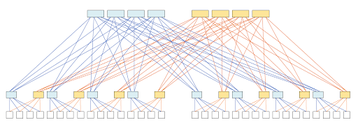

For operations demanding larger networks, rack-scale shuffle boxes provide a modular pattern with repeatable sections of neatly organized fiber that can be expanded when needs change.
For highest density, shuffle cables that require no additional rack space can be used. Every physical thread mirrors the logical weave of the mesh, ensuring that resilience engineered into the control plane is also embedded into the physical layer itself.
The number of planes and paths can increase proportionally with cluster size, allowing scalable growth without invasive or time-consuming architectural rework.
Turning this theory into a viable product requires transceivers that support multiple lanes of connections internally, plus the right high or ultra-high fiber count connectivity solutions tailored and optimized to the specific needs of large AI clusters.
“AFL is unique in offering extremely high fiber count cables,” explains Keizer. “We recently announced a solution capable of supporting 13,824 fibers per cable. Alongside our portfolio of standardized, modular solutions, we can flex to a range of high-capacity connectivity demands that characterize AI-ready operations.”
Managing AI’s impact thread by thread
To understand why today’s data centers need mesh networks more than ever, it’s important to unpack the ways in which AI workloads are redefining connectivity and forcing the industry to rethink network structures.
On one level, creating multiple paths for data exchange supports the level of redundancy and predictability AI-ready operations require. Beyond this, and perhaps most significantly, weaving together a large quantity of fibers within one cohesive system solves the fiber count and density dilemma in tandem.
“Server racks – a key building block of the data center – are packed full of AI accelerators, typically GPUs,” says Keizer. “Just a handful of years ago, one rack may have been serviced by around 12-24 fibers connected to a switch. Today, that same rack is full of GPU-based servers and switches, consuming 130 kilowatts or more, serviced by over 1,000 fibers.
“It’s now practical, and increasingly necessary, to have hundreds and thousands of fibers per cable,” adds Keizer. “This means multi-fiber connectors, as opposed to single-fiber solutions, are the new standard. It’s the best way to meet the demand for more density within a compact footprint.”
Given the scale and complexity of AI workloads and hyperscale computing, data centers are no longer a single room or building: they're campuses or clusters of multiple campuses. This space is required to house the synchronized clusters of large, expensive GPUs that underpin power-hungry, heat intensive operations. Prioritizing high-performance, efficient connectivity has become just as critical as getting power in and heat out of the data center.
“As fiber people, we see everything as fiber, but there are multiple infrastructure challenges here – you can’t just jam everything together,” says Keizer. “You need space, and everything must be carefully, and tightly interconnected.”
This reality calls for a holistic approach to network design. By combining fiber engineering, routing design, and resilient connections within one flexible architecture, meshing meets the performance expectations of AI and latency-sensitive applications with a comprehensive, end-to-end approach to connectivity.
Customized connections
Each and every project designed to support future-ready operations is a significant undertaking with a knot of competing demands to unpick and align. Detangling these obstacles requires collaboration and close communication with key stakeholders across the supply chain. Keizer elaborates:
“Generally, after a couple of project cycles, we get to know people and organizations within the data center ecosystem pretty well. Relationships build, and that helps us build strong customer connections so we can provide the most value with earliest involvement.”
Early engagement with an experienced network design partner enables a bespoke approach to connectivity and supports a holistic view that ensures the unique demands of a project can be met in conjunction with one another.
“Thinking about the network design from the very start of a project is the best way to ensure flexibility comes built-in,” adds Keizer. “The ideal approach involves installing high fiber count pre-terminated trunk cables and creating the needed shuffle in the equipment connection. This strategy avoids trapping fibers within the building or pulling them under the campus. It’s crucial for ensuring the system can be reworked in response to future requirements, but this kind of bespoke layout only works as a result of collaboration in the early stages.”
Bigger and better networks
For all its challenges, today’s landscape does afford some certainties: AI is here, it’s changing everything at pace, and it’s not going to slow down.
“We will continue to see a push for greater fiber counts, higher densities, and more inter-data center connectivity” says Keizer. “That will all play out in cabling, and of course, we’ll find more technology upgrades in this space. We expect to see multi-core fiber (MCF) and hollow-core fiber (HCF) emerge, but making these solutions mainstream will be a key challenge for further down the line.”
Well-positioned as the network design partner for the AI era, AFL is uniquely equipped to capture these emerging opportunities and navigate the complex landscape of connectivity challenges, proving that mesh networks are the foundation of the resilient, flexible connections modern operations both depend on and thrive on.
Planning a new AI factory? Give AFL a call on +44 1908 441 144 Or email us at [email protected]
More from AFL
-

Sponsored Why fiber expertise is critical to scalable AI infrastructure
Unlocking performance, reliability, and future-proofing in AI data centers through strategic fiber planning
-

Sponsored AFL launches Denali: Peak performance for optical fiber networks
Purpose-built for the evolving era of AI-driven data center innovation
-

Sponsored The convergence of energy and data: Challenges and opportunities in data center growth
As global demand for access to high-performance AI models accelerates, the convergence of energy and data will continue to drive innovation in sustainable infrastructure, integrated energy-data systems, and efficient hardware
Comments