
Before 2008, India’s data center market was relatively niche and telecom-focused, with most facilities built to serve large enterprises and telecom providers rather than mainstream IT applications. The 2008 global financial crisis, however, became a defining moment for the industry, shaping its long-term trajectory. As Sridhar Pinnapureddy, founder and CEO of CtrlS, recalls:
“We had to come up with a new offering for small and medium-sized businesses (SMBs) as well. So we started offering cloud services and disaster recovery at a time when it wasn’t fashionable. That turned out to be a big hit – enterprises began using data centers for their mainstream IT applications.”
In the late 2000s, most Indian data centers averaged 10,000 to 15,000 square feet. CtrlS redefined those limits in 2011 with the launch of India’s largest facility at the time – a 280,000-square-foot campus in Mumbai. Pinnapureddy explains:
“We scaled up to six or seven times the size of anything that existed then. Our belief was that mainstream IT workloads, not just websites or e-commerce, were moving into data centers. That vision laid the foundation for the next wave – hyperscalers.”
As hyperscale cloud providers entered India, CtrlS and its peers had to rethink design, scale, automation, and efficiency, evolving from serving traditional enterprise workloads to delivering infrastructure tailored to global cloud and AI requirements. Reflecting this shift, India’s 20.5 percent CAGR highlights the country’s rapid growth, signaling a potential rebalancing of demand in the region and challenging the historically dominant Chinese market.

DCD>Studio: India's potential with Sridhar Pinnapureddy, CtrlS
DCD's Georgia Butler and Sridhar Pinnapureddy of CtrlS discuss the growth of the Indian market, and plans for expansion in the region.
The rise of Tier 2 cities and Edge expansion
As India’s digital economy matures, the growth story is no longer confined to major metros. A new wave of Tier 2 city expansion is redefining the country’s data infrastructure landscape, driven by demand for low-latency connectivity, regional content delivery, and digital inclusion.
In Tier 2 cities, data often travels thousands of kilometers to reach servers. A ‘distributed Edge’ approach not only brings compute closer to end users but also addresses one of India’s most pressing infrastructure challenges – latency. As Pinnapureddy notes:
“Whether it’s WhatsApp or Zoom calls, if you’re sitting in Lucknow or Kolkata, your data often has to travel all the way to Mumbai or Delhi to connect. That doesn’t make sense – for telcos or for the platform creators. The sheer volume of traffic, traveling such long distances and back, creates significant latency issues.”
This challenge has become a catalyst for innovation. Edge deployments are no longer just technical investments – they represent a strategic decentralization of India’s digital fabric so that streaming services like Netflix, fintech applications, and emerging AI and gaming platforms can deliver faster, more reliable, and more localized experiences.
Beyond performance, the economic impact of Edge infrastructure is profound. Tier 2 city development stimulates local ecosystems, creating opportunities for construction firms, skilled labor, and energy providers, while supporting India’s goal of building a truly inclusive digital economy.

As data becomes the new infrastructure, Edge computing is increasingly serving as the foundation for a truly connected and intelligent nation.
Green power and innovation for dense infrastructure
As India’s data center market accelerates, power availability and sustainability have moved to the forefront. High-performance workloads now demand gigawatt-scale capacity, and for data center services like CtrlS, this challenge has become an opportunity for strategic reinvention.
According to Pinnapureddy, CtrlS has established a dedicated fifth business division focused on energy, overseeing in-house R&D, project management, and renewable integration. This means that the company’s energy portfolio now spans solar, wind, battery energy storage systems (BESS), hydro pump storage, and advanced nuclear small modular reactors (SMRs) – all designed to ensure long-term energy resilience and operational independence.
The Maharashtra cabinet, with Mumbai as the state capital, has approved a policy promoting the reuse of treated wastewater across urban local bodies, so treated wastewater is reused for cooling systems, conserving freshwater resources, and reducing environmental pollution. Data center operators, including CtrlS, are adopting this approach in their cooling systems, as Pinnapureddy explains:
“We’re collaborating with the city to divert water from sewage treatment plants to our data centers, treat it, and reuse it. Always exciting, always disruptive.”
Beyond green power, the Indian Green Building Council (IGBC) emphasizes space optimization and urban design as part of its broader vision. With real estate at a premium in major metros like Mumbai, Hyderabad, and Bengaluru, data centers are increasingly adopting multi-storey data centers – vertical facilities that maximize capacity within limited land footprints.
As Suppan Saravanamuthu, director of design and construction APAC at Iron Mountain Data Centers, notes, smart design and construction integration are critical:
“If a data center is designed and constructed well, it will have fewer maintenance issues. Coming from an operations background, I know how important it is to plan for maintenance constraints upfront. It’s a win-win for design and operations – and ultimately for uptime and sustainability.”
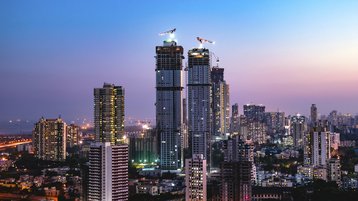


This fusion of sustainability, efficiency, and design innovation reflects a broader shift in India’s data center industry, where digital growth and environmental responsibility are no longer separate goals, but interconnected priorities.
The future of infrastructure
From Mumbai’s multi-story megastructures to emerging campuses in Tier 2 markets, India’s data center growth story is both vertical and horizontal. Growth scales upward through engineering innovation and outward through decentralization, building reach and resilience into the nation’s digital backbone.
Space-optimized facilities are becoming the norm in land-constrained metros, while dedicated energy divisions and renewable R&D are redefining how infrastructure is powered.
Industry leaders exemplify this dual pursuit of creating hyperscale-ready campuses while investing in sustainability and regional access, pushing the view of energy efficiency, water reuse, and green power not as optional checkboxes, but as core components of operational excellence.
Explore all of the content from the APAC Market Review eBook here.
More on APAC
-

DCD>Market Review | APAC 2025
Cut through APAC’s complexity with clear, actionable insights to guide your 2025 data center strategy and investment decisions
-

Sponsored Beyond metros: How India's Tier II and Tier III cities are reshaping the data center landscape
The decentralization of data centers into Tier II and Tier III cities marks a transformative phase in the development of India's digital landscape
-
Comments