
Real customer frustrations with power distribution unit (PDU) deployment often center around long deployment timelines, limited rack-level visibility, and inadequate security. These challenges are driving demand for intelligent PDUs that can meet the evolving needs of tomorrow’s data centers.
Renee Lang is the global product marketing manager for the Panduit critical power portfolio. She focuses on bringing Panduit solutions to market in ways that resonate with customers by aligning product capabilities to real-world challenges in data centers, Edge environments, and beyond.
By her side, Dipin Jain, global product manager for all PDUs at Panduit, including the Elevate to Power (EL2P) PDU. He collaborates closely with engineers, sales teams, and customers to guide product development from concept to deployment, ensuring operational challenges are solved with both technical precision and reliability.
Power problems, real consequences
In an era where data center operations demand ever more power to support increasingly sophisticated chips and workloads, effective power distribution has become critically important. So, when that distribution is unreliable or lacks visibility for the user, businesses face serious consequences, including downtime, equipment overheating, inefficient energy use, and security vulnerabilities.
“These issues don’t just affect operations – they can truly disrupt critical systems, damage brand reputation, and drive up operational and customer costs,” says Lang.
To illustrate the problem, Lang shares real-world examples. In one case, before seeking help from Panduit, a customer experienced frequent circuit breaker trips during peak usage due to power imbalances. Lacking outlet-level visibility, they couldn’t see what each outlet was drawing at the rack. In another example, shifting from a bottom-fed to a top-fed power source left a team unable to read the PDU display, forcing them to undertake a time-consuming and costly remount.
This is where intelligent PDUs make a difference – by giving teams the rack-level control and insight they need to mitigate these risks.
How to build a better PDU
An intelligent PDU is much more than just a network port. It offers granular visibility into power usage at the outlet level, real-time alerts, and security features that prevent unauthorized access to the cabinet. It also includes smart provisioning, firmware automation, and intuitive user interfaces designed to save labor to help operators, not hinder them.
When it comes to designing and deploying an intelligent PDU, Jain explains what the process looks like at Panduit:
“You need a blend of robust electrical engineering with smart integration. It’s about balancing outlet density, space constraints, thermal efficiency, and network connectivity all in a single rack-mountable unit,” he says, adding:
“Every decision has to account for real deployment environments, from hyperscale data centers to that tight telecom closet.”
Jain also emphasizes that engineering expertise doesn’t happen in a vacuum. To support the design and development process, Panduit undertook a cross-functional effort that began with customer voice sessions and continued through engineering, product marketing, and field services. As he puts it:
“Our goal was simplicity without compromise. The multi-axis swivel inlet, auto-rotating display, and toolless mounting all came from listening to what was slowing people down and solving specifically for those problems.”
In this way, Panduit prioritizes the voice of the customer to focus not just on flashy features, but on what is genuinely useful and contributes to lower total cost of ownership. For example, many manufacturers issue firmware updates every six to nine months – a significant labor burden for customers. Panduit automation tools are designed to make long-term management simpler and easier.
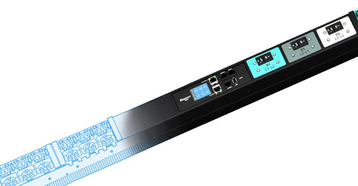
A tangible example, Jain says, is how customer feedback led to changing the outlet color:
“Customers told us the black outlets were hard to see against dark cabinets, so we introduced a new aqua-shaded outlet bank. This not only improves visibility, making it easier to see which outlets are connected to which IT equipment, but also aids in load balancing,” he elaborates:
“The aqua outlet bank is tied to a circuit breaker with an aqua indicator, so you know exactly which equipment is on which circuit breaker. That gives you the information you need about how much load is on the breaker and how much capacity remains for additional equipment. It started as a visibility issue but became a multi-faceted solution for load balancing as well.”
Built to be bright
As mentioned, the EL2P (Elevate to Power) – the newest intelligent PDU from Panduit – adds key value-driven features beyond what a standard PDU offers. These include full outlet-level monitoring, encrypted data communications, centralized control, and rapid setup tools. Lang expands:
“It also offers visual clarity with a smart display that automatically adjusts its orientation depending on whether the unit is top- or bottom-power fed. We’ve also enhanced cable routing thanks to the 360-degree swivel inlet.”
With full outlet-level monitoring, teams can remotely track energy consumption, monitor performance in real time, and receive alerts if something goes wrong, enabling faster intervention when needed.
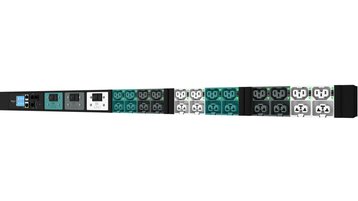


This visibility directly translates to improved operational efficiency. When you can see what's happening at the rack level, you can balance loads more effectively, reduce stranded power, and catch issues before they escalate.
In today’s fast-paced data center environment, speed is essential. An intelligent PDU must simplify installation and deployment to accelerate time to market and streamline operations.
To meet this need, Panduit designed the EL2P with a focus on simplifying both physical and digital setup. This includes toolless mounting to speed up installation and zero-touch provisioning to accelerate configuration. As Jain explains:
“Those are the two most labor-intensive tasks in any intelligent PDU deployment. These features are designed to save time and reduce errors.”
The proof?
To translate these intelligent features into real-world value, Panduit conducted an extensive beta testing phase to measure the EL2P PDU performance across installation, scaling, and day-to-day management. Drawing from both controlled tests and live customer environments, the company gathered data to validate its design. As Lang demonstrates:
“During our standardized testing, installation and firmware updates were more than 20 minutes faster than competitive models and previous-generation units.”
She adds that feedback from field engineers has reinforced the product scalability:
“We’ve had engineers report how easy it is to scale with EL2P – one solution works for any post-install changes or rework.”
The Panduit “do more with less” philosophy is reflected in its approach to intelligent power distribution, aiming to provide tools that make customers’ jobs easier, not harder. Jain summarizes:
“With a single device, fewer installation steps, and smarter features, the EL2P helps teams work more efficiently without needing more resources. That’s exactly what ‘do more with less’ is all about.”
For more information, please visit Panduit here.
More from Panduit
-

-

Sponsored Ring of steel in data center power infrastructure
The key benefits of properly fitting steel strap cleats and sleeving, and the installation speed advantages within data center power infrastructure, focusing on safety, efficiency, and sustainability
-

Comments