
Amid the AI boom, data center infrastructure solutions are swimming with possibilities. Yet, lining up responsibility, sustainability, and delivery remains a persistent challenge. As providers race to get their ducks in a row to deliver the prefabricated solutions heralded to solve these issues, Vertiv stands out as a company whose history of modular and prefabricated data centers goes back more than 25 years.
Viktor Petik, SVP of infrastructure solutions at Vertiv, has overseen this evolution across his 20-year tenure at the company.
Perhaps most notably, the launch of Vertiv OneCore illustrates the company’s tenacity and expertise in reaching this point. It is an end-to-end platform design that scales from 10MW in building blocks up to 250MW – extending further into 1GW data centers.
The company has launched five reference designs for OneCore, creating a suite of platforms for different needs, including those of chipsets such as Vera Rubin, GB300, and others.
“It’s a converged physical infrastructure that integrates power, cooling, and IT space within what we call a manufactured hybrid approach, as all the building blocks come from our factories.”
A prefabricated infrastructure approach is widely considered the most suitable for deploying high-performance compute in today’s landscape, and Vertiv’s solution is no exception. Its value, according to Petik, is underpinned by three primary benefits:
- Design responsibility: Being able to place trust in an experienced manufacturer to deliver reliability, regulatory compliance, and high performance. Quality assurance is strengthened as the most critical control processes have been completed prior to arrival on-site, reducing both on-site work and associated risks.
- Speed to deployment: Through upfront design and standardization, deployment timelines can be reduced by up to 50 percent, while on-site work is similarly cut by around half.
- Reduced total cost of ownership (TCO): With integrated commissioning and greater efficiency across the build process, TCO can be reduced by about 25 percent.
Building blocks of prefabricated furniture
So what actually constitutes a modular infrastructure solution? While prefabricated and prepped in advance, the specifics and overall configuration can look very different depending on the application.
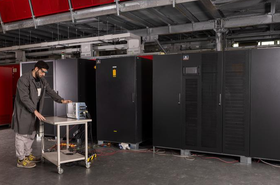
Most importantly – power. Typically positioned outside the main building envelope for ease of access, power modules are the main building blocks, comprising switchgear, UPS systems, and batteries. External modules also include hydromodules – pre-tested water treatment and pumping systems – as well as heat rejection units like chillers.

DCD>Talks: Advantages of prefabricated data center infrastructure with Viktor Petik, Vertiv
Vertiv’s Viktor Petik joins DCD’s Zoe Turner to discuss how prefabricated data center solutions are solving the scalability and infrastructure challenges posed by the AI boom.
Inside, there are cooling modules or skids, alongside the SmartRow – the superstructure that sits above the racks, incorporating pathways, piping, and network cabling:
“Using the SmartRow, on-site work is reduced by a factor of seven. Then there’s the data hall – the building itself – which we can either deliver or design for the customer, so they can have a Vertiv-designed data hall that partners or other companies can construct.”
From pre-sales through to customization and on-site deployment, Petik and his Vertiv team aim to provide a consistent voice of reassurance throughout the project lifecycle.
“Looking at the data center as one system, we can optimize the PUE, reduce environmental impact, and provide a predictable cost and schedule to the customer – which is not something that usually happens on a construction site.”
Ultimately, Petik encourages the industry to view the prefabricated data center for what it is: a single point of responsibility for design and delivery, risk mitigation through planning and factory control, and more efficient use of resources.
Watch the full DCD>Talks episode here.
More from Vertiv
-
Sponsored Managing AI workloads with advanced UPS controls
By implementing advanced controls, datacenter operators can bring greater stability and performance levels to high-performance computing environments
-

Sponsored Silicon diversification: How a growing choice of chips is reshaping data center infrastructure
Why data center operators should evaluate power and cooling infrastructure in the context of an expanding range of chips designed to support AI workloads
-

DCD Talks: Engineering the right heat rejection strategy with Maurizio Frizziero, Vertiv Global
Vertiv's Maurizio Frizziero joins DCD's James Raddings to discuss how rising chip temperatures impact cooling infrastructure globally, and which are the 3 main pillars to lead the AI transformation.
Comments