
Modern artificial intelligence (AI) computing environments present new power management challenges. Rather than the steady, predictable power draws of legacy enterprise workloads, graphics processing unit (GPU) clusters can drastically fluctuate between idle and full load in milliseconds.
To maintain resilience in these high-density environments, the industry must look beyond simple hardware capacity increases. It must also apply solutions with advanced control algorithms that can transform uninterruptible power supply (UPS) systems from a passive safeguard device into an active component to manage the AI load dynamic behavior.
Vertiv has addressed this challenge through a specialized suite of UPS features. These include Battery Shield to minimize unnecessary battery cycling at the load interface and Input Power Smoothing (IPS) to protect upstream electrical infrastructure.
In parallel, the patented Vertiv™ AI Load Simulator enables validation and optimization of the power train by accurately replicating AI workload dynamics.
Managing stability in AI power trains
AI workloads are characterized by fast and dynamic power swings. As large language models (LLMs) transition rapidly, the power demand can jump from zero to 100 percent in milliseconds.
UPS systems are positioned directly between the load and the upstream infrastructure, making them exposed to variability introduced by AI applications. When GPU clusters produce rapid load fluctuations, it is essential for the UPS to use advanced firmware controls to either mitigate these changes through energy storage to protect the utility, or pass them to the upstream network to protect the batteries. By actively managing rapid load fluctuations, advanced UPS controls help stabilize both the power train and the infrastructure connected to it.
In the absence of advanced control strategies, increased battery cycling and stress on UPS converters may occur, or high input power variability may impact generators and grid stability. AI workloads redefine the role of the UPS from solely providing protection to serving as an integral component of active power management.
Protecting energy storage with Battery Shield
With Battery Shield, power steps of AI workloads are managed internally in the UPS without engaging batteries. This allows the UPS to absorb 0-100 percent of these power steps directly, protecting the energy storage systems from unnecessary stress.
The benefits of this control feature include:
- Extended battery life: Minimizing micro-discharges preserves the chemical health of the energy storage system
- Reliable battery backup when it’s truly needed during mains failures
- Reduced total cost of ownership: Lowering the frequency of battery replacements and maintenance interventions.
Safeguarding the grid and generators with Input Power Smoothing
Managing the impact of AI dynamic workloads on the upstream power source and on generators is an important operational necessity, as the collective power swings of high-density GPU clusters can become significant enough to destabilize a local grid, or can easily overcome a generator’s dynamic response.

For example, when a training model initiates a cycle, demand can spike from 10 to 100 percent capacity in milliseconds, then ramp down just as quickly when the task concludes. Without Vertiv’s Input Power Smoothing (IPS), these violent swings would be reflected on the upstream infrastructure, potentially causing generators to fail or tripping utility breakers.
When the GPU cluster suddenly demands a massive surge of energy, the UPS pulls the difference from its batteries rather than the grid. Conversely, when demand drops instantly, the UPS continues to draw a steady average from the utility to recharge the batteries.
Without it, a generator might struggle to maintain the tight frequency tolerances required by IT equipment, potentially triggering a cascading failure where the generator trips and the site loses power. Vertiv’s algorithms are designed to manage the battery’s SOC during this process, facilitating smoother operations without compromising the system’s backup function.
Validating the AI Factory
As the industry’s need for intelligent control architectures grows, validation becomes key to verify system performance and stability. The complexity of AI load patterns means that standard ‘burn-in’ tests, which involve running new server hardware, are no longer sufficient. To verify that a data center is AI-ready, the infrastructure must be tested against the specific GPU profiles it will support.
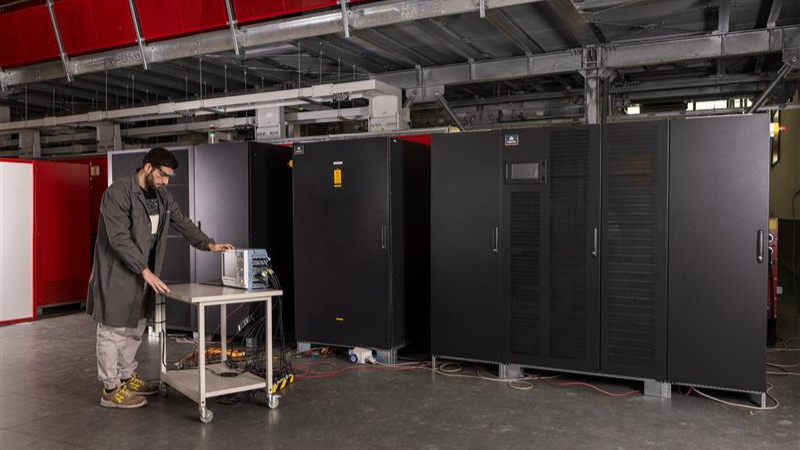
Recognizing this need, Vertiv has developed the AI load simulator. This innovative patented system allows engineers to replicate the amplitude, frequency and duty cycle of AI training and inference workloads. By using high-speed switching SCR and digital control, the simulator can mimic the behavior of thousands of synchronized GPUs. These insights are critical for optimizing design, supporting research and development (R&D) and tailoring to customer-specific requirements and demonstrations.
First deployed at Vertiv’s Global Power Customer Experience Center in Bologna, the AI Load Simulator is now being extended globally, including deployments at customers’ sites, as a critical tool to validate infrastructure readiness for AI workloads. It enables proactive stress testing and tuning of power architectures to meet the real-world requirements of modern AI clusters ─ mitigating risk, reducing overengineering and enhancing system resilience.
The future of AI power protection
High-performance computing (HPC) environments, particularly those housing massive GPUs, are no longer characterized by the steady, predictable power of legacy enterprise workloads. Instead, the modern AI data center introduces dynamic load volatility, creating electrical stress that threatens the longevity of the infrastructure and the stability of the grid.

The Critical Power Supplement
Data centers face the energy dilemma
To maintain resilience in these high-density environments, the industry must look beyond raw hardware capacity. Through firmware advanced controls, Vertiv’s large power portfolio of solutions, including Vertiv™ Trinergy™ and Vertiv™ PowerUPS 9000 systems, provides the tools needed to manage dynamic loads and protect critical loads.
As the world’s computational demands continue to soar, these control architectures maintain and support the mission-critical infrastructure to keep it running, resilient, efficient, and future-ready.
Furthermore, as data centers move towards a more environmentally responsible future, these controls play a vital role. By extending equipment life and stabilizing the grid, Vertiv helps operators reduce their carbon footprint and increase the efficiency of their operations.
What’s clear is that AI workloads will not be powered by hardware alone, but by the intelligence that governs how that hardware interacts with the world around it. It is this intelligence that Vertiv is bringing to high-performance computing, safeguarding both stability and optimal performance levels.
More from Vertiv
-

Sponsored Modular data center design: A construction choice that cuts embodied carbon
Build decisions lock in a data center’s carbon footprint before operations ever start. A lifecycle assessment (LCA) report reveals how those choices shape long-term carbon efficiency
-

Sponsored Pushing the frontiers of data center innovation
Amid today’s complex, tightly integrated AI-driven landscape, the ability to stay ahead of the curve rests on a clear understanding of the current environment and where it’s headed
-

Creating a modern digital backbone for global healthcare
Healthcare infrastructure needs a revamp to keep up
Comments