
Q. What does the term ‘chillerless data center’ mean in practice?
Traditionally, chillers use a vapor-compression refrigeration cycle to cool water, which is then circulated through the data center to remove heat from IT equipment. From our perspective, when people talk about a chillerless data center, they’re referring to a facility that doesn’t rely on mechanical chillers to refrigerate water as part of its cooling system.
Cooling is the third largest capital expense in a data center after IT hardware and electrical systems. These systems also account for roughly 40 percent of a facility’s electricity consumption – meaning cooling represents a major portion of operational expenditure (OpEx). With facilities pursuing net-zero goals and tighter efficiency targets, cooling has become a prime focus for innovation and optimization.
In practical terms, chillerless typically implies using outside air via dry coolers for instance – or alternative approaches like free-cooling or economization – rather than relying on mechanical refrigeration. However, it’s important to recognize that cooling is an architectural system. Like in your home, it involves integrating equipment from multiple manufacturers into a coherent solution. There are many ways to design it, and operators have strong preferences shaped by a range of factors.
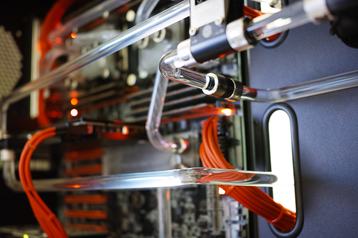

Today’s advanced accelerated compute AI factory data centers still use a mix of air and liquid cooling – typically split 80/20 between liquid and air. Even in these hybrid environments, chillers are commonly used to support both air-based systems and liquid loops. So, when we talk about chillerless cooling, we’re talking about eliminating that mechanical refrigeration layer entirely – and that’s a major shift.
Q. In light of this definition, is a truly chillerless AI data center technically possible today?
The short answer is it may be technically possible in certain conditions – but it’s not straightforward. Even in the latest AI factories, you still have equipment that relies on air cooling – such as networking gear, power supplies, and other ancillary systems. These typically represent around 20 percent of the load and make use of a low temperature chiller. For liquid cooling, higher-temperature water loops can be used, but air systems often require lower-temperature support.
There’s a lot of attention surrounding the next generation of Nvidia GPUs. The company has stated that its newest Rubin GPUs can tolerate inlet temperatures up to 45°C (113°F) – which is certainly notable, but not entirely new. Previous generations – namely Hopper and Blackwell – have come with similar thermal boundaries.
However, just because a chip can operate at that temperature it doesn’t mean facilities will design around that upper limit. Data center operators are highly risk-averse. They work with strict service level agreements (SLAs), and as AI becomes embedded in critical services – from government agencies and healthcare, to emergency systems, and beyond – uptime becomes increasingly vital to protect.
GPUs are also extremely expensive – often millions of dollars per rack. Operators don’t yet have decades of reliability data at these higher temperatures and so while upper thermal limits are expanding, many choose to run well below those thresholds for long-term reliability and peace of mind.
As power densities surge, ensuring built-in resilience is increasingly important. A recent example involved the CME Group, which experienced a major outage lasting 11 hours due to cooling system failures. The facility had upgraded its IT equipment but not its chillers. The increased thermal load stressed aging equipment, and a series of interlinked failures followed.
Q. If high-temperature liquid cooling is viable, why are chillers still necessary?
The idea that chillers are obsolete doesn’t reflect operational reality. Most modern water-cooled chillers include built-in economizers – often called waterside economizers – that allow them to bypass the mechanical compression cycle when outdoor conditions permit. In other words, they already enable free cooling when ambient temperatures are low enough.
So, the chiller becomes optional only in the sense that it doesn’t always have to run in mechanical mode. It can leverage outside air through cooling towers or dry coolers to reject heat efficiently.
If you remove the chiller entirely and rely solely on dry coolers, you reduce capital cost. But you also lose flexibility during warmer periods. For example, Green Mountain has reported achieving around 330 days per year of pre-cooling at its Norway sites – leaving roughly 35 days requiring mechanical assistance. Even in some of the coldest climates there are days when ambient temperatures exceed what’s required for direct free cooling and some form of backup or mechanical cooling remains a must have.
Q. How do chip temperature limits and system-wide thermal design interact and impact achieving a chillerless setup?
While high coolant temperatures are expanding opportunities for chillerless or economized cooling, system-wide performance remains paramount. Legacy air-cooled data centers often operated with chilled water setpoints around 6-10°C (42-50°F). In contrast, modern liquid-cooled AI factories typically run at 30-32°C (86-90°F). That’s a dramatic increase. Some operators, including Meta, have publicly stated they target supply temperatures around 29°C (85°F).
There’s also discussion around pushing even higher – to 40°C (104°F) or beyond. But that becomes more challenging as GPU power density increases. As chips become more power-hungry, internal heat dissipation requirements grow. Even if the inlet water can be warmer, there’s still a need for sufficient temperature differential to ensure effective heat transfer at the silicon level.
So ultimately, while higher inlet temperatures enable more free cooling opportunities, the physics of chip design and long-term reliability place practical limits on how far that can go.
Q. What trade-offs must exist between air, dry coolers, and evaporative systems?
In warmer climates, operators have several options. Dry coolers rely entirely on ambient air and use no water but become less effective when temperatures rise. Evaporative or adiabatic systems use water evaporation to enhance cooling. Open-loop evaporative cooling is highly efficient but consumes significant water, while closed-loop systems reduce water use but may sacrifice efficiency.
Water usage is increasingly part of the industry-wide sustainability conversation. While energy and carbon reporting are common, water use has historically received less regulatory attention. However, responsible water stewardship is now critical – especially in regions facing water scarcity.
Today, one of the most popular configurations is a chiller combined with dry cooling. This balances efficiency, resilience, and reduced water consumption. Pure evaporative systems may be more efficient in some climates, but water trade-offs have to be part of the equation.
Q. How is Schneider Electric helping operators navigate this shift?
The pace of change is unprecedented. Compute density per rack is now doubling annually in AI environments. We’re moving toward 300-400kW per rack with Rubin, and projections suggest over 600kW per rack with future generations.
At these densities even experienced data center designers will be heavily challenged to come up with an efficient and reliable power and cooling design. At Schneider Electric, we’ve been designing for 400kW per rack since 2018. We collaborate closely with Nvidia to publish validated reference designs ahead of new GPU releases, so customers can prepare the right infrastructure in advance.
And we don’t rely solely on vendor specifications – we test systems in our own labs. For example, during Blackwell testing, we discovered real-world performance nuances that required adjusting cooling parameters beyond theoretical designs.
We’re also expanding our prefabricated, factory-tested solutions. Labor shortages in HVAC and electrical trades make onsite construction challenging. By building and validating IT pods, packaged chillers, and cooling modules in factories, we reduce deployment risk and accelerate time to use.
Another critical innovation area is the coolant distribution unit (CDU). CDUs bridge the facility chilled water loop and the IT liquid loop. They regulate flow, pressure, and temperature – essentially acting as the central nervous system of liquid-cooled AI environments. As rack densities rise, CDUs must become more intelligent and scalable.
The future of cooling will be shaped by higher-temperature liquid cooling, smarter monitoring and predictive analytics, hybrid architectures that balance efficiency, water use, and resilience, plus factory-built, pre-validated infrastructure.
For more insights from Schneider Electric, read The cooling supplement, here. And you can check out Schneider's cooling solutions here.
More from Schneider Electric
-

Sponsored Rethinking power: Grid interdependence and the future of data centers
Data center operators can take steps now toward interdependence
-

DCD>Talks: Why modularity wins in the AI data center era with Joe Kramer, Schneider Electric
Joe Kramer, VP General Manager at Schneider Electric joins DCD's James Raddings to discuss how modular data center design is becoming the fastest way to deliver AI-ready capacity at scale.
-

Sponsored Liquid cooling for AI data centers: Three risks and how a trusted partner ensures success
Adding liquid cooling to your existing data center can be complicated, but when done successfully, it effectively cools hotter workloads and keeps critical infrastructure running at peak uptime and efficiency
Comments