
Currently led by China, East Asia is one of the most dynamic regions for digital infrastructure in the Asia Pacific, contributing significantly to the region’s global market share.
While many Western telecom companies sold off their data center assets ahead of the AI boom, many East Asian operators have gone in the opposite direction, investing heavily across the full infrastructure stack. For instance, SoftBank is actively investing in AI clusters across Japan through its Stargate initiative, while SK Telecom in South Korea has partnered with Nvidia and US firm Lambda to launch GPU-as-a-Service solutions.
At the same time, cooler climates, strategic connectivity, and ambitious sustainability goals are fostering an environment where high-density, AI-ready data centers can thrive. Yet alongside these opportunities come rising climate risks and the growing challenge of balancing scale with sustainability.
Climate and resilience
The region’s cooler climate – particularly in Japan, South Korea, and northern China – offers a natural advantage for data center operations when compared with other APAC countries, reducing the need for heavy investment in cooling equipment.

Is your data center earthquake-proof?
Chip fabs and data centers are often located in countries prone to extreme seismic activity, presenting challenges for operators
At the same time, climate-related risks are becoming increasingly real, reminding operators that even these traditionally favorable environments are not immune to extreme weather and environmental pressures.
For reference, the 2025 Global Data Centre Physical Climate Risk and Adaptation Report from XDI, which analyzed over 8,800 data centers worldwide, projects that by 2050, major East Asian hubs, including Shanghai, Tokyo, and Hong Kong, are expected to face significant climate threats such as rising sea levels, river flooding, and tropical cyclone winds. In XDI’s analysis, the Jiangsu data center hub in China ranks first, with 64 percent of its data centers projected to be high risk by 2050.
In 2025, over 10 percent of APAC data centers are classified as high risk, which is projected to rise to over 12 percent by 2050, making it imperative that operators in the region increasingly integrate these insights into site selection, design, and contingency planning.
Market spotlights
Japan: Stability and hyperscaler growth
Japan remains a cornerstone of hyperscaler investment due to its geopolitical stability, strong government commitment to digital infrastructure, and a deeply ingrained culture of disaster resilience that took shape after the 2011 Tohoku earthquake. Japanese enterprises have long embraced disaster recovery and offsite outsourcing, making Tokyo, Osaka, and Kansai key nodes for data resilience.
These factors make Japan one of the most trusted and strategically important markets for global cloud and AI deployment. In fact, data center energy consumption in Japan is expected to triple by 2034, driven by AI workloads and cloud adoption, according to Wood Mackenzie. Hyperscalers like Oracle, Google, and Microsoft are contributing to an estimated $28 billion in new investments, as Soon Chen Kang, senior research analyst at S&P Global, attests:

DCD>Studio: Trends in the APAC data center market with Soon Chen Kang, S&P
DCD's Georgia Butler speaks with S&P's Soon Chen Kang about the recent trends in the APAC data center market.
“US hyperscalers are very confident in Japan. It remains a close US ally and continues to attract significant capacity commitments.”
While Japan’s peak power demand remains below US levels, the country faces a complex path toward decarbonization, as fossil fuels are projected to still account for over 40 percent of capacity in 2034, despite investments in cleaner technologies.
As such, renewable energy adoption – expected to reach only 17 percent by 2030, according to Naomi Oshita, research associate for Asia Pacific power and renewables at Wood Mackenzie – will be essential in channeling sustainability goals and meeting national net-zero ambitions.
Hong Kong as a submarine hub and connectivity gateway
Hong Kong’s strategic position as a submarine cable aggregation hub makes it an important gateway for hyperscalers and enterprises seeking low-latency, cost-efficient connectivity across APAC. Its location not only enables efficient international data routing, but also provides seamless access to mainland China’s domestic networks through established terrestrial cable backbones.
This connectivity density and advantageous geography underpin Hong Kong’s long-term market resilience, particularly as demand increasingly shifts toward hyperscale workloads and enterprise cloud adoption. For enterprises, these advantages translate into lower latency and connectivity costs, while providing reliable access to domestic and regional markets.
However, global hyperscalers continue to face regulatory, land, and permitting challenges when developing their own campuses in Hong Kong. As a result, many are partnering with local data center operators, who leverage their deep regulatory understanding, strong relationships with government and utilities, and vertically integrated capabilities to deliver projects faster and more efficiently.
Reflecting this momentum, Hong Kong’s data center market is projected to grow from $2.1 billion in 2024 to $3.5bn by 2029, representing a promising 10 percent CAGR.
South Korea’s sustainable expertise and smart grid ambitions
South Korea combines advanced digital infrastructure with a robust data center ecosystem, positioning the country as a hub for innovation and knowledge transfer. With approximately 700MW of capacity around Seoul alone, South Korea is one of the larger data center markets in APAC, laying the foundation for a resilient, AI-ready digital infrastructure ecosystem.
The government is complementing this industrial strength with initiatives in AI-enabled energy management. For example, piloting smart grid and microgrid projects in South Jeolla Province to optimize renewable energy generation and electricity distribution. Recent regulatory reforms, including pilot programs under the Korea Electric Power Corporation (KEPCO), now also allow direct electricity trading between local utilities, renewable producers, and enterprise consumers – a game changer for reducing reliance on centralized power distribution.
This opens the door for AI-integrated energy systems that can dynamically balance supply and demand across grids. In other words, South Korea is not just building smart-grid technologies in isolation, but reshaping the market structure to support decentralized, data-driven energy trading.
DCD>Studio: Pivoting to data centers with Herson Suindah, SM+
Herson Suindah from SM+ speaks with DCD's Georgia Butler about pivoting to data centers.
Building on these technological and policy advancements, innovative projects like the Dangjin Green Energy Hub – a planned hydrogen fuel cell power plant integrated with 300MW of battery storage – exemplify South Korea’s commitment to sustainable, high-capacity data centers.
While the country has a continued reliance on fossil fuels – 24 percent coal, 36.6 percent oil, and 18.5 percent natural gas as of 2023 – it is actively pursuing decarbonization, targeting 20 percent renewable energy by 2030 and 35 percent by 2040.
Beyond its borders, Korean firms are exporting their expertise by delivering integrated digital infrastructure and IT services across Southeast Asia. At DCD>Connect APAC, Herson Suindah, president director and group CEO at SM+, noted that Korean giants such as LG Group bring deep experience in designing, developing, and operating hyperscale facilities.
Partnerships with these players enable regional operators, such as SM+ in Indonesia, to accelerate large-scale data center development while bridging critical skills gaps.
China: Supercharged AI and submerged innovation
Mainland China has long been one of the world’s top data center powerhouses, second only to the US in installed capacity and among the top in the number of facilities. Now, AI ambitions are transforming China’s digital infrastructure at an unprecedented scale. For example, plans for data centers in the Xinjiang desert housing over 115,000 Nvidia chips illustrate the scale of investment, even amid ongoing US export restrictions.
In August, the Chinese government issued a directive requiring publicly-owned data center operators to source more than 50 percent of their chips domestically, citing national security concerns over potential vulnerabilities in Nvidia’s H20 processors – considered a less advanced version of the H100. Since then, authorities have reportedly imposed an even tighter crackdown on Nvidia chip imports, further restricting access to advanced US semiconductors.
This push toward self-reliant, high-performance computing is reinforced by Alibaba’s development of AI inferencing chips and Huawei’s annual Ascend AI releases, indicating a continuous national commitment to technological independence.
Cloud computing spend in mainland China reached $11.6 billion in Q1 2025, up 16 percent year-on-year, with AI demand identified by Canalys as the primary growth driver. Alibaba has also pledged 380 billion yuan ($52.4bn) in cloud and AI infrastructure, fueling a surge in AI computing center construction. Huawei, meanwhile, plans to release updated Ascend AI chips every year until 2028, aiming to double compute capabilities with each generation.
These initiatives are further supported by government-led efforts to centralize and consolidate cloud networks, intended to better allocate computing power across the country so that areas with high demands can access sufficient capacity without unnecessary waste in others. This will enable China’s digital infrastructure to scale more efficiently in response to rapidly growing AI demand.
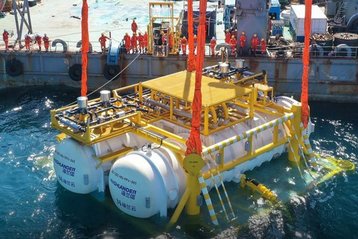
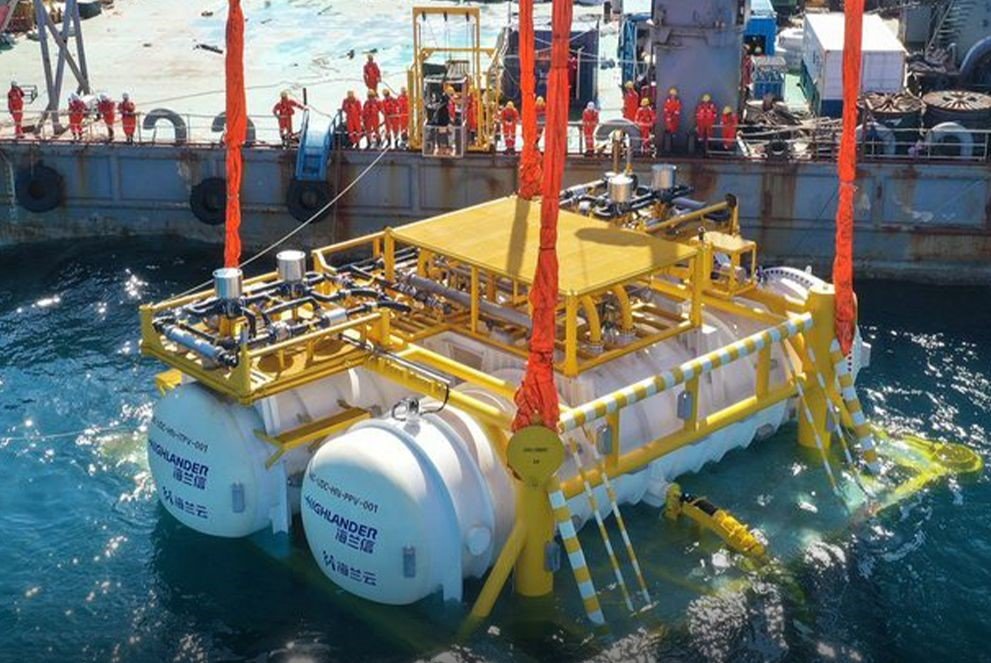
Further, innovation in China’s data center landscape now extends beneath the surface. HiCloud’s underwater data centers (UDCs) in Hainan and Shanghai, powered by offshore wind and cooled naturally by seawater, indicate 30 to 40 percent energy savings compared with traditional facilities. These modular, submerged units are designed to maximize efficiency, support high-density AI workloads, and offer a scalable model for space- and energy-constrained environments.
According to HiCloud general manager Su Yang, submersion reduces refrigeration energy use from up to 50 percent of total power consumption to below 10 percent, cutting overall energy demand by as much as 40 percent. Chen Jinshan, head of the administrative committee of Lingang Special Area of China (Shanghai) Pilot Free Trade Zone, adds that this approach “strengthens Lingang’s position as a global hub for cross-border data flows, AI computing, and intelligent connectivity.”
By combining large-scale GPU deployments with cutting-edge submerged infrastructure, China is redefining the next frontier of digital infrastructure.
To conclude
Where AI, sustainability, and resilience converge, East Asia exemplifies the next frontier of digital infrastructure. Japan leverages stability and connectivity, Hong Kong thrives as a submarine cable nexus, South Korea pioneers smart grid integration, and China pushes the boundaries with hyperscale AI and submerged data centers.
As demand surges and technology evolves, East Asia is poised to lead the way in building the next generation of AI-ready, environmentally-conscious digital infrastructure.
Explore all of the content from the APAC Market Review eBook here.
More on APAC
-

DCD>Market Review | APAC 2025
Cut through APAC’s complexity with clear, actionable insights to guide your 2025 data center strategy and investment decisions
-

Sponsored Why women are leading the next chapter of data centers
Sandy Xiao on how asking different questions sparks the quiet innovations that make data centers faster, greener, and fairer
-

Guide: APAC data center expansion
Discover the trends and challenges shaping today’s rapid growth in APAC and the fast-arising opportunities just beginning to develop
Comments