
Plans for around three dozen data centers and more than 100,000 Nvidia chips to be deployed in the deserts in Xinjiang have been uncovered by Bloomberg.
The publication reports that it has analyzed numerous investment approvals, tender documents, and company filings from Chinese firms, which demonstrate the intention to deploy 115,000 Nvidia AI chips in data centers. Bloomberg did not include links to the documents, nor name the firms except for Nyocor Co., a Tianjin-based energy firm.
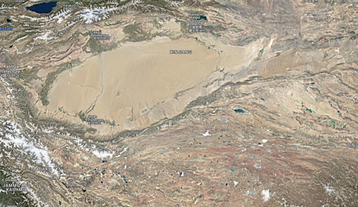
In total, Bloomberg reports that local governments in Xinjiang and nearby Qinghai approved 39 data center projects in Q4 of 2024. Construction is currently in progress or tenders have been won for AI computing services for seven of those projects as of June 2025, the publication claims.
According to Bloomberg, around 70 percent of computing power planned by the identified projects is in a single compound set up by the local government in Xinjiang. While not explicitly identified in the Bloomberg report, in April 2024 the Xinjiang government announced plans for a "converged computing center" in Urumqi that would provide "supercomputing, intelligent computing, and data storage capabilities, and has national computing power levels."
Bloomberg notes that the Xinjiang government has already brought its first “intelligent computing center” online, and constructed 24,000 petaflops of computing power for demand from the logistics hub of Chongqing. The compute power is equivalent to around 12,000 Nvidia H100s.
According to the "investment plans" seen by Bloomberg, the chips being sought are the Nvidia H100 and H200 GPUs - both of which are not allowed to be sold to China or Chinese companies.
Sales of several Nvidia AI chips to China have been limited since 2022 by the US government, aiming to limit the country's progress with AI. This was extended to include the Nvidia H20 - previously designed as a less sophisticated version of the H100 and to be available to the Chinese market - in April 2025.
Nvidia began working on a new chipset for the Chinese market that would comply with export rules in May 2025.
Bloomberg spoke to people both "involved in or privy to US government investigations" into leaked chips to China, and "people with direct knowledge of the black market in China" to establish if it would be feasible for the Chinese firms to get a total of 115,000 H100s and H200s.
The publication reports that those familiar with the US probes were unaware of the data center buildout and do not know of an "illicit trade network sophisticated enough to procure more than 100,000 such processors." According to two senior Biden administration officials, they estimate that around 25,000 banned chips are currently in China.
Nvidia told Bloomberg in an email: "Posting a web page asking about restricted products is not the same as successfully licensing, building, and operating a data center. Data centers are massive and complex systems, making smuggling extremely difficult, and we do not provide any support or repairs for restricted products.”
The company added that “trying to cobble together a data center from smuggled, previous-generation products makes no business or engineering sense,” particularly with Huawei chips being widely available in China.
Bloomberg notes that it has found no evidence that China has amassed or could amass 115,000 Nvidia GPUs.
Xinjiang has a wide availability of wind and solar energy, and is abundant in coal, offering a ready source of affordable power.
Bloomberg said that it reached out to eight data center operators in Xinjiang, all of which either "ignored, rejected, or agreed to and then cancelled" interviews. The Xinjiang government and the Ministry of Industry and Information Technology (MIIT) did not respond to requests for comment.
Xinjiang is alleged to be home to Chinese internment camps, where the government is accused of committing genocide against the local Muslim Uyghur population. Intel previously told its suppliers to avoid products or labor from Xinjiang, though it later apologized to China.






Comments