
In the data center world, fine margins can give you a competitive edge over your rivals. The fastest throughput garners the best performance, which in turn makes your data center more appealing to prospective clients. But what can you do to ensure it’s your data center that has that edge? New, faster infrastructure often involves major upheaval, with conveyance being added to allow for greater capacity fiber. Surely there’s another way?
That’s where shuffling comes in. Shuffling, sometimes known as meshing, is a simple way to get the most out of your data center with minimal structure adjustment. To learn more about shuffling, DCD spoke to Ron Gruen, hyperscale market development manager and distinguished associate at Corning Optical Communications, who begins by explaining more about how shuffling works.
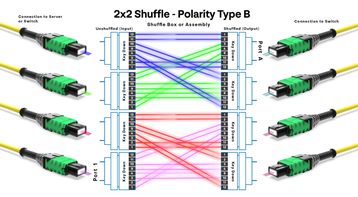
“Shuffling is an evolution of what the industry refers to as “meshing”. Shuffling is a new term, but it’s not a completely new concept”, explains Gruen. “It’s a larger scale of mesh break out, designed to keep networks flat and efficient. For example, where eight fibers, in four lanes, break out into four individual lanes.”
Port efficiency made simple
This method, in combination with a spine and leaf architecture, allows data center operators to allocate ports more efficiently. This in turn means they can manage density, work at scale, and meet future demand, all whilst keeping the network flat. A ‘flat’ network ensures all devices are on one level, a single-tier structure where every device is connected to just one switch.
The upshot is that the data can be transferred in the most efficient way, using the fewest possible number of switches. This approach reduces maintenance costs at the switch layer, and further creates much less administration. Gruen adds:
“When we talk about administration for fiber, we’re not really talking about labelling, keeping track of everything – we mean the networking itself – keeping the network flat, avoiding it becoming unwieldy with more and more switches. Using this technique, the need for one to one port connectivity is not required.”
In other words, as you add more GPUs to each spine switch of your spine and leaf network, you’ll eventually outpace the ports you have available in each switch. Your options then are either to add more switches, or for a more cost effective solution, shuffle your ports to allow parallel processing with fewer switches – something that will continue to be of increasing importance to keep that competitive data center edge.
For AI use cases, which form the backbone of many hyperscalers workloads in this burgeoning era, shuffling is become more of a necessity to accommodate the huge throughput of data-heavy solutions such as Large Language Models (LLMs), and reduce the pain points that current data trends have introduced.
How shuffling works
Gruen introduces the concept by providing an insight into how Corning’s 3U shuffle unit works to solve these issues:
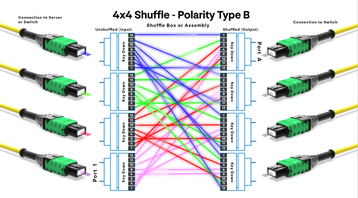
“Every hyperscaler has a different way of handling their network, but our off-the-shelf offering, the 3U, is modular, and each module has so many ports in it. We can also customize this to your needs, or offer alternatives such as 1U and 2U. The shuffle unit literally shuffles the fiber throughput in either 2x2, which is the most common across the industry, or 4x4 increments. That means if you have 400GB entering the port, it outputs either 2x200 or 4x100 after shuffling.”
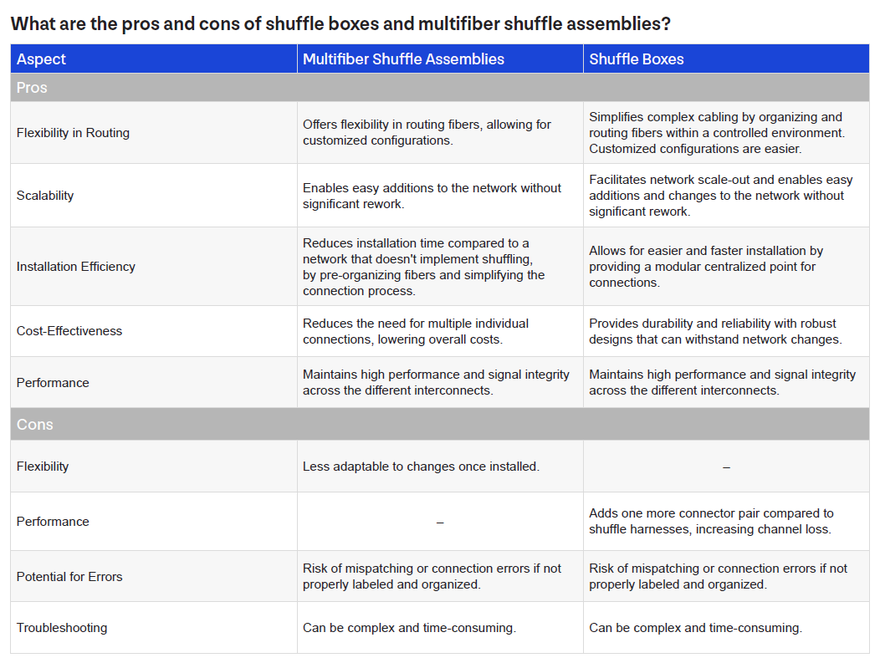
The shuffle unit is scalable, allowing the data center operator to add more modules as required, or add another housing as the facility grows – offering a futureproofed solution.
But these pain points are not transient. Data center architectures will grow ever more complex in the coming years, thanks to new technologies such as Co-Packaged Optics (CPO) and next generation chips and systems such as Rubin and Kyber. Corning is already working to embrace these technologies, before they hit the mainstream – and always in response to the needs of the customer.
Shuffling made simple
The beauty of shuffling as a solution is that it is available ‘off-the-shelf’ and can be self-installed by engineers. For more complex solutions, Corning can offer a bespoke design. Because of its versatility, shuffling can be adapted for a huge variety of use cases, and as demands continue to increase, more complex shuffling implementations can be designed, something that Gruen is already working on:
“As we look to the needs of 2030, we’re already working on an 8x8 solution for one of the silicon photonics manufacturers. That uses 16 fiber MPOs and brand new connector types which are in constant development, to allow shuffling in three different locations across multiple boards and housings. In other words, shuffling can become more complex as the customer needs demand.”
As individual as your use case
Constant R&D is vital to ensure that shuffling can be achieved with the growth of co-packaged optics (CPO) which take fiber past the traditional point of termination at the transceiver, all the way to the chip or switch itself via fiber harnessing.
It all comes down to customer need, and so if a supplier such as Corning doesn’t yet have the off-the-shelf solution for your shuffling requirements, it’s in everyone’s best interest for them to help you invent it.
Now we know what shuffling is, and how versatile it is, we turn to how it can help your data center. Why does shuffling even matter? Gruen hones the answer down to two areas: automation and precision.
“Everyone is looking to keep their network as flat as possible, right? You can carry on adding more and more switches, but that’s clunky, and requires more space and more maintenance. But with shuffling, you can break out ports and connect them to multiple switches, which reduces cost. It allows for more automation because you don’t have to manually reassign and patch cables, which can fall prey to human error - that’s all done by the shuffle box, and ensures more precise and repeatable network reconfigurations as networks scale in size and complexity.”
“I can connect to multiple servers, ports or rails across multiple switches, and to reduce density, I can use Very Small Form Factor (VSFF) connectors, to reduce the amount of hardware and space required. Our newer connectors are MMC, and are about a third of the size of an MTP, so I actually save space on the rack itself.”
And of course, by reducing the amount of hardware, and the quantity of cabling required, there’s less to go wrong, less to misconfigure, which can have a direct impact on reducing power draw, which in turn reduces the required cooling provision. Gruen explains:
“Anytime you have a lot of congestion with cabling in the rack and it gets in front of the fans, it reduces the amount of airflow, so less cabling means less cooling. Meanwhile, if you think of a shuffle box as being like a giant patch panel that covers the whole data center, then the net amount of equipment required is reduced, so less power is required.”
Plus, of course, that reduced amount of space being taken up by interconnects is available to further expand the facility, improving the scalability of the data center.


Shuffling as a cornerstone of GlassWorks AI
For Corning, the introduction and integration of shuffling is far from being a mere “buzz term”. It represents a cornerstone of the company’s GlassWorks AI infrastructure offering, with the business investing in growth and innovation within the space.
“We’re able to innovate alongside our customers to make sure that their network requirements are met. Scalability has always been a talking point for Corning, whilst efficiency is fundamental for serving our clients, both present and future, in the best possible way.”
A testament to this pledge is the adoption of Glassworks AI by several members of the so-called “Magnificent 7” companies, as they seek to enable next generation architectures such as GB300 and Rubin/Kyber GPU arrays.
The future of shuffling: Evolving with Rubin and Kyber
Rubin and Kyber are just the beginning. Shuffling is a technique that can grow with system complexities in the decades to come. As these new innovations drive ever higher port and fiber counts, shuffling will become even more critical.

Advancing the AI revolution
Fiber first for the future of AI
But while the formats of shuffle solutions will evolve, the need for effective port management will never disappear. That’s why Corning is innovating, not just for tomorrow, but for the days, months, years and decades after that, with modular designs, and automated processes, ensuring that shuffling remains at the forefront of AI infrastructure.
Gruen reminds us: “At Corning we're the fiber experts. We invented fiber. We've been in the business for a very long time, providing all the way from carrier markets to the long haul data center interconnects. We continue to innovate, to ensure that our customers can deploy faster. Time is money. They need to be efficient, they need to be able to scale, they need to be able to grow their networks. That’s what we do.”
As is so often the case with data center infrastructure, the earlier you can incorporate shuffling into your data center design, the more effective it will be to meet your needs. That’s why it’s important to involve experts like Corning when your facility is still on the drafting table.
Corning offers tailored consultation and design support. For more information, you can check out its new Shuffling Solutions Guide, containing a wealth of useful information, including use cases, technical insights and customer success stories.
Shuffling Solutions are not just a convenience – they’re a necessity for scaling AI infrastructure efficiently, as data centers evolve to accommodate Rubin, Kyber, and beyond.
To find out what else is new with Corning, you can check out their upcoming broadcast ‘Multicore fiber: More density, faster builds, same pathways’ airing April 13th, here.
More from Corning
-

Corning unveils suite of next-gen optical tech to connect AI data centers
Multicore fiber and CPO offerings on display at OFC 2026
-

Sponsored The missing piece of the puzzle: Rethinking connectivity
To fuel the AI era, sourcing more power is only half the story. A fundamental reimagining of networking and connectivity are equally as critical for enabling continued growth
-

Innovation for the future
Foundational connectivity solutions for next-gen networks
Comments