
For decades, the data center facility lifecycle has followed a largely predictable model – anchored in racks of IT equipment, power systems, and cooling control – but in the AI era, that lifecycle is undergoing a fundamental shift.
As rack densities push beyond 30, 60, and 100kW, AI applications are no longer introducing only IT challenges, but transforming data center infrastructure into a construction and physics problem too. The limiting factor shifts from the GPU to the building itself: can the facility actually supply the power and remove the resulting heat?
In this new era, the primary bottleneck has moved from silicon to thermodynamics. CIOs are no longer buying performance in isolation; they must contend with physical constraints, heat rejection, and the operational risk introduced by unprecedented compute density.
When the success of AI infrastructure depends on physical facility engineering, power delivery, thermal dynamics, and lifecycle operability – rather than component-level performance alone – become first-order design considerations.
This shift clarifies what truly differentiates a strategic facility enabler from a traditional hardware manufacturer. Rather than delivering what is essentially a box – defined by tick-box metrics such as chip speed, memory, and storage – a strategic facility enabler solves for the physics of the room across the full facility lifecycle.
Against this backdrop, xFusion exemplifies what it means to implement a facility-layer approach, engineering solutions that enable extreme-density AI workloads without compromising data center resilience, efficiency, or long-term operability.
The power and space crisis
Where earlier generation data centers were designed around CPUs consuming roughly 150 watts per chip, today’s processors can draw closer to 3,000 watts, representing a dramatic increase in power density. As a result, data centers shifting to GPU-centric AI workloads are being forced to rethink how power is delivered, distributed, and cooled. And with AI-driven compute demand projected to grow more than a hundredfold by 2030, progress will stall unless the physical constraints around power delivery are critically addressed.
Compounding the challenge is a widening mismatch between the pace of compute innovation and the evolution of power infrastructure. Today, processors advance on cycles measured in months, while grid capacity and facility upgrades can require up to ten years of planning, approval, and construction, creating what is increasingly described as the AI infrastructure paradox.
Most enterprises cannot afford to wait this long for new facilities, yet their existing air-cooled environments were never designed to support processors operating at this level, introducing safety and reliability risks.
This reality is pushing CIOs to seek partners that understand white space optimization at a facility level. It is no longer sufficient to buy the fastest server; success depends on integrating high-density systems into existing floor plans without introducing operational risk. Put simply, if the facility cannot support the density, chip performance is irrelevant.
How roadblocks can quickly turn into car crashes
The load imposed by AI data centers on the grid can create rapid and severe power fluctuations – reaching up to 70 percent within tens of milliseconds. It’s akin to highway traffic repeatedly hitting sudden roadblocks, dramatically increasing the risk of collisions.
These fluctuations are highly disruptive and threaten both grid stability and the operational continuity of the data centers themselves. When operators attempt to deploy high-density AI into facilities designed for legacy air-cooled workloads, they run into serious failure risks that can render their data center vulnerable. The most significant include:
- Thermal instability caused by insufficient heat rejection
- Power bottlenecks reached well before space limitations
- Increased operational complexity that amplifies human error
- Unplanned downtime resulting from immature liquid cooling systems
At the same time, CIOs face financial and operational risks when pursuing AI density through extensive retrofits without a strategic facility enabler. The most critical of these is stranded capital. According to xFusion, investing heavily in AI hardware that cannot be fully utilized due to facility constraints leads to wasted expenditure – particularly if infrastructure cannot scale or requires a full rip-and-replace within a short timeframe.
Operationally, the consequences extend further into higher opex, longer deployment timelines, increased risk of downtime, and potential ESG non-compliance. xFusion argues that these risks can be mitigated through a facility-level roadmap that ensures investments remain usable, scalable, and compliant over time, while optimizing total cost of ownership (TCO).
Ultimately, without facility-level engineering, operators risk turning production data centers into experimental and costly science projects.
Infrastructure solutions for sustainable AI
In the AI era, data center industry experts increasingly agree that true infrastructure enablers design around system-level outcomes, not just individual component specifications. Solving for these challenges shaped xFusion’s strategy to become a ‘bridge to the future,’ built around three key pillars:
- Heat dissipation: Proprietary thermal materials and cold plate designs that remove heat far more efficiently (up to 50 percent better than industry standards), critical for dense AI systems.
- Power efficiency: Using advanced GaN-based power supplies that have a very high efficiency rating (96.2 percent) to reduce wasted energy and heat, easing strain on both the data center and the grid.
- High-speed interconnects: Custom circuit board designs to support the latest, fastest data standards (PCIe 5.0/6.0) while using less physical space (a 30 percent smaller footprint).
These capabilities enable the support of the highest-density chips while simultaneously reducing energy consumption.
Beyond raw compute, the most significant transformation in AI data centers is cooling. Traditional air cooling is no longer sufficient, with liquid-cooled solutions increasingly extending across larger portions of the data center white space. Even networking infrastructure, for example, now often requires dedicated liquid cooling to handle the added thermal output of AI workloads.
Techniques such as liquid cooling and blind-mating designs – where servers automatically connect to power, networking, and liquid cooling manifolds when inserted into a rack – are core to xFusion’s strategy.
The FusionPoD triple-bus blind-mating design eliminates cables in the aisle, removes the need for manual pipe connections, and is fully robot-ready. So, what would normally be a complex, high-risk engineering challenge becomes a plug-and-play business asset, combining high density, reliability, and operational efficiency.
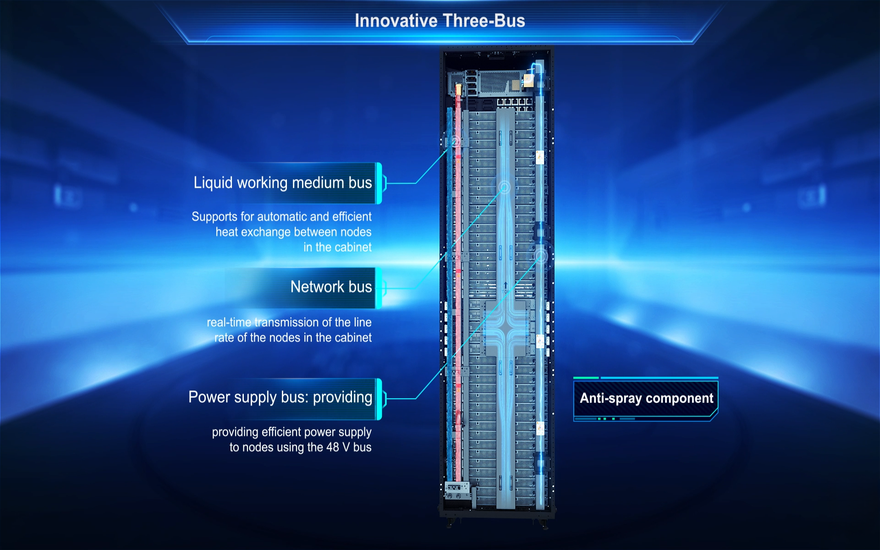
Sustainable AI depends on scaling density without stranding existing capital or taking on the risks of disruptive retrofits. To tackle the dilemma of not wanting to introduce 100 percent liquid cooling in one go, xFusion has implemented a dual-track approach: the FusionServer V8, which is air-cooled, to maximize performance in legacy racks immediately, in combination with FusionPoD, which is liquid-cooled, to enable high-density clusters.
This hybrid approach allows clients to leverage existing building and power infrastructure while introducing high-density capabilities exactly where needed – effectively enabling brownfield sites to support AI without waiting years for new greenfield facilities.
Real-world validation
With CIOs seeking partners that truly understand white space optimization, alongside the ability to integrate liquid cooling, blind-mating power architectures, and robot-ready operations into existing floor plans, what's next?
From xFusion's perspective, fully preparing for high-density AI involves more than just hardware - it requires evaluating efficiency and operational readiness across several key dimensions:
- Power-density scalability per rack
- Cooling compatibility across mixed environments
- Maintenance workflows and failure isolation
- Deployment speed and repeatability
- Partial power usage effectiveness (pPUE) and space utilization
Importantly, sustainability should be reframed as a source of competitive efficiency, not merely a regulatory obligation. When treated as a tax, sustainability is about compliance and cost containment. When treated as an efficiency driver, it directly enhances performance, resilience, and growth.
Energy efficiency
While floating-point operations per second (FLOPS) remain important for AI, white space optimization is not simply about achieving maximum density – it is about maintaining sustainable, operable density over time. Key facility metrics include pPUE and TCO; how efficiently power is delivered to compute, and how much value is extracted from every watt consumed.
Global Switch brings direct liquid cooling to Hong Kong data center
Company wants to meet AI demand from Chinese clients
Energy efficiency directly translates into usable compute capacity. Every watt saved through improved cooling and lower PUE is a watt that can be redirected to processing power. By achieving a low pPUE, organizations effectively expand their compute budget without increasing their overall energy footprint, turning sustainability into a driver of operational performance.
xFusion points to its Hong Kong-based client, Global Switch, as an example. Operating in one of the world’s most expensive real estate markets, the customer needed to maximize yield per square meter.
By deploying FusionPoD liquid cooling technology, they achieved rack densities exceeding 100kW with a pPUE of 1.06, improving space utilization by 20 percent and avoiding up to 60,000 tons of carbon emissions.
Resilience
Resilience is another critical dimension of real-world validation. High-stress or extreme operating environments directly impact downtime, operational confidence, and scalability – and in the AI era, downtime is exceptionally costly.
Resilient infrastructure reduces unplanned outages, stabilizes performance under load, and minimizes the need for manual intervention. Key metrics include fault tolerance at extreme temperatures and stability at 100 percent utilization, ensuring utility-grade reliability for AI operations.
xFusion cites its client ENAGEO in Algeria as a case in point. Operating in the Sahara Desert, where ambient temperatures exceed 55°C, required ruggedized hardware designs to preserve data integrity and system stability.
Through these designs, ENAGEO achieved a 66 percent reduction in system downtime, giving CIOs the confidence to scale AI workloads without fear of cascading failures.
Performance and economics
Performance in the AI era must be considered alongside longevity and cost efficiency. Advanced heat dissipation and high-density designs allow organizations to maximize compute output while minimizing power loss and extending hardware lifecycle.



Poznań Supercomputing and Networking Center (PSNC) in Poland – part of the Polish Academy of Sciences – needed to meet strict EU sustainability requirements while supporting high-performance computing workloads. By deploying xFusion’s FusionServer and HPC solutions with advanced heat dissipation technologies, PSNC achieved 12.5 percent lower power loss than the industry average, improving long-term efficiency without sacrificing performance.
From an economic perspective, TCO and cost per FLOP become the defining metrics. xFusion estimates that its infrastructure approach can reduce TCO by approximately 15 percent over five years, increasing density without new facility construction and lowering both capex and opex – turning infrastructure efficiency into a sustainable competitive advantage.
Conclusion
Beyond proven real-world deployments and validation, xFusion continues to drive innovation through its network of 12 xLAB research centers. By advancing material science, thermal management, interconnects, electromagnetics, and chip technologies, these labs deliver breakthroughs across every layer of the stack – from device- and board-level engineering to system architecture and data center infrastructure.
The objective is not simply to deliver a server and hope the facility can absorb it, but to engineer the entire lifecycle – ensuring the extreme densities demanded by modern AI do not compromise the data center itself.
At its core, xFusion believes that infrastructure strategy determines AI success. In this high-stakes landscape, CIOs must prioritize facility readiness, operational simplicity, and scalable efficiency, and with the right partner, AI density can be deployed safely, sustainably, and profitably – starting today, not years from now.
Explore more real cases here, or request a consultation here.
Comments