
The rapid rise of energy-hungry AI-ready data centers is placing significant strain on traditional power infrastructure such as the national grid. As the number of facilities continues to rise, this pressure intensifies alongside construction – threatening grid reliability.
By 2027, 40 percent of data centers are projected to face power shortages, with grid connection wait times stretching up to seven years. For those looking to scale up and compete in the AI era, sourcing enough power is now a race against the clock.
Meeting the dramatic growth in demand must be distributed amongst alternative power generation solutions that lie beyond the waning grid. In addition to providing enough power, these systems must deliver clean, reliable energy – and fast.
To unpack the most pressing power challenges facing the US data center market today, Sanna Silander, energy business director for region north at Wärtsilä, shares the stats and facts behind the headlines, what operators should look for when it comes to adopting alternative power generation, and what makes the company’s efficient engine-based solution a strategic answer to reliability, scalability, and sustainability concerns.
The supply mismatch
The dominant industry narrative is no longer exclusively concerned with cooling, connectivity, or rising densities – it’s about how power has become a key strategic bottleneck. And today it’s not just about accessing more power, it’s about timing too:
“Right now, contracting power is the greatest hurdle to continued industry growth,” says Silander. “Operators that move fast to secure reliable supply will keep building – and those who don’t will be left behind.”
Existing grid infrastructure is no longer equipped to keep pace with the momentum of technological advancement. Today’s high-density workloads aren’t just bigger – they’re dynamic, unpredictable, and rapidly intensifying.
This reality is at odds with a grid that was never designed to handle this rate of growth. Aging transmission lines, congested interconnection queues, and the variability of renewable sources have created an unprecedented mismatch between supply and demand.
“We’re currently seeing wait times of five to seven years just for grid interconnection approvals,” says Silander. “Plus, turbine deliveries are taking between three and seven years ex-works, and more time to reach commercial operations, meaning equipment supply chain challenges are also compounding the issue.”
With cycles of new GPU release and deployment now occurring at an accelerated pace, the extent of these delays is unsustainable. In theory, it means operators could construct a facility faster than they can power it. The cost of power-related postponements is simply too high amidst a time-pressured market.
“If these challenges aren’t mitigated, we’ll see stunted industry growth,” adds Silander. “Power delays will halt data center development and create economic impacts well beyond our industry.”
Beyond the grid
Faced with grid bottlenecks, permitting delays, and equipment constraints, operators are increasingly turning to alternative energy strategies to overcome these hurdles and avoid becoming frozen in time.
Utility-grade, modular distributed power has developed in leaps and bounds to deliver fast, efficient, and flexible energy solutions. As a result, it’s rapidly becoming a go-to solution for meeting power needs and navigating industry-wide concerns.
Rather than treating the grid as the default, self-generating power models offer greater control over project timelines – mitigating uncertainty and delivering power precisely when and where it’s needed.
With a range of viable distributed energy models now on offer, the key question becomes not whether to adopt alternative power, but which solution offers the efficiency, reliability, and flexibility modern operations demand.
“Operators should seek future-ready solutions that deliver power within two to three years – rather than five to seven,” explains Silander. “Rapid deployment capability must be complemented by scalability, enabling facilities to begin at one capacity threshold and expand as demand evolves.”
Environmental and operational adaptability are equally critical. Facilities require power systems that can perform reliably in high temperatures, at elevated altitudes, and without excessive water consumption. Silander outlines the importance of selecting the right solution:
“Technology choices made today cannot lock users into slow, inflexible, or carbon-intensive systems. The wrong decision can limit both scalability and sustainability for years. Future-ready power strategies must be built around modularity, flexibility, and compatibility with evolving fuel options.”
Time for something new
Among the rising number of alternatives, modern engine-based power solutions – specifically medium-speed reciprocating internal combustion engine (RICE) systems – have gained significant traction.
Crucially, these are not legacy diesel platforms. Instead, they’re modern, high-efficiency, low-emissions, natural gas power plants that can be constructed on site to deliver dispatchable, controllable power at pace.
Unlike turbines, which require steady conditions to maintain efficiency, engine-based systems can respond to minute-by-minute changes in demand – without compromising on performance and while providing low-emissions. This level of responsiveness is essential for meeting today’s demands and getting ahead of tomorrow’s. Silander highlights what makes Wärtsilä’s RICE power solution stand out from the crowd:
“Currently, our engines offer faster delivery than gas turbines, with modular scalability up to 750MW and fuel flexibility that supports decarbonization pathways. The ability to use natural gas today and hydrogen-blend or alternative fuels tomorrow ensures that a decision made today is still a viable one years down the line.”
Data centers are being built across increasingly diverse locations – each with complex site-specific demands. “Our plants are designed for heat resilience up to over 100 deg F and don’t lose output under high-altitude conditions of up to 6000’ in some circumstances,” adds Silander.
Water consumption is another growing priority. Traditional turbine systems can be extremely water-intensive – a rising issue in drought-prone regions and for meeting increasingly stringent sustainability targets. Engine-based power generation consumes around 1/1000th of the water required by many turbine technologies, reducing permitting timelines and environmental impact.
Through a modular design approach, operators can begin by specifying just enough capacity to meet day-one demands, and then grow in structured increments when the time is right.
“Modularization enables phased buildout and faster commissioning,” says Silander. “Operators aren’t forced to over-invest early, nor are they delayed by waiting until final capacity is required.”
This deploy-as-you-need model has financial implications too: “Engine-based systems typically offer 20-35 percent lower fuel costs and 20-30 percent lower capital costs compared to turbines which tend to overbuild in these circumstances to allow for maintenance outages. Faster commissioning reduces the price of financing by accelerating time to market, and opex costs are limited thanks to high efficiency and minimal water use,” continues Silander.
Towards a hybrid energy future
This pattern of development suggests that the future of data center power won’t be single-source. Instead, it will be hybridized: “We expect more microgrids and hybrid solutions combining engines, battery energy storage, and renewables,” says Silander.
In this distributed energy ecosystem, engines and renewables work together like clockwork. Wärtsilä is actively developing integrated storage and digital optimization technologies to orchestrate these systems, ensuring that every watt-hour flows where, when, and how it’s needed.
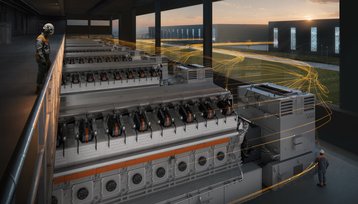

“Engine-based solutions will remain a cornerstone for fast, reliable, and sustainable power,” adds Silander. “They’ll continue to be the go-to solution because of their efficiency, modular design, heat tolerance, low emissions, minimal water use, and operational flexibility.”
Even the best power technology is only as strong as the service behind it. Silander emphasizes that Wärtsilä’s advantage extends beyond machinery: it includes a comprehensive national support network.
“Our service operations allow us to support customers seeking long-term reliability,” she explains. “We have a robust contingent of US-based field engineers, plus parts logistics centers, expertise hubs, and workshops to assist customers wherever they choose to build.”
The clock is ticking
Only time will tell exactly what the future of data center power will look like, but what is clear today is that the national grid can no longer be the go-to power source, and those that adopt modern alternative generation solutions will gain access to reliable, scalable power in order to drive continued growth.
“The industry isn’t slowing down, and so neither should time to power,” states Silander. “Unlocking growth and maintaining momentum is now entirely tied up in the ability to navigate the bottleneck and contract power quickly.”
Far from being a background utility, securing power is firmly in the spotlight as the defining factor for securing a strategic advantage. As data centers accelerate into a complex AI-powered era, operators must become the timekeepers of their own energy procurement.
For more information on Wärtsilä’s data center power solutions please visit wartsila.com/energy/solutions/flexible-baseload-power-plants/data-centre-power-solutions
Comments