
As AI workloads drive higher rack densities, attention is shifting beyond the cold plate itself to the systems that move coolant around the data center. The challenge is no longer simply removing heat from the chip, but managing thermal loads efficiently across increasingly complex cooling networks.
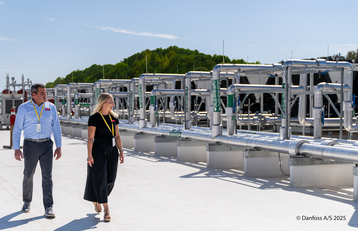

In this DCD>Talks episode, Zachary Dominique, global director of data center sales at Danfoss Climate Solutions, discusses that as liquid cooling becomes more widespread, managing the coolant itself is emerging as a critical factor for operators.
The shift to liquid cooling
Liquid cooling is moving into the mainstream as operators adapt to the demands of AI workloads. While traditional air cooling remains common, higher rack densities and power requirements are accelerating the adoption of liquid-based systems across the industry.
Dominique points to Danfoss's long history in water-based thermal management as a useful foundation for this transition.
“Danfoss has nearly a century of experience in efficiently transferring thermal loads using liquid systems,” says Dominique.
But as liquid cooling becomes more widespread, he argues that the industry's next challenge lies elsewhere.
The next challenge: Managing the liquid
While liquid cooling is often discussed in terms of cold plates, heat exchangers, and heat removal, Dominique argues that an equally important focus lies in managing the coolant itself.
As rack densities increase, cooling infrastructure must continuously balance flow across increasingly complex environments. “The impact of hydronic balancing is often underestimated,” says Dominique. “It's making sure that the right amount of coolant is delivered to the right place at the right time across the entire cooling network.”
For Dominique, this represents a shift in how operators should think about liquid cooling. As deployments scale, maintaining consistent cooling performance increasingly depends on how effectively coolant is distributed throughout the facility.
“The cooling challenge isn't just heat removal anymore,” he explains. “It's managing the flow across hundreds or thousands of servers in a very stable and predictable way.”
The implications extend beyond thermal performance alone. Coolant distribution requires pumps, controls and supporting infrastructure. Optimizing on the system level and improving flow management can therefore help operators avoid unnecessary energy use while maintaining cooling performance across increasingly dense AI environments.
Designing the cooling ecosystem
According to Dominique, managing increasingly complex cooling systems requires more than advances in individual technologies. It also depends on closer collaboration between the organizations designing the next generation of AI infrastructure.
The rapid pace of change in AI hardware means cooling systems can no longer be developed in isolation. Chip designers, hyperscalers, OEMs, and infrastructure providers are all working to keep pace with evolving rack densities, power requirements and deployment timelines.
“If suppliers wait until the specifications are finalized before getting involved, you're already behind and it's too late to influence,” says Dominique.
Danfoss has a very collaborative approach. Rather than simply supplying components, the company works directly with hyperscalers, chip designers and OEM partners to understand where cooling requirements are heading and how future infrastructure will need to evolve.
“We get involved in their process,” he explains. “Those conversations give us insight into where things are heading so we can influence where our product portfolio needs to go to meet their needs in the future.”
The company also participates in industry initiatives such as the Open Compute Project (OCP), helping ensure cooling technologies and standardization evolve alongside future infrastructure requirements.
Rather than reacting to finalized, varying specifications, suppliers, operators and technology vendors are working together earlier in the design cycle to help shape and define the next generation of thermal infrastructure.
From waste heat to an energy resource
As liquid cooling becomes more widespread, attention is also turning to what happens to the heat once it leaves the data hall.
Excess heat is increasingly being viewed as a potential energy resource. Higher coolant temperatures associated with liquid cooling can make heat recovery more practical, creating opportunities to reuse thermal energy in other applications.
In Northern Europe, Dominique points to district heating networks as one of the most established examples. By supplying excess heat to nearby communities, data centers can contribute to wider energy systems while improving the value extracted from their cooling infrastructure.
However, opportunities vary significantly by region. While district heating networks provide a ready outlet in parts of Europe, many areas of North America lack the surrounding infrastructure needed to support large-scale heat reuse.
“Identifying the consistent and economically viable application for it nearby. That's going to take a little bit more creativity and coordination,” says Dominique.
That challenge may also create new opportunities. Industrial facilities, greenhouse agriculture, and other commercial applications could potentially make use of excess thermal energy where the right local partnerships exist.
Ultimately, liquid cooling is no longer just about removing heat from the chip. Increasingly, operators must consider how thermal energy is managed across the wider cooling infrastructure, from coolant distribution to heat reuse.
Watch the full DCD>Talks episode with Zachary Dominique of Danfoss here. For more information please visit datacenters.danfoss.com.
More from Danfoss
-

Sponsored Increase energy efficiency by thinking systems, not components
Smarter, faster scaling starts and ends with efficiency
-

University of Southern Denmark to deploy Nvidia-powered AI supercomputer in partnership with Danfoss and HPE
System will comprise 128 Nvidia Blackwell GPUs
-

Comments