

Liquid cooling has emerged as the data center industry's go-to for high-density servers and advanced workloads.
The type of liquid used varies from system to system, but with a much higher heat capacity than any other liquid and impressive thermal conductivity, water makes for an excellent coolant.

The Cooling Supplement
Chilling innovations
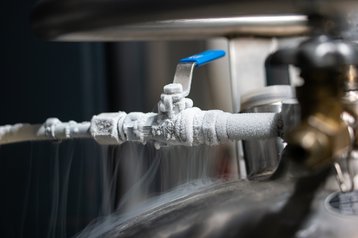
However, its downfall is the result of basic physics - water freezes. Frozen pipes are a disaster in any situation, from household plumbing to a car engine or data center cooling systems. But unlike a frozen pipe in a house, when it comes to a data center’s cooling loop, you cannot simply flush the system with hot water. That’s where antifreeze comes in.
What is the point of antifreeze?
Antifreeze stops the water in the primary loop of a cooling system from freezing should the outdoor temperature become too low. It also plays an important role if servers stop working, preventing water from freezing in the absence of the heat usually provided by the hardware.
“Essentially, antifreeze is glycol,” says Peter Huang, global vice president for data center thermal management at oil company Castrol. “The percentage of glycol depends on how cold the environment is. The colder the environment, the higher percentage of glycol antifreeze that you need to use.”
In a very cold environment, the percentage of glycol may reach up to 50 percent. In Canada, says Huang, operators are using percentages of up to 40 percent to prevent liquid cooling systems from freezing over. Concentrations aside, there are also different varieties of antifreeze.
The first is propylene glycol (PG), and the second is ethylene glycol (EG). While EG is much more effective when it comes to cooling, it is a toxic chemical with many potentially dangerous side effects related to exposure. PG is less toxic and more environmentally friendly, but far less efficient as a coolant. This means, Huang argues, that its green credentials are up for debate, as a less effective coolant drives up the amount of electricity used to pump the water around the loop system to cool the chips.
Though traditionally a company focused on lubricants for vehicles, Castrol has been expanding its data center business in recent years, with a range of cooling fluids for different systems, as well as antifreeze. Its products are marketed based on the type of glycol they contain and the concentration, but it is worth noting that the product is not usually shipped as a finished good, Huang explains. To save on both energy costs and shipping costs, glycol is shipped as a concentrate. Once it is received at the data center, it can be blended with water.
Keeping track of the amount of antifreeze in a system is also important, as the liquid cannot simply be left alone. Huang says Castrol recommends its clients take samples every 50 to 100 days, as antifreeze can evaporate, particularly in dry, warm climates. Most of the refills happen in the primary cooling loop, he adds.
Cold and broken
Cooling is a complicated equation, Huang explains, and depends on the chip, the density, and the system as a whole. Cold climates may be branded as a big advantage for the cooling world, says Huang, but they make liquid cooling systems susceptible to freezing.
This is where antifreeze becomes an important part of the picture.
Cold regions such as the Nordics are often hailed as the data center industry’s solution to rapidly growing cooling system power needs. Operators in countries like Norway routinely rave about their sustainability, reduced capex and opex, and improved efficiency, all achieved through free cooling, or using the external air temperature to chill cooling fluid.
In 2024, Montana-based cryptomine data center firm Hydro Hash suffered an outage after temperatures dropped from -6°C to -34°C (21.2°F to -29.2°F) in a little over 24 hours. Its 1MW facility lost power, resulting in the water block cooling system freezing solid.
Castrol’s Huang explains that operators can save a substantial sum by using direct and indirect free cooling, foregoing the need for mechanical chillers. For instance, he says, in Iceland, the ambient temperature averages below 15°C (59°F) and so can be used for free cooling, although he notes that data center operators don’t design facilities that purely use direct free cooling.
And while antifreeze is more necessary in cold climates, data centers operating in more temperate regions still need to consider it an important part of their cooling systems.
Huang says that the most important phrase when designing a cooling system is “supply temperature,” the temperature the cooling fluid needs to be when it reaches the rack to effectively cool the hardware. This can be calculated by working backward. For example, if the customer wants the water temperature inlet reaching the racks to be 26°C (78.8°F), the water in the primary loop needs to be around 20°C (68°F), which means the ambient temperature needs to be around 15°C.
An alternative to antifreeze
As it stands, Huang believes there is no emerging alternative to antifreeze. As long as water remains the best heat-conductive fluid and liquid cooling is necessary in the data center, antifreeze is the only solution to preventing unwanted frosty surprises.
However, LRZ München, the supercomputing center for Munich’s universities and the Bavarian Academy of Sciences and Humanities, has deployed an alternative to glycol-based antifreeze systems, using nitrogen. The university decided to take a new approach to antifreeze in part because of its location adjacent to the River Isar. Glycol is particularly toxic for marine life, meaning a leak into the river could have damaging consequences.
Hiren Gandhi, scientific assistant at LRZ München, explains that the system uses purified water. In comparison to a water and glycol solution, the heat capacity and thermal conductivity of pure water are higher, and the viscosity of the fluid is lower, so less energy is required to pump the liquid around the system. “It’s not a secret,” he says.
“What we have here is a standard chemistry lecture in schools.”
If the ambient temperature reaches freezing point, the water is immediately drained out, and nitrogen is sent through the pipes. Gandhi explains: “If we use air through the pipes, oxygen will corrode them. Therefore, we use nitrogen.”
With the pressure of nitrogen entering the pipes, all water is drained. Gandhi adds that the system is designed “only for an emergency situation,” and is activated when the servers stop working. If the servers are not down, they are able to supply enough heat so that the water never freezes, even in freezing outdoor temperatures.
Gandhi says this has enabled LRZ München to achieve 30-40 percent energy savings. The system could be put to use in larger data centers, he says, as it is easily scalable, though obtaining and storing nitrogen in large quantities is not without its problems.
Whether viable alternatives to glycol-based antifreeze emerge for commercial operators remains to be seen, but with more and more pipe work filling the newest generations of AI data centers, keeping the water flowing has never been more important.





Comments