

Adding more butter and salt is a classic trick used by chefs to enhance the flavor of their savory dishes. While DCD has not yet come across a dairy-based cooling system, it turns out salt is also a key ingredient in a new method for chilling racks and harvesting water from the warm air generated by their servers.
Startup Uravu believes it has come up with the perfect recipe for data center operators looking to make their data halls more efficient. By adding a dash of its proprietary saltwater desiccant to the cooling loop, it says it can extract water from waste heat, which can then be reused for chilling hardware, as well as creating surplus water that can be sold elsewhere, making data centers water-positive.
If Uravu’s founders get their way, the technology, which already provides a sustainable source of drinking water for 40 hotels and restaurants, could soon be on the menu at campuses around the world.
What a desolate place this is
Uravu’s story begins in 2012, but the idea for the company is rooted in CEO Swapnil Shrivastav’s love of George Lucas’s famous sci-fi universe.
“In 2012, I was a second-year undergraduate student, and there was a student competition around the theme of the future of water and the city,” he says. “We proposed an air-to-water solution because I’m a big Star Wars fan, and in the Star Wars universe you have this air-to-water technology.”

The Cooling Supplement
Achieving efficient data center cooling
In Star Wars, farmers, including the family of protagonist Luke Skywalker, use moisture vaporators to extract water from the air in hot desert areas, so they can use it to tend to their crops. Uravu’s cooling unit is called Tatooine, in reference to the desert planet where the Skywalkers live.
Back in the real world, in 2016, Shrivastav found himself studying at NIT Calicut, a university in Kerala, southern India. Here he was writing a thesis on wastewater treatment and reuse when he got firsthand experience of what it’s like to go without water.
“Our college campus ran out of water,” he recalls. “There was a two-week hiatus in water supply, and when that happened, we realized the full impact of having a water source disrupted and the multiplying effect that has on day-to-day life. That’s when we started to work on this more closely.”
Water stress, caused mainly by climate change, is an issue in many countries around the world, and is a particularly serious problem in India, which is home to 18 percent of the world’s population but only four percent of its water resources, per figures from the World Bank. As a result, 600 million Indians are said to live in water-stressed areas, and the nation’s consumption could double by 2030, compounding the issue.
As H2O becomes scarcer, data center developments are competing for water both in India and other markets around the world, fueling fears that digital infrastructure could put even more pressure on this precious resource.
Intervening in the cooling loop
Uravu’s system intervenes directly in the data center’s cooling loop, where waste heat is rejected. Usually, this is low-grade waste heat at between 35-60°C (95-140°F).
The firm’s absorber takes in the air, where a portion is reserved for water recovery. The rest comes into contact with the saltwater liquid desiccant, which absorbs the water from the air and is then heated.
The salty solution then releases pure water in the next part of the system - known as the desorber - as vapor, with a vacuum pump employed to lower the pressure, enabling evaporation at lower temperatures. This means cooling water can be returned at a temperature of 27-32°C (80-90°F). It should probably be noted here that 27°C is at the top of the ideal temperature range for operating servers, as specified by ASHRAE, the authority on such things, though 32°C also falls within the permissible range for those wishing to run their equipment hotter. Indeed, the hyperscalers regularly allow even hotter temperatures for equipment in their own data centers, though this is less common in regular colo environments.
Uravu’s absorber runs at “ambient temperature, plus four degrees,” before picking up the waste heat, Shrivastav says. He adds: “That's already quite cold, a normal cooling tower would be at this temperature. That’s why we use this liquid desiccant; it helps us maintain a very low temperature and means that, in many locations, you can 100 percent replace your chiller or a dry cooler.”
The volume of water Uravu believes it can retrieve from hot air is significant. The company claims that for every 1MW of data center power, it can generate up to 30 cubic meters of pure distilled surplus water per day. Though this figure can fluctuate depending on ambient conditions and humidity levels, Shrivastav says the system generates at least five cubic meters of water at the “lower end of the spectrum,” all of which is ready to either be used as drinking water or for other industrial processes.
Using waste heat in the process keeps energy costs down too, Shrivastav says. “Energy consumption-wise, it’s almost a fifth of an air-cooled chiller, half of a water-cooled chiller, and almost the same as an adiabatic chiller,” he says. “That enables users to keep Power Usage Effectiveness (PUE) low, and you can also claim negative Water Usage Effectiveness (WUE) because you have surplus water that can be supplied to communities.
“It quickly becomes an efficient and economically feasible solution.”
Time to make a splash
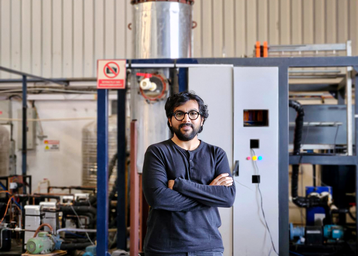
Currently, Uravu works with businesses in other sectors, supplying them with water from air. It has 40 clients in the hospitality sector, which serve bottled water produced by one of Uravu’s machines at the company’s labs in Bangalore, India. This is capable of making five cubic meters of pure water per day.
Data centers are a relatively new area of interest, Shrivastav says. “About a year ago, I started interacting with members of the Open Compute Project who were looking at waste heat reuse and other things. Since then, we’ve developed a 125kW unit, which is fine for small deployments and pilot projects, but our next goal is a 1MW block that can then become a modular solution. We want to standardize a lot of our production so that our clients can benefit from economies of scale.”
Deployments of its small module in data centers will begin this year, says Shrivastav. The company has agreed on the terms of a pilot project with an unnamed hyperscaler, likely to begin in Q2 of 2026, and is in discussions with five other digital infrastructure firms about starting similar pilots. Uravu has raised $4.7 million from a variety of venture capital backers, and plans to launch a Series A funding round later in the year. It employs 40 staff in Bangalore.
Shrivastav believes the company is well-placed to capitalize on the AI boom, and that its product design skills can give it an advantage over other businesses marketing air-to-water solutions.
“Everything we’ve done has been developed in-house,” he says. “I’ve been working on this since 2012, and the company has been around for six years. My background is in the design and build environment, one of my co-founders is a mechanical engineer, and we have other researchers from chemistry and materials science backgrounds.
“I think you need a balance between material and system design, and I would say our team is 70 percent focused on system design and thermal engineering, and 30 percent on the material. A lot of weight in this space is put on the materials, but it’s no good having a fancy material if the amount of water you can produce is low. We’ve tried to take a more integrated approach.”







Comments