
On the banks of London’s River Thames is a school with a football pitch (soccer to those of an American persuasion) – one of the few such sports grounds within the old City of London proper. Those attacking the goal on the far side of the pitch will be greeted with a great view of St. Paul’s Cathedral.
But those with an interest in digital infrastructure might be more interested in the two buildings seen in front of that iconic church. In the middle-ground is British Telecom’s (BT) Faraday House, part of what was one of the first telephone exchanges in London and a notable piece of telecoms history.

Issue 58 - The UK's copper switch off
How BT and Openreach are approaching the end of copper
And immediately behind the opposition goal is the telco’s Baynard House, a brutalist monolith and probably the only data center with a wall regularly used to stop balls being kicked out of bounds.
Both of these buildings, and thousands more like them across the UK, make up the core of the UK’s copper network. But not for much longer.
Though the first next-generation fiber networks date back to the 1970s, copper has remained the dominant way to deliver phone and Internet service well into the new millennium.
But as today’s fiber networks reach more and more of the furthest reaches of the UK and countries all over the world, time is now being called on legacy copper networks en masse.
Copper networks and telephone exchanges
The Public Switched Telephone Network (PSTN) is the traditional analog network in the UK that uses copper cables to carry landline voice calls between users.
Beyond phone calls, the copper network also supports ADSL broadband services as well as the likes of alarm systems, medical devices, and monitoring equipment.
The UK’s first telegraph networks launched in the 1830s, with the first central telegraph station opening in London in 1849, and were nationalized by the Post Office around 1870. The first copper phone lines and public telephone exchange in Europe opened in London in August 1879. Launched by the Telephone Company (Bells Patents) Ltd at 36 Coleman Street, it boasted around a dozen subscribers and relied on overhead wires.
It, and the 1,565 others that had popped up in the intervening years, were also nationalized in 1912 by the General Post Office, giving the government a near-total monopoly of the country’s nascent phone network.
Copper networks come with large numbers of exchange buildings (sometimes known as Central Offices or Wire Centers), where the physical phone lines are interconnected and signals redirected between properties.
Once, these would have had human switchboard operators manually connecting calls, before the process became automated from 1912 onwards.
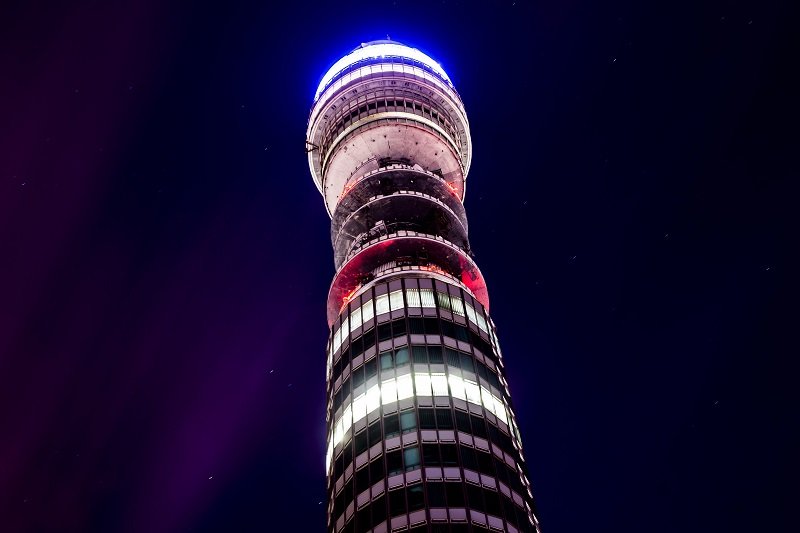
BT's Openreach showed DCD around the BT Tower, the company’s iconic inner-city radio tower and telephone exchange, ahead of its planned closure and redevelopment into a hotel.
The company showed us PSTN rooms filled with System X and System Y/AXE10 switching gear, the MDF, its customer equipment hosting area, and the more modern fiber equipment that is all to be removed ahead of the company’s exit from the site.
Even today, these exchanges don’t feel like your average data center. While they generally have a cable chamber or vault of the kind found in many of today’s facilities, these are typically larger and filled with thousands of strands of copper, some dating back decades, as well as more modern fiber wires. Old paper-insulated copper networks – which are still in operation in some places – even need their own systems pumping compressed air down the line to ensure no moisture can get in anywhere there’s a tear in the lining.
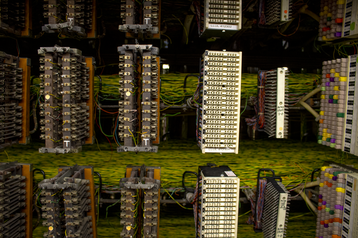
From the chamber, the wires travel into the room above, where they meet the main distribution frame (MDF), a large unit where the external copper network meets the internal networks – both Openreach’s and its communication provider customers'.
These rooms don’t feature huge amounts of cooling equipment, and the termination blocks have no blinking lights or fans whirring away. The room DCD saw feels more like an old garage than a key interconnection point.
More reminiscent of traditional data center white space is the multi-user area (MUA) upstairs, where Openreach’s communication provider customers can place racks of networking gear that can handle both copper and fiber services.
Every house with a phone had at least one physical line that was wired to a nearby telephone exchange. Most people in the US or Europe will live near one and probably never even realize it. There are thousands in operation across the UK, and major cities would have multiple exchanges to handle the large number of phone lines – a website documenting the UK’s exchanges notes there have been more than 100 across Greater London alone.
From the outside, exchanges vary in style. Coming from a different age, many are more aesthetically pleasing than your standard grey box modern data center, and were designed to fit in with their surroundings. Due to the need for proximity to end users, exchanges are often located in the center of towns and cities, rather than on the outskirts.
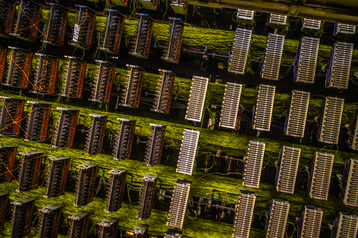
Exchanges range from boring nondescript offices and glorified sheds to divisive brutalist structures and grand neo-Georgian beauties reminiscent of the lush art deco telephone exchanges of New York – many of which still serve as major interconnection hubs today. Openreach notes the UK’s smallest exchange is located on the Shetland Isle of Papa Stour, serving just 14 homes; the largest still in operation, in the Oldham area of Manchester, serves more than 45,000 properties.
The UK’s copper network and exchanges were built over a period of decades by incumbent operator BT. The telco was long government-owned and part of the Post Office until being re-privatized in the mid-1980s. Today, the copper network and exchanges are operated by Openreach, BT’s wholesale network arm that offers fixed wireless access on a wholesale basis to communications providers (CPs) across the UK.
But after more than 100 years, the telco has plans to shut down its copper network and close thousands of exchanges across the UK.
This mammoth undertaking will have a massive impact not only on Openreach, but also on its hundreds of wholesale customers and, in turn, their millions of end users.
A shutdown for the ages
Copper’s days have been numbered since 2017, when BT officially announced plans to shut down its PSTN and ISDN networks by the end of 2025 - a date later shifted back to December 2027 - and transition to a single all-digital Internet Protocol (IP) fiber network.
The telco is swapping out PSTN, ISDN (Integrated Services Digital Network – which allows voice and data to be sent over the copper PSTN wires), and ADSL with full fiber-to-the-premises (FTTP) offerings and the slower single order generic Ethernet access (aka SOGEA, which offers fiber-to-the-cabinet and then copper from cabinet to an individual property).
Closing the thousands of telephone exchanges that the copper lines come into is a longer process that will happen in phases from this year until well into the 2030s. While tied to the PSTN shutdown, the exchange exit is technically a separate program; with the PSTN turned off, many exchanges will be largely idle and not be worth the effort and money to operate.
“We want everyone off copper, because copper has to terminate at a local exchange, and that's the fundamental problem here with closing exchanges,” says Raj Chadha, senior manager, migration strategy, commercial and programme, at Openreach. “There is no case to build fiber everywhere and keep copper there at the same time.”
He adds that the exit program is driven by redundancy: “Fiber does not need that many exchanges, and does not mean that many exchanges in London.”
Openreach, which maintains BT’s telephone cables, ducts, cabinets, and exchanges, was formed in 2006 to ensure rival telecom operators had equal access to BT's local network. It doesn’t deal with the end-users of its network, with its customers being the communications providers (CPs) that serve other businesses and/or the general public (including BT). It serves more than 500 ISPs and communications firms across the UK, and is leading the copper network and exchange shutdown.
Openreach currently operates some 5,600 telephone exchanges across the UK; most of which are for copper and other legacy services, with the company running fiber services from around 1,000 exchanges, or Openreach Handover Points (OHPs).
Customers using the firm’s wholesale line rental and Local Loop Unbundling services, both of which are copper based, will need to move clients elsewhere, ideally to fiber offerings from remaining OHPs. Between the 2027 PSTN switch off and exchange exits, Openreach will continue to provide copper services from closing exchanges via interim metallic path facilities - copper-based services for providing broadband and voice services - and SOTAP, a copper broadband and IP voice service to replace ADSL in areas where fiber alternatives aren't available.
Consultations on closing of the 4,600 non-OHP sites started back in 2020, with BT saying it aimed to end leases at around two-thirds of exchanges leased from landlord Telereal Trillium. Even then, Openreach said it would be a “complex, long-term issue with implications for the whole industry.”
In 2023, Openreach revealed plans to close 103 legacy exchanges by December 2030, starting with a trial of five sites, later reduced to three: Deddington, Oxfordshire; Ballyclare, Northern Ireland; and Kenton Road, London.
All three are due to be fully decommissioned by the end of May 2026, with Deddington the first to go. Openreach announced its exit from the Deddington side in November 2025, making it the first exchanges across the UK to be fully decommissioned as part of the copper network shutdown.
The physical migration of all customer services out of the Deddington exchange taking around 26 months. Around 1,800 copper lines providing connectivity to local homes and businesses have now been upgraded to fiber, with those new lines now served and managed from the nearby Banbury exchange.
Openreach will continue to work with its customers to remove physical equipment over the next few months to ultimately vacate the building.
The next 105 exchanges (and 108 total) of the initial tranche are due to close in phases from 2028 to 2031. The remaining 4,500 will be closed over the course of the early 2030s. Work to exit another 12 exchanges is due to start in April 2026. These include Staines, Thames Ditton, Baynard, Wraysbury, Nazeing, Langford, Allestree Park, Beacon, Childwall, Lundin Links, Carrickfergus, and Glengormley.
A number of OHP exchanges – around 17 of the initial sites and a further 20 in the long run – will also be closed and consolidated into other OHP sites, leaving the final total of fiber-serving exchanges at around 960 facilities.
This isn’t the first time the BT group has shuttered exchanges – the company has closed more than a handful of sites in the last 100 years or so – but the speed and scale of the current transition is unprecedented. The fact that migrating services need to be moved to fiber, instead of a like-for-like copper network, is another complicating factor.
Uptime and sustainability
According to BT, the PSTN can “no longer sustain modern requirements and is becoming increasingly fragile and prone to failure,” and stats do suggest the network is becoming more brittle with age.
Ofcom’s 2024 Connected Nations report showed the number of significant PSTN resilience incidents reported increased 45 percent on the year prior – though the total number of lost hours declined as there were fewer customers on copper to impact.
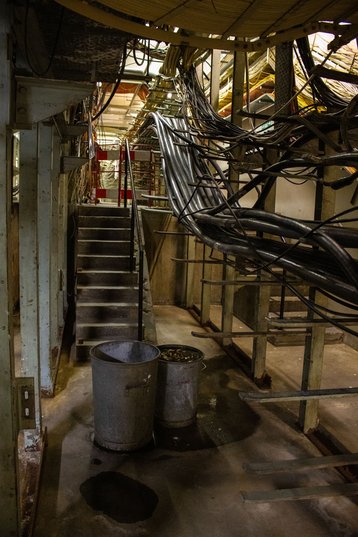
The report shows there were 1,523 significant resilience incidents in 2024, up from 1,209 in 2023 and 1,281 in 2022. Hardware faults accounted for under a third of total lost hours; Ofcom noted PSTN incidents were growing due to equipment being beyond its intended lifespan and the reduction of qualified personnel within industry with experience of these legacy technologies.
BT also has a 2030 carbon-neutral goal it will be hard-pressed to meet if it doesn’t turn off its copper services.
“We can't get a net-neutral industry without removing the PSTN and copper. It just has to happen,” says Chadha.
European telecoms lobbying group Connect Europe has suggested a fibre-to-the-home line improves energy efficiency by at least 80 percent compared to copper, requiring about 90 percent less power and halving an operator’s opex costs. Norway’s Telenor has said it expects to save up to 100GWh annually after its copper switch-off – around an eighth of its total energy consumption across its fixed and mobile networks. A Telefónica report suggested the electricity consumption of fiber equipment is 10 times lower per megabyte emitted than copper equipment.
Though it didn’t break out network splits, BT has previously said it alone consumed nearly one percent of the UK’s electricity annually as recently as 2022; it purchased some 2.5TWh of electricity in 2021. It has also said 95 percent of its energy needs come from its fixed and mobile networks, with “much” of the energy usage going towards PSTN/TDM technology. The company has, however, reduced its global energy consumption by 17 percent since 2017 – totaling some 420GWh – driven in part by the shutdown of its 3G network.
Openreach told DCD that fiber optic networks consume up to 70 percent less energy than copper networks. And, because they generate minimal heat, fiber reduces the need for cooling systems. The newer network also offers the benefit of longer lifespans and lower maintenance.
BT has partnered with IT asset disposal firms N2S and TXO for what its calling the Exchange Clearance Operation to remove, reuse, and recycle materials from exchanges. In 2023 alone, N2S said it aimed to support BT in extracting 200 tonnes of copper cable via recycling and the resale of redundant network equipment, as well as recycle over 2,000 tonnes of lead batteries. That figure reached more than 600 tonnes of copper in 2024. Part of that is being recovered via bioleaching, which uses bacteria to recover precious metals. Openreach told DCD that most of its waste will be recycled rather than sent to other countries for spare parts in other legacy copper networks.
Exiting exchanges
The BT Tower exchange that Openreach showed DCD around hosts some 6,000 PSTN and MPF lines. The tower is also home to some 28,000 lines of fiber with some 5,000 active circuits. While some fiber might be private lines for enterprise customers or for interconnecting exchanges, individual fiber lines can serve up to 32 residential customers on fiber to the premise.
The facility should be fully empty of customers by midnight on March 31, 2029; London’s Marylebone Exchange, a mile west, is the receiving site for customers at the tower.
At the time of DCD’s visit to the tower, Openreach said it had contractors doing physical cable audits tracking the cable from end to end for around a month at that point. The processes just for this tower is expected to take several months at least.
“They are understanding what it is, and then they are reporting that back into our planning teams to understand where it goes,” says Rory Lockyer, exchange exit, delivery professional for Openreach. “From there, we can then get a grasp of who is expected to be on that cable, what customers are we expecting to serve, and where does that cable go?”

When asked if seeing the thousands of lines of copper on the MDF brings any kind of anxiety about getting everything and everyone out of the exchange on time, Lockyer says no, because many of those lines will have already been disconnected as people have already moved to fiber.
“As folks self-select onto fiber, you end up with wires here that you don't necessarily care about, so it becomes a lot easier to decommission,” adds Chadha.
Openreach has already done preliminary work at many of the 105 sites that will be closed down following the initial pilot, including preventing new copper products being sold by CPs.
Nesta Colburn, exchange exit manager at Openreach, said the company is starting the exit process by tackling “some of the most complex” sites.
While some parts of facilities, such as the MDF, fit a fairly standard design, exchanges vary dramatically in terms of size and layout, making each one unique in terms of the work needed to close it down. The company declined to tell DCD how much money it will be putting into the exit program due to its “commercial sensitivity.”
The OHPs that Openreach is keeping reflect the geography of the company’s fiber rollout. Those remaining will be large enough to fit all the Openreach and CP equipment required to serve customers across the UK once the rest have been closed, the company says. On average, each OHP replaces four to five traditional exchanges, with some OHPs replacing ten or more in some inner city locations.
An OHP site hosting fiber services can be found inside the BT Tower, and is one of those facing the chop. The OHP areas of the tower exchange, akin to large meet-me rooms, feel similar to traditional white space, with one networking box hosting around 2,000 fiber customers, compared to the 100 lines a single similar-sized copper block could host on a copper network on the MDF downstairs.
In the BT Tower and other OHPs that will be closing, fiber customers will need to be migrated to facilities that are remaining open. Though the migration of this network will need far less manual intervention than the copper customers, some physical re-splicing of the fiber will be required in parts of the network.
All CPs present in closing exchanges will be offered equivalent space and power in other OHPs, Openreach tells DCD. Not all exchanges are head-end buildings, where fiber networks terminate, which the company said has been factored into some of the decisions around what sites Openreach will close in the program.
At BT Tower, Openreach is retaining the cable chamber vault where copper and fiber cables enter the building, and is constructing a small area to host passive network equipment.
“Because of some of the sensitive equipment we have in here, and some of the contracting that we agreed when we sold these buildings, we are able to retain certain spaces,” says Lockyer. “In [the BT Tower], we are planning to move all of our fiber equipment down to the cable chamber. Over the next 12 months, we're creating a space that will be used to passively manage all of our fibers, so there won't be any active equipment like head-ends in here.
“It will be a secure location that fibers can transit through to go on to their receive site.”
Complications and regulations
While BT, via Openreach, still has a monopoly on exchanges, the shutdown will have a major impact on hundreds of communications providers across the UK.
Earlier this year, Openreach said its full fiber network is available to around 18 million homes and businesses, with some 6.5 million premises currently taking a service. Ofcom data suggests there are still around 5.2 million PSTN customers in the UK, totaling approximately 27 percent of all landlines. Openreach has said it is reaching an average of 85,000 new premises every week with its full fiber offerings and is targeting a total of 30 million premises by 2030. The company says its full fiber build-out will cost in the region of £15 billion ($20bn).
But, like any data center migration, each exchange exit is a multi-step process that involves multiple parties. The shutdown is a complicated process that is fraught with business, logistical, and regulatory hurdles at every step. While Openreach is a B2B firm serving communications companies, the impact on vulnerable residential customers will likely govern the final pace of the shutdown.
To begin the exit process, Openreach issues a stop sell notice to make sure it and any wholesale customers aren’t connecting any new lines. Stop sells are triggered when a majority (75 percent) of premises connected to a particular exchange can be served via fiber. Once a stop sell has been called, the companies can begin the slow process of cataloguing, migrating, and disconnecting the thousands of cables in each exchange – a complicated operation that will involve Openreach working with its customers, and those communication providers working with each customer individually. Once everyone is fully migrated and disconnected – a process which will take years – equipment can be shut down and removed bit by bit.
BT and Openreach have said the exit of the simplest exchanges could be done within four years, but the process of exiting the most complex exchanges would begin up to seven years before their final exit date.
Chadha says: “We understand the pain of the journey, we're not blind to it. Some of it is just really hard to move because you can't tolerate disruption.
How do you make sure that you migrate the system that operates traffic lights, for example, without them stopping?”
He says some CPs have been resistant to change, and have to be convinced a migration is possible: “It has always started with 'this is why you can’t do it,’ but we've crossed the rubicon into ‘how are we actually going to do that?’,” Chadha says.
Lockyer adds: “There are going to be 1,000 different reasons why someone can't migrate. And we will come back with 1,001 answers or solutions on how to get them to migrate.”
To help sweeten the deal, Openreach has a commercial offer that involves an incentive payment to CPs if they exit all exchanges on time. If CPs do not migrate all of their customers on time, they forego this payment.
It can be difficult to get a repeatable pattern on such migrations. In the traffic light example, the company has already come up against at least two separate traffic light networks, with different ownership and operating structures, operating with different network set-ups via different CP providers.
“It's not a cookie-cutter approach where we can say we've learned something here and we're going to apply that same process elsewhere; we start to find that we're doing bespoke solutions," says Colburn.
Despite this, it is hoped that the answers to many core issues can be found during the pilot stage. An example Lockyer gives is the cable chamber being retained in the BT Tower; going forward, it is hoped any other retained vaults in buildings will be a quicker and easier process once the first one is complete.
The first stop sells were issued at two sites, in Salisbury and Mildenhall, in 2020 and 2021. Today, more than 940 exchanges – covering around 8 million premises and some 44 percent of the company’s fiber footprint - have received the notices, with another 226 exchanges set to be added the list next year. Customers on existing contracts can continue to use copper-based services, but will unlikely be able to renew their deals.
The rub is that an exchange can’t be closed until the last customer has been disconnected. And that can’t happen until a fiber alternative is made available and any vulnerable customers relying on a copper network have been switched onto a similar service. The fact that Openreach only deals with CPs and not the end customer can make that process more difficult.
“Once you've got fiber, customers usually self-select onto that because it's a better product,” says Chadha. “That takes the majority out of it, then you're left with the rest. And the economics, keeping this [exchange] open for that small proportion, ultimately, just doesn't work, for Openreach, for BT group, the UK, or industry.”
He adds: “We don't have control of providing to the end customer, and that becomes really difficult if you're trying to close an exchange or the PSTN. If the CP hasn't done enough, how do you manage that end customer?”
He notes the challenge for CPs around migrating large enterprises. National and international chains are more likely to want a nationwide approach to switching to fiber, rather than the Openreach calendar, where different exchange sites are exited at different times.
“Think about a hospital, or a supermarket, or a coffee chain. How do you start moving them all? If you're their CP, it's not an easy conversation,” says Chadha. “The challenges of this stuff often come down to really hard commercial problems.”
He tells DCD that regulation reform is needed to help ensure its mandated like-for-like services are available to every customer, especially in the residential space.
The company has historically struggled to gain access to multi-dwelling units, such as apartment buildings, in order to install new fiber lines. Landlords can be difficult to contact - or convince - to gain permission to install new fiber. Even if Openreach has the right to enter units to fix the copper network, it has no automatic upgrade rights to install fiber. Chadha notes Openreach also would like renters to have the right to install fiber without needing permission from the landlord.
He also questions why it needs to be Openreach providing the fixed-line fiber replacement for copper when other fiber providers or even wireless networks could offer a similar quality of service in many areas. Other countries have seen the copper-operating incumbent given the power to force-migrate customers to a new service, which Openreach doesn’t have.
“We all agree that every customer needs a decent connection. But as long as folks have a good connection, I think we need to be a little less obsessed about how it's provided and by whom,” he says.
Connect Europe’s report suggests operators should “receive strong support from national policy makers and regulators to assist them in their switch-off efforts.”
The UK’s telco industry watches and waits
While this is a copper-centric program, the exchange exit has a large impact on fiber providers, too.
As well as copper offerings, many exchanges offer Ethernet, Dark Fibre (DFX), and PIA (access to existing cable ducts and poles) solutions. OHPs that are closing will see fiber services relocated to enduring exchanges, meaning equipment needs to be moved.

Openreach, created because the UK’s wave of new telecoms didn’t like how BT was abusing its 100-year monopoly and incumbent status in a modern deregulated market, still has an occasionally uneasy relationship with the rest of the UK’s communication providers. The exchange exit is again causing the industry more worries.
The scale of the exit at each exchange will vary depending on the CP. Neos Networks, a UK fiber wholesaler, has previously said it has its optical equipment in around 550 Openreach exchanges to regenerate signals every 80 kilometers.
Even companies that aren’t using Openreach’s copper networks, such as some of the UK’s new upstart fiber providers, or altnets, will have fiber equipment in exchanges and use other Openreach infrastructure impacted by the exit program.
Though moving racks of one MUA into another at an enduring exchange isn’t as complicated as the copper migration and closure, the Independent Networks Co-operative Association (INCA), which represents UK ISPs, has warned that the exchange exit could cause problems for the altnet fiber providers, both directly and indirectly.
Many companies rent duct and pole space from Openreach (a service known as Physical Infrastructure Access, or PIA) to save building out their own. INCA has warned that although some PIA infrastructure might no longer be required by Openreach once an exchange closes, it could still be important to altnets.
INCA has also bemoaned the fact that “effectively, it is up to Openreach’s customers to shoulder the burden of rearranging their networks at their own cost – except where Openreach has specific contractual obligations to cover costs for its customers, which is extremely limited.”
Openreach has said customers will need to rearrange their network to hand over at an alternative location if an exchange is being exited. The company briefly proposed allowing PIA users to acquire this unwanted infrastructure, but that idea has since been withdrawn. A 2025 survey by Neos suggested rerouting networks due to exchange closures will cost companies an average of £1.4m ($1.88m) each – a hefty sum when many are already operating at a loss in an attempt to scale.
And while the enduring OHPs stand ready to host the increased amount of fiber going to each site, whether they are ready to host more IT equipment is less of a sure thing.
CPs and altnets house racks of network gear at exchanges in the MUAs, and Openreach is offering like-for-like space and power in its OHP exchanges. It also pays compensation for CPs relocating racks from one exchange to another. That offer, though, could see those continuing OHPs filling up fast, and could require a power upgrade.
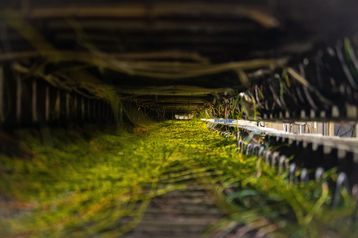
Racks in the tower exchange will be moving to Marylebone, along with the networking gear of two other sites.
Elsewhere in London, exchanges in Wandsworth and Streatham will be consolidating into an enduring facility in Balham, which Openreach says will likely need a power upgrade to accommodate all the new gear.
“While the focus on this program is on the 108 exchanges we're closing, we need to be focusing on ones that we're keeping, because those are the ones that are going to be here forever,” Openreach’s Colburn says.
The company is now working with CPs to establish if moving all the equipment is really necessary: “If a customer has a point of presence in the tower exchange, North Paddington, Paddington, and Marylebone, do they actually need four tiles in Marylebone or could you make do with two, because all of the current equipment is only operating at about 50 percent?” Colburn says.
Cost savings from using less space and, potentially, less power in consolidated sites might be enough of a carrot to encourage some CPs to move, it is hoped.
The wider BT Group is already investing in some upgrades. In its 2025 annual report from May, BT said it had installed and upgraded cooling plants in its local exchanges, saying it had invested more than £9m ($12m) on adiabatic cooling systems upgrades in the last year.
And even if companies don’t have hardware in exchanges or are users of PIA services, the facilities act as ‘meet-me’ points and are key for the third-party supply of backhaul and other services to altnets. Openreach dark fiber services generally connect back to exchanges, and some altnets or their suppliers use this DFX service for backhaul - which could be shut down in some areas if an exchange is closed.
Openreach told DCD that the network in the exchange area is not impacted by the exchange closing, so the network element for PIA CP that is using Openreach duct or poles in the area will not be impacted. However, the company noted that if an alt-net or PIA CP has opted to route their network into a closing exchange, it is “their responsibility to re-route/rearrange this to another exchange or another location of their choosing before the exchange closes.”
The industry group has noted that altnets are also concerned that increased demand at Openreach’s enduring exchanges could result in a shortage of space and power when relocating. There could also be challenges in ensuring there is enough inter-exchange capacity if ducts between two remaining sites are full. Current PIA rules don’t compel Openreach to build more duct space or remove idle copper, potentially preventing new altnet fiber taking its place. DCD understands BT is working to ensure there is sufficient space and energy at all exchanges.
“The closure of approximately 80 percent of Openreach’s exchanges will significantly impact the current and future design of altnet networks and will result in significant costs for altnets to change their networks to mitigate the closures,” INCA said in a report. “If Openreach is only required to provide access to space and power in an enduring exchange on the principle of ‘where available,’ this could create significant capacity constraints.”
Not all companies will be impacted equally. Some altnets, like CityFibre, have been busy building out small exchanges over the UK. The company has at least 100 ‘FEX’ deployments, with most being small containerized pods with a handful of racks.
The closing of exchanges will also likely have an impact on local wireless services. Many exchanges host cell towers and other wireless equipment for BT/EE and others; the closing and potential redevelopment of those sites could mean the wireless infrastructure will have to be removed. Cellnex’s On Tower took BT to court in 2024 over the latter’s attempt to terminate a roof lease early at an exchange due to be decommissioned; the case is still ongoing at time of writing. Both companies declined to comment on the matter.
Get out or pay up
Though BT says there are operational and sustainability reasons for the copper switch-off, it also faces a very real financial penalty if it misses the looming 2030 deadline to exit exchanges. Fittingly for London, a city with an ongoing rental crisis, BT and Openreach are very wary of their landlord putting up the rent.
BT sold the majority of its real estate sites to real estate firm Telereal Trillium in a sale-leaseback deal back in 2001 for £2.38bn (around £4.45bn/$5.27bn today, adjusting for inflation). The company was aiming to reduce its debt pile, which was hovering at around £30 billion ($40.19bn) on the back of the build-out of its then cutting-edge 3G network. Today, amid an ongoing 5G build-out, BT’s debt is just under £20 billion ($26.8bn).
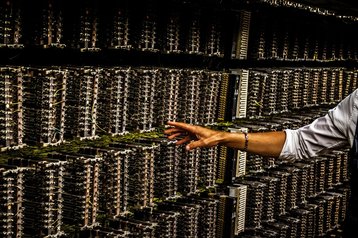
Openreach tells DCD the 6 million sq ft (557,420 sq ft) portfolio was leased back to the BT group on “very favourable” terms, with minimal rental increases in the intervening years. However, once the current leases end in 2031, the telco faces a stark choice: Be fully exited from a facility, lease the property again for a minimum of ten years (until 2041) at today’s market value, or buy the property back, again at 2025 valuations. This applies to any of those thousands of exchanges from which BT is not fully exited.
“2031 felt like a long way away [in 2001]. Then, all of a sudden, when we got to 2020, we were starting to think about this lease break coming up in 10 years,” says Colburn. “And now we've really started to ramp up. ”
Property value was a major factor in identifying the first 100 buildings to close before that 2031 deadline. Given that many exchanges are located within inner city metros – including central London – BT Group can ill-afford to risk being locked into thousands of expensive long-term contracts at sites it doesn’t want. This is “definitely a big deal” for the company, its execs told DCD.
Many of the facilities in the initial tranche of 108 exchanges being closed are located in London; these include Baynard House near Blackfriars, as well as facilities in Bayswater, Wapping, Wandsworth, Streatham, Kensington, Southwark, Shoreditch, Pimlico, Paddington, Monument, New Cross, and Mayfair. Further afield, exchanges are due to be closed in the centers of towns and cities, including Sunderland, Liverpool, Birmingham, Glasgow, and Edinburgh, where property prices are higher than in rural areas.
Aside from the BT Tower, only one other exchange in the initial 108 exchanges isn’t currently owned by Telereal; the Skyport exchange near Heathrow Airport near London, owned by UK aviation regulator, the CAA.
When asked if all the enduring OHPs will be owned by BT Group or Telereal Trillium, Openreach said OHP locations will be housed in “enduring sites where Openreach can agree terms with the landlord.”
DCD reached out to Telereal Trillium to discuss its plans for the Openreach/BT exchange portfolio once the telco exits the sites, but the company didn’t respond.
An Openreach spokesperson said the landlord would likely sell the buildings off to developers – something it has done with other exited BT properties. BT Group declined to comment on its real estate plans.
“We’re freeing up great properties like the tower to create additional economic value from becoming an amazing hotel that people are going to travel for,” says Chadha. “Right across the country, what can you unlock by freeing up those exchanges that are often near high streets?”
Could they make good data centers still? Potentially. Some companies in other countries have repurposed legacy exchanges into colocation facilities. They can’t offer the same kinds of densities as modern facilities, and operators have to contend with the fact power is usually distributed in 48 VDC power rather than AC, but they do offer ready-made capacity in key locations.
But the fact that many such properties are in central locations in major metros means they are prime redevelopment opportunities into apartments – most exchanges exited in the last 20 years have been turned into residential accommodation.
Though it is part of the wider exit plan, the BT Tower was not actually part of the Telereal Trillium deal. The BT-owned site was recently sold to a hotel chain for redevelopment. Both Openreach and BT are involved in their own respective exit programs – the tower is also a broadcast operations center and has a separate BT-operated data center in the complex – but on different terms to the rest of the portfolio.
The future legacy
Referring to all the PTSN gear at the BT Tower, Chadha says: “In 2027, all of this has to disappear, and that date has to stick.”
On the wider exchange shutdown, Chadha reports mixed success from the three pilot sites: “My confidence today is that we've got two of those three that look very likely that they are going to close and that we actually will succeed,” he says. “The third one's difficult, but we’ll see where we get to.”
It might be a long time off, but what happens after BT and Openreach close all those exchanges? The group will have a smaller, more energy-efficient network and real estate portfolio for sure. But does that open up new opportunities for a new Edge play?
David McKean, BT’s specialist tower division director, recently told TelcoTitans that the company has been considering whether it can repurpose some of its enduring exchanges and its tower portfolio for data center use. The telco also recently posted a job opening for an Edge computing architect, suggesting moves could be afoot.
BT Group owns at least 200 radio masts and towers in Britain – more than a dozen of which are large concrete towers in the style of London’s BT Tower.
The group’s total cell tower footprint, used by its EE unit, is unclear; the company said EE’s 3G switch-off involved retiring technology at more than 18,000 mobile sites, with more being rolled out to support the group’s 4G and 5G network.
BT previously sold around 220 of its towers to Cellnex in 2019 for £100 million ($134m), with the telco remaining a customer at a number of the acquired sites.
Several European operators, including CRA in Czechia, Digita in Finland, Telecentras in Lithuania, LVRTC in Latvia, and Cellnex in the Netherlands, as well as HKBN in Hong Kong, have deployed data centers at TV and radio tower sites. Edge data centers at cell tower sites are more common, with the likes of Cellnex, American Tower, and SBA having deployed data centers at cell sites.
The relationship between BT and Openreach could well change too. Allison Kirkby, BT’s CEO, has previously hinted that Openreach could be spun off into a completely separate company once the group has completed its fiber roll out.
But will Openreach and BT meet their punchy targets to exit the 100 or so initial exchanges before 2031, let alone the thousands it is targeting long term? Despite delays to closing the initial three (already downsized from the original five sites), Openreach seems to think so. Not all are so convinced.
“Altnets have little confidence that Openreach will meet its initial target for exchange closures and significant delays may be incurred in the overall program,” INCA said in its report, “similar to the delays being faced by Openreach on its PSTN switch-off program.”
We are reaching the end of the analog era. This writer just hopes whoever takes over Baynard House lets us keep playing football there once the last copper wire is pulled out. It really is hard to beat that view, even if our win record in the shadow of the tower isn’t quite as spectacular.
This piece is part of a series on the UK’s copper network shutdown and Openreach’s exit exchange program. Many features within this series first appeared in DCD>Magazine #58. Register here to read the whole magazine free of charge.
- Copper gets the cold shoulder
- BT’s landlord looms large over the UK’s telephone exchanges
- History exchange: London telephone exchanges in focus
- Copper exchanges in all shapes and sizes
- UK ISPs and altnets on Openreach’s telephone exchange exits






Comments