
With smartphones dictating every facet of our lives, connectivity has never been more crucial.
The sending of messages, making payments, and surfing the Internet mean telecoms infrastructure has fast become critical infrastructure. So, it’s almost unfathomable that some would attack this vital equipment.

Issue 58 - The UK's copper switch off
How BT and Openreach are approaching the end of copper
However, this is becoming a reality for a lot of telcos and communications providers at present. And simply put, the telecoms industry is fed up with it.
The problem has become so bad that some within the industry have called the issue an “epidemic” and a threat to national security.
"The reality is that there is no shortage of individuals, rogue groups, nation states, and others seeking to cause harm to Internet users, broadband networks, and in some cases, the collective critical communications infrastructure," said former US Federal Communications Commissioner (FCC) Michael O'Rielly earlier this year.
As he says, these attacks can be for several reasons, such as people deliberately vandalizing telecoms infrastructure, stealing critical equipment such as copper cables, or even sabotaging fiber cables.
Copper cables in particular draw a large amount of interest, given the street value of copper.
Rising numbers
In the past year alone, vandals have caused millions of dollars' worth of damage to telecoms infrastructure.
According to Protect Critical Communications Infrastructure (CCI), a coalition designed to “protect America’s critical communications infrastructure from theft, vandalism, and the costly disruptions they cause,” in the last six months of last year, nearly 6,000 intentional incidents of vandalism against communications infrastructure were reported.
In one instance, suspected copper thieves toppled a 488-foot rod cell tower in Oklahoma, causing an estimated $500,000 in damage, while just this summer, a man was arrested after stealing more than 900 backup batteries used at cell towers across Phoenix, Arizona. The latter targeted 66 T-Mobile cell tower sites between August 2024 and February 2025, resulting in more than $330,000 in damages.
Bell’s copper conundrum
Bell Canada is one carrier experiencing more incidents. Copper theft-related incidents have increased 23 percent year-over-year across Canada as a whole, and since 2022 Bell alone has recorded more than 2,270 thefts across the vast country.
“Copper theft is a crisis that continues to grow,” David Joice, director of network operations, Bell Canada, tells DCD. “It endangers public safety and disrupts critical communications in Canada as well.”
Joice explains that the issue is showing no sign of improving, with numbers rising even higher, stating that the problem is costing the company “millions of dollars.”
So far this year, Bell has reported 700 such incidents, with around 88 percent down to copper theft. June saw 200 incidents of vandalism against its network. “It just continues to escalate,” he adds.
The key to this issue is the black market that is driving demand for copper, explains Joice.
“The cost of metals has increased over the years, and people are not only stealing it, but people are willing to buy it, knowing that it could be stolen,” he says.
The situation is similar in the US says Chris Antlitz, principal analyst, Technology Business Research. He likens the issue to one that was prominent for Toyota Prius car owners, whereby thieves targeted the vehicles for their catalytic converters, due to the high scrap value of the materials.
“It’s a big problem in the US. The cost of materials has reached a point where illegal activities get a payout that's worth their time,” he says.
“People used to take the catalytic converters from the car to reclaim the metals. It's the same idea with the telecom infrastructure. There's a lot of copper in telecom equipment, especially legacy stuff.”
Joice acknowledges that attacks are an everyday battle for telcos such as Bell.
“I'd say we don't catch the majority of them. We do catch some and I'd say over the years, it seems like we've gotten better at catching people, but the fact that it continues to happen every day, it seems like we're not winning that battle,” says Joice.
He notes that Bell works with law enforcement on almost every case to prosecute criminals, but says the vast landmass of Canada can often mean it’s difficult to keep on top of incidents, noting that attacks are often in rural areas.
“An act of domestic terrorism”
US-based Charter Communications has also been the target of vandals.
However, unlike Bell and other carriers, Charter’s network doesn’t include copper, but is made of fiber. This has not deterred criminals, despite fiber not having the value of its metal counterpart.
An attack on Charter’s fiber network in Los Angeles in June led to an outage that impacted a range of customers, including a US military base, emergency dispatch and 911 communication services, local fire and police departments, financial institutions, carriers, and more. On that occasion, 13 fiber cables were severed, including more than 2,600 individual fibers.
The company labeled that incident as an “act of domestic terrorism.” Sadly, it wasn’t the only such incident for the company, with Charter outlining a recurring issue in Missouri, another state, close to 2,000 miles away.
Up to the end of June, Charter logged 148 outages related to criminal attacks on infrastructure in the state of Missouri alone.
“The impact is that of domestic terrorism, cutting off access to critical services, preventing vital communications during times of emergency and crisis, creating a pervasive and persistent threat to families and businesses in Missouri and across the country. This criminal activity must not be allowed to continue,” said Tom Monaghan, executive vice president, field operations for Charter in July. He made similar comments at SCTE TechExpo in Washington, DC, last month, along with Comcast's executive vice president and chief network officer Elad Nafshi.
In a statement to DCD, the company has doubled down on its view of these attacks against telecoms infrastructure.
“When the impact of these intentional attacks impacts public safety, it isn’t just vandalism - this is a form of domestic terrorism,” says a Charter spokesperson.
They added that stealing fiber does confer the same financial benefit as copper.
A driver of this issue is the rising price of copper and precious metals,” the spokesperson says. “Many of these attacks are being perpetrated to steal copper often found in cables. However, our fiber networks contain no copper, and so criminals are cutting these lines, not finding any copper, but causing significant damage and impacting the services and in many cases, public safety.”

Misinformation
The attacks against the infrastructure are not always in the pursuit of a quick payday. In some instances, people have attacked infrastructure due to the spread of misinformation online.
One of the biggest examples of this was around the pandemic back in 2020, when numerous attacks across parts of the world saw people destroy or attack 5G cell towers as part of “Anti-5G” protests.
This was down to conspiracy theories being shared online incorrectly linking the spread of the virus with 5G technology, and even sometimes pedaled by celebrities.
Incredibly, five years on, several 5G masts were targeted in parts of Belfast, Northern Ireland, earlier this year.
Protests around mobile technology are nothing new, says Ineke Botter, who has held high-level positions across several countries in Europe, plus CEO positions at telcos in Kosovo, Lebanon, Azerbaijan, and Haiti. Botter is currently Ambassador for Telecoms sans Frontières, a group which focuses on emergency-response technologies.
In one instance, Botter recalls people chaining themselves to 2G cell masts in Switzerland amid fears of health concerns, though these protests eventually petered out.
She says the misinformation can be “dangerous” and has to be nipped in the bud quickly.
“You have to be vigilant of social media,” she says. “In Haiti, you saw people stirring up nonsense on social media, and you’ve seen the same with things like ‘5G is dangerous’ and all that nonsense,” explains Botter. “If you don't manage that constantly and you don't nip it in the bud, you have a real problem.”
That said, her role as a CEO in war-torn countries presented trickier assignments. In Lebanon, the terrorist group Hezbollah was a regular threat to the communications infrastructure in the country.
“Hezbollah had a sort of attitude that everything is ours,” explains Botter. “They were stealing infrastructure, such as cables, and were stealing from the generators. So what you had to do there was to make sure that the plots were very well protected with dogs and guards and all, but of course, you don’t win against Hezbollah.”

Attacks slow down fiber build-out
UK broadband provider Openreach has experienced its own fair share of issues with vandalism against its network, in particular, copper theft.
James Arnold, regional security operations manager, UK South & London at Openreach, told DCD that theft of its copper network has impacted the business, especially as the company pushes to build out its fiber network. The company plans to reach 25 million premises with its fiber network by the end of next year.
“Cable thefts are hugely disruptive. The loss of phone and broadband is not only inconvenient but can put vulnerable people at risk. Repair work also pulls our engineers away from other work, can take weeks to finish, and costs thousands of pounds,” says Arnold.
“I'm dealing with a welfare case whereby a vulnerable customer has been impacted by cable theft in Lincolnshire,” he adds. “It can detract from important work, such as our fiber rollout. It detracts our engineers because they then have to do the repair.”
As copper theft has become such a big issue for Openreach, it’s led the broadband provider to step up its security to prevent copper from being stolen from its network, which can lead to network outages, such as in the New Forest, UK, last year.
To combat such theft, Openreach has used tracking technology, SelectaDNA, to trace its copper, noting that the technology has seen copper theft drop by 30 percent during the last year.
“We take the security of our network seriously and have a wide range of crime prevention tools to prevent thefts and catch those responsible. Our dedicated security team investigates all attacks, and our network is alarmed and monitored 24/7 by our control center,” he adds.
It does, however, seem to be working, says Arnold, who notes Openreach has seen a reduction of 37 percent in live network attacks year-on-year, while the company has reported a 90 percent decrease in estate and cable compound targeting.
Unfortunately, it’s not just the infrastructure that has been attacked; but Openreach has also reported a significant amount of abuse directed towards its engineers.
Last year, the company logged 450 incidents of abuse and assault on its workers in the year up to the end of March, up eight percent year-on-year, and up 40 percent up from 2022-23.
“We’ve had engineers being shouted at, sworn at, even spat at,” says Adam Elsworth, health and safety director at Openreach. “We've had engineers where their vans are blocked on people's drive and even people being shaken off of step ladders or pushed down people's stairs.”
He notes that around half of the incidents occur in the public domain.
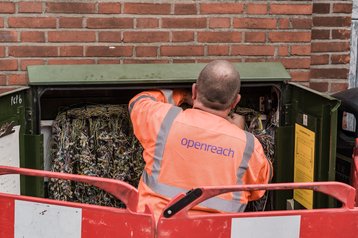
In an effort to support their workforce in such incidents, Openreach is utilizing a “panic alarm” on engineers’ mobile phones, which connects them in seconds with a monitoring center. The center has the ability to directly dispatch emergency services if needed.


Tougher punishments are needed
The issue at hand is a big one for telcos globally, and it needs to be addressed.
Telecoms associations are becoming more vocal in calling for tougher laws to curb these attacks.
In July, four US telecom trade associations wrote a letter asking for urgent action to be taken to safeguard the nation's critical network infrastructure.
In the letter, which is addressed to Kristi Noem, secretary of the US Department of Homeland Security (DHS), and Kash Patel, director of the FBI, the Internet & Television Association, ACA Connects, NTCA – The Rural Broadband Association, and USTelecom, calls for tougher measures and action to prevent further attacks.
"We write today to highlight a significant and rapidly growing threat demanding urgent, coordinated federal, state, and local action: widespread, organized critical infrastructure attacks targeting our nation’s communications networks," said the four associations.
DCD tried to contact the associations for more information on several occasions, but got no response.
Stepping up security
The telecoms companies have taken it upon themselves to combat the issue at hand by bolstering security.
South African telcos, including MTN Group, Vodacom, and Telkom, have previously strengthened their security to deter vandals and thieves, while also working closely with police forces to clamp down on the issue.
Joice says Bell is doing the same in Canada, noting that security has become a key priority.
“In some cases, we actually have alarms on the copper cables. So if they are cut, that notifies us and the local authorities right away,” says Joice, who adds that this has enabled the police to apprehend people faster.
“We have lots of copper out there, so we have to be fairly strategic where we place these systems. We’ve also installed more security cameras and hired security guards.”
The company hopes its move away from legacy copper networks will lessen the impact of the vandalism.
Meanwhile, Charter is also working closely with the relevant authorities to detain vandals.
“We are able to quickly identify when and where these attacks occur and quickly dispatch our teams to begin repairs,” says Charter. “To fight this issue, we are working closely with law enforcement agencies and prosecutors to identify, catch, and prosecute those responsible.”
The company says it has also worked with elected officials to pass legislation seeking to increase the penalties for these crimes. “In 28 states these critical infrastructure attacks are now a felony offense,” its spokesperson adds.
Take control of the network
While the need for tougher sentences is widely agreed upon by the industry, some suggest that there’s a need to educate the public on why this infrastructure is so crucial.
According to Antlitz, there’s an opportunity for telcos to take control of the copper issue, by reclaiming their copper before opportunistic vandals can.
“The telcos are reclaiming their own copper,” he says. “They are ripping out their own copper anyway to recycle it, because a lot of that equipment is legacy, and they're replacing it with fiber.
“The fiber doesn't have value on the secondary market, so they're not really stealing the fiber, unless there's vandalism.”
Arnold agrees, saying the company wants to get its fiber in the ground as soon as possible.
“We are already coming off the copper network nationally, across the UK, and we are extracting copper at a fast pace, almost in a race with the criminals, because the quicker we can get copper out of the ground, the quicker they can't get hold of it,” he says.
Botter believes that educating the public would potentially deter more people from attacking the infrastructure that plays such a key role in everyday life.. “If you can't explain difficult things in very simple terms, then you are not good for your job,” Botter says.
“You need to really make people understand that these base stations are there for them, so that there is communication. If you destroy those, you're out of communication.”
As she points out, when war or natural disasters strike, the power of telecoms infrastructure becomes more critical and non-negotiable for everyone, which should give wannabe telco criminals food for thought.
This feature first appeared in DCD>Magazine #58. Register here to read the whole magazine free of charge.
Comments