
Cable companies Charter Communications and Comcast have once again called for tougher measures against people who deliberately sabotage telecoms infrastructure.
The comments were made in response to a question about the Strategic Threat Response & Infrastructure Knowledge Exchange, or STRIKE, initiative, during SCTE Expo, in Washington DC.
STRIKE is co-led by the Society of Cable Telecommunications Engineers (SCTE) and NCTA – The Internet & Television Association.
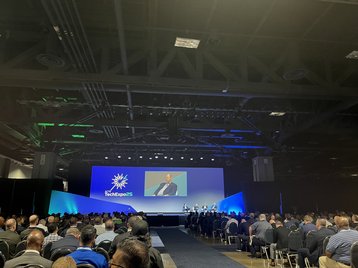
The purpose of STRIKE is to encourage data sharing and best practices among operators and industry organizations to combat the rise of copper theft and telecom infrastructure attacks. Executives from Altice USA, Cable One, Cox Communications, Mediacom Communications, and Canada's Rogers Communications are also in the group.
Elad Nafshi, executive vice president and chief network officer, Comcast, and chair of STRIKE, said tougher action is necessary.
"Network vandalism is no longer a normal thing that just happens here and there. It is something that is hitting us in scale. It is something that disrupts our customers, and worse, it disrupts critical workers. It disrupts police stations, federal buildings, and schools, and everything that connects to our networks," said Nafshi.
Everyday problem
Tom Monaghan, executive vice president for field operations, Charter Communications, noted that the issue is a daily problem for the company. Monaghan is also on the board of STRIKE as a vice chair.
He labelled the attacks as acts of "domestic terrorism." The company has highlighted the issue on several occasions, notably in June when its network in Los Angeles was attacked.
Charter has previously told DCD that attacks on infrastructure impact public safety.
Monaghan told attendees that tougher policies are needed to curb the attacks.
"To us at Charter, it's domestic terrorism," he said, stating that more needs to be done.
"Today, it's a felony in 28 states. It has to be 50, no ifs, ands, or buts. Number two, you can have a law on the books, you have to prosecute. We've had cuts in major markets in broad daylight that have happened, people have gotten arrested, and ultimately not prosecuted. That can't happen anymore, or this problem won't go away."
On top of this, Monaghan wants to see tougher policies on places that buy copper from people, knowing that the material has likely been stolen.
"There's not a day that goes by at Charter that we don't get one [cable cut]," added Monaghan. "And depending on where you are, like I said, this used to happen in the dark of night. I mean, it's getting brash where they're doing this during the day, and over a period of time, it affects millions of customers."
AI detection speeds up response times
Nafshi noted that Comcast is working to implement tougher measures to minimize outages when its fiber cables are cut. He adds that the vandalism isn't confined to just copper theft, but also "vandalism for the sake of vandalism."
"We focus on the discovery of these cuts, there's no time to wait," said Nafshi.
"We've invested a lot of money and a tremendous amount of technology innovation, including putting in place fiber monitoring with AI operations that monitor more than 800 kilometers (497 miles) of fiber across our footprint, and are capable of detecting fiber cuts within 120 seconds with pinpoint precision where the fiber cut occurred."
He adds that Comcast can automatically dispatch fiber restoration crews to the impacted location. Because of this, Nafshi said the company is able to reduce the outage times "by hours."
Earlier this year, former Federal Communications Commissioner Michael O'Rielly also called for tougher punishments for people who steal or attack telecom infrastructure.
One of the biggest factors for vandalism against telecom infrastructure is the value of materials such as copper. DCD has covered several stories in the last year alone relating to copper theft.
Read more about how the telecoms industry is fighting back against telecoms infrastructure attacks in Issue 58 of DCD Magazine.






Comments