
In the week when the US government shutdown grabbed the headlines, something else was taking place in the nation’s capital, Washington DC.
It was the SCTE TechExpo, an event that brings together the US telecoms and broadband industry, and policy makers, including Federal Communications Commission chair Brendan Carr, to shape the country’s connected networks.
As expected, there were a number of talking points from this year’s show, notably around the handling of the $42.5 billion Broadband, Equity, Access, and Deployment (BEAD) program, spectrum, workforce standards, plus safety and security around telecoms infrastructure.
In total, 45 members of Congress, 120 congressional staffers, and state representatives attended the event, while DCD was also in attendance.
Is BEAD a “race to the bottom”?
It felt as if BEAD was front and center of SCTE TechExpo, as US states continue to work on allocating funds.
BEAD, which was set up by the Biden administration and confirmed by Congress in November 2021, has been implemented by the NTIA. The federal grant program was designed to fund projects dedicated to providing Internet infrastructure in unserved locations across the US and its territories.
Initially set up to prioritize fiber over alternative technologies such as satellite Internet, President Trump reworked the program earlier this year, as part of efforts to consider other technologies.
According to the NTIA’s website, 43 out of 56 states and territories have now submitted their final proposals for review, as funding for carriers and technology providers is divvied up.
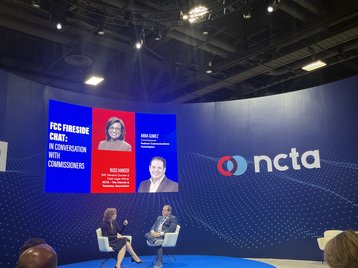
Speaking last week, FCC Commissioner Anna Gomez, the only Democrat Commissioner, outlined her worries about the direction of the program.
“I’m very concerned about what's happening with the main program over at NCIA. I call it a race to the bottom, where the only thing that matters now is how much the deployment costs. It’s penny-wise, pound-foolish,” said Gomez.
“I think that what concerns me is that we are going to incentivize deployment of technologies that are not going to meet the demand and are going to leave some communities behind, particularly as this administration pursues a policy of becoming a world leader in Artificial Intelligence. I don't want users to be left out of the AI world.”
Left behind
Gomez wasn’t the only one to voice frustrations with the program.
Parul Desai, chief counsel, Communications and Technology Subcommittee on the House Energy and Commerce Committee, says the program has gone backwards, and risks leaving communities across the country behind.
“BEAD was on track to get shovels in the ground months ago, but the program has been delayed for months now. I think oversight would be important, and is going to be important because NTIA has restructured the program in a way that is inconsistent with, I think, the letter and the spirit of the law in many ways,” says Desai.
Desai added that US states previously had more flexibility over the types of technologies they wanted to prioritize as part of the BEAD program, as each state varies. She says the previous administration adopted a more “tech-neutral approach.”
“I think the way the program has been restructured, the focus is on the cheapest as opposed to the best technology. I would also say with the low cost option, the statute specifically says states determine what the low cost option is,” added Desai.
She referred to Louisiana’s recently drafted BEAD proposals, which is set to allocate 80 percent towards fiber, when it was 90 percent in the state’s first proposal.
“Louisiana now has 80 percent fiber. That still sounds like a lot of fiber, but where's that 10 percent that no longer has fiber deployment? It's the poorest areas in Louisiana,” she said.
BEAD is “more tech neutral than ever”
Desai’s comments about tech neutrality were called out by Duncan Rankin, senior policy advisor, Senate Commerce Committee.
Rankin argues that the issue around BEAD isn’t because of the changes made by the Trump administration this year, and refuted her claims that the previous approach was more tech-neutral.
“I hear Parul saying that fundamentally, by your own admission, the criteria preferences fiber. That's not a tech-neutral approach,” said Rankin, who continued that the pace at which people are connected is important.
“If the goal is connecting the unconnected and unserved, then you should look at how do you do that the fastest, and that is not always going to be fiber.”
He added that the previous administration focused too much on fiber, whereas the reworked BEAD framework looks at alternatives. “I think the approach that the administration has taken is, in my view, much more tech-neutral and one that will end up with cost savings."
NTIA administrator Arielle Roth also took aim at the previous administration, saying the government “they took their eye off the prize,” when referring to BEAD.
She accused the previous administration of not prioritizing the program, and defended the reworking of BEAD, labelling it a “course correction.”
“They also pushed extreme technology bias that had the effect of raising costs and creating distortions,” said Roth.
Proposals have been submitted by 43 states so far, Roth said, adding that the NTIA aims to have the final proposals approved by the end of the year.
FCC’s Carr takes aim at China
It wasn’t just BEAD on the agenda at the event. Indeed, as the government shutdown was happening, the FCC’s Carr was taking jabs at China over its AI policy.
Carr told attendees that the “US leads the world in AI," while comparing its efforts so far to the country's transition from 3G mobile networks to 4G.
He then moved on to talk about China. "On the one hand, you've got China, which very clearly wants to dominate in AI, but their AI is deeply embedded with ideological bias," he added.
"For instance, if you ask DeepSeek what happened in Tiananmen Square, they’ll tell you it was a wonderful day. If you ask them how the Uyghurs are doing, they say they're doing wonderful. It's a total misperception of reality. We want AI to develop free from that type of bias. That means the US has to lead the way, and that means for us, our networks have to continue to be the best, the most high-performance out there."
His comments came after the FCC denied applications from four “bad labs” the agency linked to the Chinese government, building on 11 previous denials sent out last month. Carr noted that the process around labs in the US had been "pretty basic.”
He also aimed a dig in the direction of Europe while on stage, claiming that "heavy-handed regulation of the Internet" has driven a significant decline in speeds across the continent.
Spectrum key for Build America
Since Carr took charge of the FCC earlier this year, the agency has had its powers restored to auction spectrum, when Congress allowed the FCC's authority to lapse in March 2023, for the first time ever.
Since then, no more spectrum auctions have taken place. Carr addressed the issue briefly, noting that work is underway to get an auction off the ground.
According to Carr, this is a key part of the Trump administration’s ‘Build America’ agenda.
“The key part of that agenda is we got to get shovels turning dirt again across the nation,” he said.
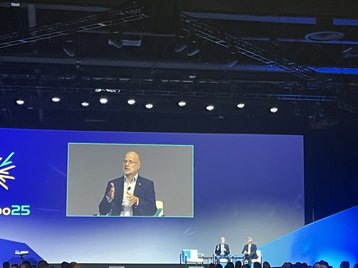
“So the Build America agenda has a couple of key pillars. One, we’ve got to restore US leadership in wireless. The last couple of years in particular, we flatlined a bit in terms of making new spectrum available. Thankfully, President Trump and Congress came together. They restored our auction authority, and we're full steam ahead on that.”
That said, Carr didn’t specify any timeline for when an auction can be expected to take place.
The nation’s fourth carrier
It’s undeniable that the US is served by the "Big Three" mobile carriers - AT&T, Verizon, and T-Mobile. But is there a fourth challenger?
Dave Watson, CEO of Comcast’s Connectivity and Platforms unit, thinks so, labelling cable as “the nation’s fourth carrier.”
His comments come shortly after EchoStar’s failed efforts to challenge as a fourth carrier. However, Watson sees it playing out differently for cable operators.
Watson says that broadband alone is an $80 billion opportunity for Comcast.
“The cable industry has become the nation’s fourth carrier," he said. "Between us, Charter, and others in the mobile business, the total addressable marketplace is two times the $80 billion, so we’re talking $160 billion in the wireless marketplace opportunity,” says Watson.
Comcast and Charter both notably signed an MVNO deal with T-Mobile earlier this year. As part of that, the two cable companies are expected to launch “wholesale mobile connectivity” services from next year.
Elsewhere at the Expo
Also at the SCTE TechExpo, the issue of network vandalism was highlighted, as Comcast and Charter in particular called for tougher measures against vandalism against telecommunications infrastructure.
Charter continues to battle the problem, referring to the attacks as “domestic terrorism,” while urging policymakers to hand down tougher sentences.
That said, Comcast’s executive vice president and chief network officer, Elad Nafshi, revealed that the firm has successfully used AI to better monitor its networks when attacked.
“We've invested a lot of money and a tremendous amount of technology innovation, including putting in place fiber monitoring with AI operations that monitor more than 800 kilometers (497 miles) of fiber across our footprint, and are capable of detecting fiber cuts within 120 seconds with pinpoint precision where the fiber cut occurred,” said Nafshi.

Because of this, he said, Comcast can automatically dispatch fiber restoration crews to the impacted location. Because of this, Nafshi said the company can reduce the outage times "by hours."
Beyond this, one of the other eye-catching announcements came from CableLabs CEO Phil McKinney, who was outlining the transition from DOCSIS 3.1 to DOCSIS 4.0.
While DOCSIS 4.0 is expected to raise the spectrum potential to 3GHz - it’s currently at around 1.8GHz, McKinney outlined DOCSIS 4.0 "optional annex”, which he says will utilize 6GHz and deliver potential speeds of up to 50Gbps.
McKinney didn’t elaborate on a timeline for when the industry can expect to see these sorts of speeds, given there’s no immediate use case or necessity for speeds this fast. In his view, at least, it’s about creating the most intelligent infrastructure possible.
“We're exploring territory where the networks become so capable, so intelligent, they basically just totally transform what it means as an infrastructure. But think about that progression,” he said.
“We're going from 1Gbps in DOCSIS 1, up to having 25Gbps in DOCSIS 4.0 with the ‘optional annex,’ to a future that looks towards 6GHz and 50Gbps.”
Incredibly, he wasn’t finished there. He explained that CableLabs has been working on fiber at its labs, in particular around coherent optics.
“We've demonstrated something that will take your breath away as far as where coherent optics could go. 50,000Gbps over a single strand of fiber, and it's the fiber you already have in the ground,” explained McKinney.
“We were talking about going all the way up to 50Gbps, and now with coherent optics, we take that to 50,000Gbps. The future capabilities of our networks is literally unlimited, multiple pathways, multiple options, multiple approaches that any operator around the world can take advantage of.”
Again, it’s not clear what use cases would require that sort of speed or how soon it will arrive. It's likely some way off, though, for now at least.




Comments