

In 1916, two retailers battled for supremacy in a niche market: golf balls.
Department store chain Wanamaker’s had seen its position as the leading seller of the small white balls usurped by A.G. Spalding & Bros, and incoming boss Lewis Rodman Wanamaker, son of the store’s founder, John Wanamaker, and heir to the retail empire, set about righting the course of history.
Wanamaker himself was an avid golfer and, by all accounts, really quite good. On January 17, 1916, he hosted a luncheon that brought together 60 amateur and professional golf players from around the US to discuss launching a match play championship for which Wanamaker would donate a cup and $2,580 ($76,720 today), and to launch the first national association of professionals.
Wanamaker’s motivation for this was simple: The man liked golf, and he wanted to sell more sports equipment. It was truly a ‘two birds with one golf ball’ situation.
And thus, the Professional Golfers’ Association of America was formed, and in 1929, so was the official “circuit” of the PGA Tour. Almost 100 years later, the tour has evolved into one of the world’s most high-profile - and lucrative - sporting events. Hundreds of players compete at tournaments on courses across the US and beyond each year, battling for prize pots that regularly run into tens of millions of dollars. The tour is watched by millions of fans worldwide.
Much has changed from a technological standpoint, too.
Golf and data centers do not sit in the same quadrant of the mind. And yet, as anyone in the digital infrastructure sector will know, there will always be a thread of connection somewhere. The thread in this case is actually more like a rope.

The Sport Supplement
Pitch-perfect digital infrastructure
In December 2025, DCD sat down with Eric Hanson, vice president of digital at PGA Tour, during the AWS Re:Invent 2025 event, and Hanson conceded that the two topics may not seem congruous at first.
“You wouldn’t think a golf tournament would require data centers,” he laughs, before pointing out the sheer multitude of data points there actually are in the tournament.
“If you consider how golf actually works, we have 18 holes and 144 - sometimes up to 156 - players, and every time a shot is hit, we have to determine where the ball lands. We have to understand which part of the course it is on. Is it in a bunker, fairway, or near a tree? There are more than 30 different data points on every single shot.
“The other thing is that when someone goes up or down on the leaderboard, it doesn’t just affect that single person, it affects the other 144 around them.”
The shot tracking system used by PGA today is powerful, impressive, and incredibly complicated.
A big/small problem
Golf has one very clear problem. A very small ball, moving very fast, in a very large environment. When the PGA Tour started, this would have been handled by spotters - people watching and doing the best to keep an eye on a white ball despite glare from the sun, or white cast from clouds.
Distances would be measured the traditional way through irrigation sprinklers labeled with yardage to the green. Needless to say, accuracy was sometimes lacking.
Today, the technology used knows exactly where a ball will land before any observer or player does.
Hanson begins, asking if DCD knows a lot about golf. After a firm shake ‘no’ of the head from this writer, he explains: “Someone starts at the tee box. They’re hitting the first shot into the fairway - the big part of the course - towards the green. Behind the player, before they take their shot, there is a military-grade radar, as well as one on the green, because these balls are going some 140 miles per hour. There’s also a camera system tracking the ball.
“We use both those systems to track the ball, and once it is hit, we know where it will land within one second. No one else knows - the players, the viewers - but the system does. When the ball lands, another series of cameras finds it, and we can get the distance - how far it was hit and its distance to the hole.”
This setup is replicated for each of the 18 holes that make up a standard golf course.
On the connectivity side, PGA sets up a WiFi network on each course, powered by “a ton of generators” because “there’s no plugs on a golf course.” Then, there is fiber optic cabling running between the equipment and the course.
“We have to run many loops of redundant fiber, because coyotes eat it, or if someone cuts the grass then the fiber could get cut too,” Hanson adds.
On the processing side, the system is using machine learning and computer vision to understand what is happening. Because of this, as more data comes in, the system is actually continuing to get better. “It starts to learn over time, and gets smarter,” he says.
Today, that machine learning and process is all done on Amazon Web Services (AWS).
Data centers of days gone by
While once upon a time, PGA Tour did in fact have physical data center locations, the organization has undertaken a cloud migration to AWS.
Some of this was typical enterprise data centers or presence in colocation facilities - all of which have now been exited, Elaine Chiasson, global golf team leader at AWS, tells DCD - but more unconventional were the data centers on wheels of a different era.
Hanson explains that, to handle the many data points generated by the shot tracking system, they used to bring data centers to the courses in trucks. Information “could be processed on the course, and then sent out to wherever it needed to go,” he says. “Frequently, that was back to our office for processing. We don’t have those servers anymore, we don’t have those trucks. Everything is on the cloud.”
Not only would the tour’s operations previously need the data centers onsite, but broadcasters were also stuck in the same bunker.
Hanson recalls that the broadcast organizations, too, would bring “18 wheelers with video libraries in them to every single event.” In the event of needing a piece of footage, they would go into the library and pull out the necessary tape.
While there is something quite comforting and nostalgic about this concept, impracticalities abound. Chiasson says that because servers “don’t move well,” transporting them on trucks is far from ideal. “The reliability of that, but also the sustainability side of things, has been solved by just moving to the cloud,” she adds.
Migrating any organization with a lengthy history of legacy IT to the cloud is a complex task. As decades go by, generations of digital infrastructure get layered upon one another, some systems get modernized, while others are left behind, and when it comes to actually shifting everything, there is a decent amount of consolidation that needs to be done.
The PGA Tour has an archive of more than a century of golfing footage and data, much of which was in very old-fashioned formats. Each tape, each piece of content, had to be “modernized and digitized,” and while in the past the amount of footage generated during each tournament would have been smaller, today there is not only the regular broadcaster clips, but also the footage generated by the 140-odd cameras around the course used for shot tracking.
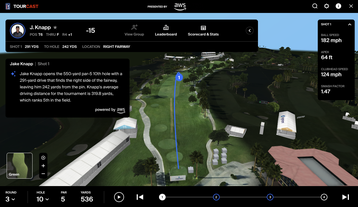
According to Chiasson, PGA currently has some 28 petabytes of data, but it is now growing “very, very quickly” due in no small part to the complexity of the aforementioned shot-tracking system. From a cost management perspective, they are using a tiered approach to storage - hot storage for things needed easily, and cold storage for those lesser-used assets, all stored on AWS S3.
Another area that is data-rich and not necessarily obvious to the casual golf observer is the work that goes in before the tournament even begins.
Around six weeks before the rubber sole of a golf shoe has even touched the green, PGA Tour sends “a fleet of drones” to the course to map the entire thing with LiDAR (light detection and ranging) and photographs, which are later layered on top. All of this, too, must be processed and stored on AWS, and according to Hanson, has to be done fresh for each tournament, even if the tour returns to a previous course.
Explaining why this is necessary, Hanson says: “In California, one of the courses is built on a cliffside, next to the ocean. Erosion is gradually changing the geography. So every year that hole is moving further and further in, and they have to remap it. Visually, it might look the same, but some of the dynamics change.”
Generative AI enters the game
As is usually the case these days, no organization can discuss its deployment of IT or presence in the cloud without generative AI coming up at some point.
PGA Tour is no stranger to this, having begun using the technology to support its editorial and content team. While DCD initially expressed some distaste about this, Hanson insists that they are in no way seeking to replace journalists and writers with the bots.
“With all the players in the field, we have no way of covering every single one,” he says. “Right now, the reporting staff can only focus on the top players, and we want them to focus on the features - the in-depth and interesting pieces that go into a player's life and give context, versus just recapping a round.
“For most players, we have zero content written for them. So we're looking at how do we take this automation and these agents and actually build this written content where it never existed before?
“We want to actually give the base level news information for these players that never had any information written about them, and allow our writers to go focus on the things that are more value-added on the site. It allows our writers to go spend time writing what actually matters, to go to the locker room and get the details.”
It is not just in the written content that PGA demonstrates its passion for the game. Currently, only around 30 percent of the footage and shots are actually televised from the PGA Tour, but the group is looking to change that.
“What we want to do is be able to offer any shot of any player,” Chiasson says. “At the moment, if your favorite player is not in the leader group, you probably don't get to see any of their game. So we're using new cameras that are AI-enabled with tilting and zooming capabilities."
PGA is using AWS Nova to enable automated camera switching between all the cameras on the course to “determine which has the best shot,” Chiasson adds. While this is still being tested, the hope is that, eventually, the entire tour will be fully accessible. When asked what particular hardware or instances PGA uses on AWS, both Hanson and Chiasson laugh, telling DCD “I don’t think there is anything we don’t use.”
Chiasson later elaborates that the tour is employing at least 70 AWS services at this point, and as a customer, has been particularly forthcoming about adopting new technologies.
“PGA Tour has been using AI services from AWS for over a decade,” she says. “This is nothing new. When generative AI really came on the scene a few years back, they jumped in because they're very forward and trailblazing in this area.
“They are a customer that actually pushes and drives our roadmap at AWS with feature requests. They meet our project teams a lot, and they use things in a lot of different ways.”
She adds: “I think a lot of people assume that PGA is a massive organization because of the brand, but actually their team is a lot smaller than you’d expect.
“Because of that, they really rely on AI and automation and AWS to be more efficient."



Comments