
It takes a certain boldness to take on the likes of Nvidia, Microsoft, and Amazon.
Cloud gaming has been around in some form since before the widespread concept of cloud computing even garnered attention. In 2005, Finnish company G-Cluster rolled out a ‘gaming-on-demand’ technology on its IPTV network.
More than 20 years later, G-Cluster is no more, but cloud gaming as a concept has gained greater traction. Boosteroid is a ‘player’ in this market, having emerged in 2016 and, despite its smaller brand presence than, say, Nvidia or Microsoft, is counting the biggest technology companies among its competitors, Boosteroid’s SVP of infrastructure, Antonina Batova, tells DCD.

DCD Magazine #61 - Life and death on a tower
The cell tower climbers risking it all to help us stay connected
Cloud gaming, at its core, enables players to run resource-intensive games that would usually require “the latest GPU on the market and a gaming rig” instead on a server in a data center, effectively streaming the game using infrastructure operated by a cloud gaming provider. This is where Boosteroid comes in, allowing players to stream through Windows, macOS, Android, iOS, and TV boxes.
“We deploy servers with the latest GPUs on the market. It’s not only GPUs, but they are a core value to the server because it does most of the processing and most of the rendering,” explains Batova. “We are deploying those GPU servers in data centers, and then the processing takes place on a server, rather than your computer or laptop.” Some of the most popular games played on Boosteroid’s platform include Fortnite, Arc Raiders, Call of Duty, and Overwatch.
In essence, this is something like how Netflix works, but more complicated. As Batova puts it, with Netflix, the ‘stream’ is one way, but with gaming, “we [Boosteroid] need to have your answer and your input too. If you make a move, shoot a gun, run somewhere - we need to receive this input back,” and thus the infrastructure requirements are very specific - and highly latency-sensitive.
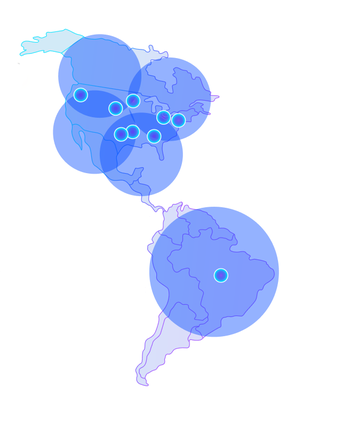
At present, Boosteroid has deployed in 29 data centers - largely in Europe and North America, but also with two locations in Brazil - and operates somewhere around 30MW of capacity.
The number of locations and capacity in them is also continually growing, with Boosteroid adding server capacity to France, Poland, and the Czech Republic in March 2026 to meet its “growing player base.” Currently, Batova tells DCD that the scale of these deployments varies significantly but is usually in the “hundreds of kilowatts.”
What is surprising is that player demand in the region is not necessarily the primary driver of a new data center location.
Choose your spawn point
“There’s a lot of nuance in it,” Batova says. “Obviously, we are looking at where the users are, and there is a demand, but it’s not the only metric - it's not even really a metric at all - because we first have to look at the data center market. What are the players [companies] out there? What do they offer? And how can we cooperate with them to offer low-latency gaming to our users?”

Ultimately, it seems that when it comes down to location, cloud gaming is not so special.
As with many data center deployments, power is king. Batova says that the company first has to weigh up how much power they will need and where they can find it, including whether the “economics would work,” before the thought of user location really comes into play. What is a little special is how the company goes about evaluating this.
“The standard approach in the market is that you take the nominal values from the data sheet that the vendor provides, and calculate how much power you need. What we do instead is, before anything else, when the hardware is ‘architecturally ready,’ we do artificial stress tests.
“We also complement this with tests where a human is in the loop - the lucky employee who gets to play a game instead of their usual day-to-day tasks (Is Boosteroid hiring? DCD wonders) - and that gives us a real-time value of what our demand would be.” From there, it comes to looking at where the user demand is and thus where the best location is that triangulates all those requirements.
This approach really proved its value, Batova says, during the Covid-19 pandemic. While all was chaos at this time, gaming was certainly getting a growing customer base as, frankly, people were stuck inside and paralyzed with boredom and fear. Boosteroid was looking for new data center locations, but simultaneously contending with the inflation related to the pandemic and skyrocketing power costs.
“When Covid hit, the supply and demand chain was impacted, and there was inflation. A lot of things changed, and most of the data centers nearly doubled power prices seemingly overnight, and this was exactly when we were looking to expand to new locations." Naturally, Boosteroid turned to the Nordics - the GOAT of cheap and stable power supply- and, as Batova noted, it didn’t have the same constraints as the Tier I markets like London, Amsterdam, and Frankfurt. Ultimately opting for Sweden, that data center location covered the entirety of the Nordic region.
Min/max builds
Latency is a key issue when it comes to cloud gaming, as player experience is highly dependent on it feeling seamless - pressing a button and the action happening in real-time.
For Boosteroid, the acceptable latency is up to 20 milliseconds, which Batova says “allows for quite decent gaming unless you are hardcore and require zero ‘microfreezes’.” However, ‘up to 20 milliseconds’ doesn’t really cover it, as the company is always aspiring to get as low latency as possible, but it depends on a number of factors - and not necessarily always distance-related.
The laws of physics are not up for negotiation. A signal can only travel through fiber as fast as the speed of light, and longer distances simply mean greater latency, but this is not the be-all and end-all. “You can be located as close to the server as possible - in the same city as the data center - but still have lots of latency issues. It’s dependent on the Internet connectivity provider, both on our end and the user's end.
“In some cases, say, there are 1,000 players with no issues during their streaming session, but there is one player with the same data, in the same city, and they are experiencing issues. What we are doing is trying to communicate with the users, get information from them, and then our network engineers go to the Internet provider and collaborate with them to try to improve the routes because, historically, Internet providers are using ‘traditional’ routes that aren’t really optimized for every user out there, and it can make a mess for us sometimes.
“The Internet providers aren’t aiming for the lowest latency for every customer - because normally, it's not necessary. It doesn’t have to be as low latency for Netflix, or Google Docs, for example.” Beyond the latency, another consideration when it comes to the data center specifications is density, though Batova notes that while this used to be a problem when racks above 10kW or 15kW were hard to come by, today it is far more common to find densities in the 30-40kW region due to the AI boom.

“There is a physical barrier to how many units or servers you can put in the rack. We operate GPU servers where most of the power draw comes from the GPU. But it's not always the best decision for us to take the most powerful rack in the building.
“We always have to consider these little trade-offs. We could take the easy path of taking as much as is indicated in the data sheet, but then we would pay for ‘ghost kilowatts’ of capacity that we would never actually use. We need to tailor every little bit of our infrastructure - how many units and how many kilowatts of power our servers need.”
For now, Batova says that air cooling is sufficient for Boosteroid’s deployments, but said that she isn’t sure if it will remain the same “even in the near future.”
While Batova told DCD that Boosteroid was not an AI company, since doing the interview, the company has announced that it will be launching AI cloud services as well in due course.
Epic specs
What is interesting about the gaming industry is that players are some of the few in ‘gen pop’ with an awareness of data center infrastructure and hardware. “I think in our case, infrastructure is part of the final product and it's quite living and breathing, because everything depends on the location and on the GPU grade,” Batova says. On the storage side, Boosteroid is currently storing around 15,000 TB of gaming data and configuration settings, but the more exciting side of things is definitely in the compute. Games are often designed with a specific GPU in mind, and new games require Boosteroid to continually look to upgrade its fleet - which it does with customized hardware. According to the company, it is the only cloud gaming provider offering customized desktop-grade GPUs.
“We are working with Asus and AMD. Our latest servers are based on AMD GPUs, but we used to run on Nvidia GPUs. One of the reasons we moved to AMD was that AMD has a customized desktop-grade GPU, so this is a GPU that would run in a home base like a PC computer, but we customized it for data center use. This allows us to give users 4k quality at 120 frames per second. This is not usually the case with data center-grade GPUs and enterprise GPUs, because they are built for a different purpose. The current configuration used by Boosteroid includes AMD Epyc Zen 4 processors on the CPU side, for example the 9374F with 32 cores/64 threads, up to 4.1GHz boost clock, and 384MB L3 cache, and the AMD Radeon RX 7900 XT (RDNA 3 architecture) with 20GB GDDR6 VRAM at 20Gbps for 800 GBps bandwidth, 80MB Infinity Cache, and 5,120 shaders with up to 2.5GHz game cloc.
The company is working on a new high-end tier that will be based on the AMD Ryzen 9 9900X CPUs (Zen 5, 12 cores and 24 threads with high single-thread performance) combined with AMD Radeon RX 9070 XT GPUs, which will also be paired with around 50GB of DDR5 memory capacity per instance to provide for “heavier titles” and more demanding users.
“Because there are new games coming out designed for that GPU, we need to start integrating it. We need to continue upgrading all the time. We still use our old GPU servers for some indie games or games that don’t need that much processing power. But to run the latest releases, we have to keep up with the game developers,” she says.
Upcoming patch notes
The future for Boosteroid is thus to be expected - newer hardware, and more of it. But this in itself is in a challenging place. Experienced across the data center industry is the issue of memory shortages, not to mention power capacity and data center demand simply outpacing supply.
“The prices for RAM are skyrocketing, and it takes longer to get equipment now. It’s taking longer than usual to plan deployments, from hardware lead times to procuring power from the data centers,” says Batova. Regardless of the obstacles, Boosteroid will continue to see new opportunities, whether it’s seeking opportunities to upgrade storage servers or improve the network health. For Batova, the industry is always in a state of flux, and that won’t change any time soon. She tells DCD: “We are always in this state of development and testing new solutions, and planning for where the capacity can go.”




Comments