
China has a lot of electric buses. In 2023, the nation’s public transport network was home to more than 470,000 electric vehicles ferrying passengers to and from their destinations.
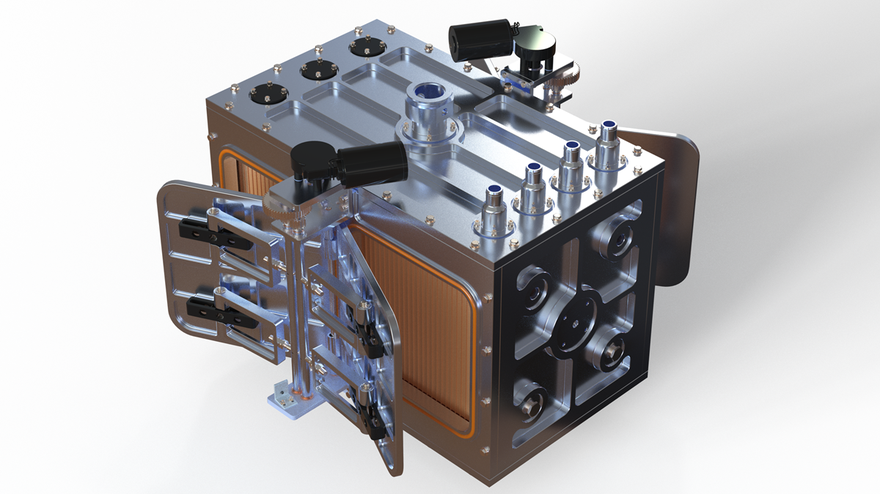
These buses provided an unlikely inspiration for AirJoule, a firm seeking to cut data center emissions with a system that can capture water from waste heat generated at air-cooled data centers so that it can be reused.

The Cooling Supplement
Chilling innovations
“One of my previous companies worked with [Chinese battery manufacturer] CATL to marry our motor technology with their batteries,” says AirJoule CEO Matt Jore. “We developed an advanced power train which is operating in buses all over China.
“As part of that process we discovered that in congested cities, where 90 percent of the journey is spent in traffic stopping and starting, air conditioning is blasting away, so it’s not unheard of to have seven or eight times more energy drain from the battery for air conditioning than in normal driving conditions.
“So we started looking at ways to improve the efficiency of that air conditioning, and that’s what got me involved in what we’re doing now with AirJoule.”
AirJoule’s system will not be taking a ride on the bus anytime soon, but the company intends for it to become a common sight in heat-generating industrial settings such as data centers, where it says it could help cut energy usage.
Organic growth
AirJoule’s machine is based on metal-organic frameworks, or MOFs, a type of porous polymer with strong binding properties and a large surface area. This, in theory, makes MOFs ideal for binding onto specific particles, such as water.
MOFs have been around for years, Jore says, but applying them in commercial settings has been difficult for two reasons; activating the useful properties of the polymer generates heat, and the material has been expensive to produce and purchase.
AirJoule solved the price issue by working with chemical company BASF to develop a cheaper MOF. By scaling the production process, Jore claims the company has managed to reduce the cost of the material from around $5,000 per kg to “something nearer $50.” When it comes to the first problem, AirJoule’s system reuses the heat generated by the MOF to turn water vapour back into liquid, creating what the company says is a “thermally neutral” process.
Explaining how the system works, Jore says warm air enters the AirJoule machine and is processed in two stages. “We divide the water uptake and the water release into two chambers that are performing their functions simultaneously,” he says. “The heat generated in the absorption process is passed over to the second chamber, and it’s pulled under a vacuum. We suck the air out, and now all that remains is this coated material full of water vapor molecules.”
The system then initiates its vacuum swing compressor that “creates a pull on the water vapor molecules,” Jore says. “Trillions of these molecules pass through this vacuum swing compressor, and we slightly pressurize them so that they increase their temperature and condense.”
How much water comes out at the end of the process depends on how many AirJoule systems you buy. The company says one module will be able to harvest 1,000 liters of distilled water a day, either to be reused by the data center’s cooling system or supplied to the local community. “You can scale it in modular pieces,” Jore says.
Despite the claims of thermal neutrality, AirJoule does still produce a small amount of waste heat. In March, the company revealed that tests had shown that AirJoule demonstrated the ability to produce pure distilled water from air with an energy requirement of less than 160 watt-hours per liter (Wh/L) of water.
This apparently makes it more efficient than other methods of extracting water from air. “Compared to existing technologies, AirJoule is up to four times more efficient at separating water from air than refrigerant-based systems (400-700 Wh/L) and up to eight times more efficient than desiccant-based systems (more than 1,300 Wh/L),” the company said in March.
Building a partnership
The AirJoule machine is based on principles developed by Dr. Pete McGrail at the Pacific Northwest National Laboratory, a US scientific research institution in Richmond, Washington.
After meeting Dr. McGrail during the Covid-19 lockdowns and finding out more about his work, Jore and his colleagues decided to try and turn it into a product. They teamed up with power technology firm GE Vernova, which was already working on its own air-to-water project with the US Department of Defense.
Recalling the early days of the collaboration, Jore says: “The two teams met in Montana in my garage. We had four PhDs from GE Vernova come out and spend the week with us and try to put our technologies together, and by the end of the week, we were clinking beers together because we knew we had something promising.”
To take the technology to market, a joint venture was formed in March 2024 between Jore’s firm, Montana Technologies, and GE Vernova. The partners each own 50 percent of the JV, though in a slightly confusing move, Montana Technologies has since changed its name to AirJoule Technologies Corporation, a decision it took to reflect its role in the JV.
The JV raised $50 million when it went public via a special purchase acquisition company, or SPAC, last year, and in April announced it had raised an additional $15 million from investors, including GE Vernova. So far, it does not appear to be offering great value for its stockholders, with its share price having dropped significantly this year.

DCD>Studio: Revolutionizing water generation with Matt Grandbois, AirJoule
DCD's Matt Gooding speaks with Matt Grandbois of AirJoule, discussing their innovative technology that uses metal organic frameworks to absorb and release water efficiently.
Jore and his team will be hoping to change that when it gets its machines into data centers and other facilities that produce a lot of heat.
“With every business I’ve worked on, you build a prototype, with cost and reliability defined, and get people to come and see it,” he says. “We’re going to have a working unit this year that we can show to our customers and partners, and from there we’ll be able to demonstrate the replicability of that unit.”
Since this feature was first published, AirJoule has announced a partnership with an unnamed hyperscale data center developer, which is set to evaluate its technology.
Jore believes the AirJoule offer will be compelling for the market, despite the plethora of water harvesting technologies that already exist.
“The companies that have been out there for the last 20 years using desiccants to absorb are not transferring the heat of absorption like we are,” he says. “We have a unique proposition in that respect.
“But the challenges the world faces around water supply, in the global south and here in the US, in places like Arizona and California, are not going to be solved by any one company, and they’re likely to get worse over the next five years. There are some great people working in this space, and I see a lot of synergies between us. It’s going to take a common heart and a common mission to tackle this problem.”
He adds: “The conversation in the data center industry at the moment is all about power, and we can reduce the amount of power needed by accessing the world’s largest aquifer - the atmosphere. AirJoule is the first technology that makes tapping into that aquifer a truly ethical prospect.”



Comments