
The sound of drilling echoes in the New Mexico sunshine. You'd be mistaken for thinking this is just another instance of fossil fuel exploration; however, the large hole being bored into the ground serves a different purpose: to generate energy through heat resonating from the Earth itself.
Often, we forget that the deeper you go into the earth, the hotter it tends to get. Humans' utilization of this heat, better known as geothermal energy, dates back to ancient times, with evidence of its use in bathing, cooking, and washing, most commonly via underground hot springs.
Only since the early 20th century has humankind been able to harness the Earth's heat to generate electricity, with the first geothermal power plant built in Larderello, Italy, in 1911.
Today, we stand on the threshold of a new geothermal revolution, with innovative techniques, known as Enhanced Geothermal Systems (EGS), offering a new and innovative way of harnessing geothermal at much higher capacity factors and across a significantly larger footprint.
Its potential has not gone unnoticed among the hyperscalers, with Google, Microsoft, and Meta all signing agreements with geothermal developers in the last two years alone. But can geothermal energy become a key source of power for the data center sector, both in the US and further afield?

Heating up
Geothermal isn’t a particularly new technology. Shallow conventional techniques, utilizing heat pumps and borehole heat exchangers, have been in common use since the 1970s.
Conventional wells are typically up to 400 meters (1,300 ft) deep and are used mainly to heat and cool buildings. While we have seen a growth in deeper geothermal electricity generation projects, which reach depths exceeding 1 kilometer (0.62 miles), these wells are very location-specific, found in regions with high-temperature underground resources, such as the US, Indonesia, and Kenya. As a result, geothermal energy currently accounts for less than 1 percent of the global energy mix.
EGS, unlike conventional methods, has the potential to boost that figure significantly by tapping into “hot dry rock,” which is more abundant than natural hydrothermal reservoirs and offers substantially higher generation potential.
EGS was first explored as a concept in the 1970s at the Los Alamos National Laboratory in New Mexico. Inspired by offshore oil drilling techniques, the scientists tested the possibility of forming artificial geothermal reservoirs by fracturing deep, hot, impermeable rock. The project proved a success, producing 10MW of energy by 1985. But cost and complexity issues saw it canned.
Interest in EGS was revived in the 2000s, with considerable advances in hydraulic fracturing and other drilling techniques leading to a resurgence of investment. A 2006 MIT report stated that: “Geothermal energy from EGS represents a large, indigenous resource that can provide base-load electric power and heat at a level that can have a major impact on the United States.”
Today, the International Energy Agency (IEA) estimates that in the US, at least 7TW of capacity is accessible at depths less than 5km (3.1 miles), and more than 70TW is accessible across all depths. Most of the potential capacity is located in the Western US, specifically in California, Nevada, Utah, Oregon, and New Mexico.
In comparison, the “technical potential estimates for hydrothermal energy are about 25GW,” says Ben King, director at Rhodium Group's energy and climate practice. “With EGS, you’re on the order of terawatts available across much wider areas of the country.”
This vast potential has led think tanks such as the Rhodium Group to project that if scaled effectively, EGS systems could ultimately supply nearly two-thirds of new data center demand by 2030.
Energy in Abundance
Meta has been a particularly enthusiastic backer of EGS.
Facebook’s parent company signed deals with EGS firms Sage Geosystems and XGS over the past 18 months. The two projects differ significantly in terms of location and technology, providing a glimpse into how such systems actually work.
In August of last year, Sage Geosystems became the first EGS company to partner with Meta for 150MW of power from its project located “east of the Rockies.” Founded in Houston by a former oil and gas executive, Cindy Taff, the company leans heavily on techniques developed in that industry.
At the heart of Sage’s offering is what it has dubbed a “pressure geothermal system,” which combines heat and mechanical energy stored deep underground.
“We call it pressure geothermal because we’re using not just the temperature underground – we’re using the pressure element as well. There’s thermal energy, and there’s mechanical energy. When you combine them, you can increase the net output of your system,” explains Jason Peart, general manager of strategy and development at Sage Geosystems.
Sage drills paired wells, reaching depths of up to 20,000 feet into hot rock at temperatures of 180°C (356°F) or higher. In each well, it creates an artificial “lung-like” reservoir that is filled with water. The rock’s natural elasticity allows it to flex and contract, storing pressure in addition to heat. One well produces hot, pressurized water to a surface power plant while the other recharges and reheats, with the two switching roles daily.
The system is modular by design, which creates incredible potential for scaling, says Peart. “Each well pair has a net output – 3MW in some places, 8MW in others – and you just keep adding additional well pairs for greater capacities. If you want 100MW, 500MW, even a gigawatt, you put more pairs on a pad.”
The ability to scale doesn't only boost output, Peart argues, but also makes it more economical.
“One well pair isn’t particularly cost-efficient,” says Peart. “It carries all the costs of mobilizing equipment and building the facility. But when you start putting eight, ten, 12 wells on a pad, you get drilling efficiencies, operational efficiencies, and economies of scale that change the cost dynamics.”
In order to change the cost dynamics, Sage needs to demonstrate that its technology actually works. It currently has several projects in its pipeline, mostly located in Texas. The Meta project has no fixed location and is expected to be developed via a phased approach, with phase one of 4-8MW completed in 2027 and phase two of 150MW completed in 2029.
Closed Loop
In its second deal, signed in June, Meta partnered with XGS on its planned project in New Mexico, a state the vendor’s CEO Josh Prueher calls one of the “world's best geothermal resources.”
While the region offers an abundance of hot rock, its arid conditions make water use a challenge. To address this, XGS has transitioned away from traditional water-based geothermal energy and is instead pioneering a fully closed-loop geothermal system.
XGS starts by drilling a single well into rock hotter than 200°C (392°F) and lowering a steel casing to the bottom. It then injects a ‘thermal reach enhancement’ material to draw heat from the surrounding rock. Inside the casing, an insulated tube completes a tube-within-a-tube system, carrying the captured heat to the surface.
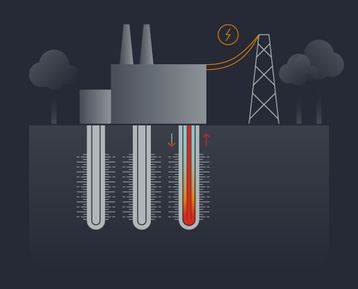
The design ensures that water never comes into contact with rock, thereby eliminating water loss and contamination. Additionally, according to Prueher, the system is pressurized, sterile, and chemistry-controlled, ensuring predictable and stable thermal flows over decades. This lowers operational risk and costs, Prueher says, as unpredictability can often lead to a 40-50 percent drop in the effective capacity of geothermal plants.
“Banks and independent engineers want to see steady, predictable flow rates over 20 or 30 years,” he says. “Conventional systems just haven’t been able to give them that because nature is variable. That’s why geothermal has been stuck at about 4GW in the US for decades.”
In providing this, XGS views itself as competing on the same terms as other baseload power sources, rather than renewables. “Our value proposition is: we’re clean like renewables, but we’re firm like natural gas – and we can site close to load. That’s why data center operators are taking this seriously,” Prueher contends.
The project is expected to launch by 2030 and supply 150MW into the local grid, which will in turn supply data centers in the region. The company intends to develop several projects in the region, ranging from 5MW to more than 500MW.
Like Sage, the company is looking to lean heavily on the oil and gas sector to utilize the drilling technology required to access the hot rock deposits. “We’re not waiting on some moonshot,” says Prueher, “That’s why we’re confident we can go from first-of-kind to gigawatt-scale projects in just a few years.”
Strategic bets
So what has made Meta so confident in the technology that they have signed not one but two deals within the sector? For John DeAngelis, the company’s head of clean technology innovation, the agreements are “strategic bets.”
“Those bets are designed to help technologies and companies scale, to prove their technical feasibility at scale, and to drive down costs in an accelerated way,” he contends.
As of yet, only Fervo Energy, which became the first EGS firm to sign a deal with a data center company back in 2022 when it inked an agreement with Google, has successfully initiated a demonstration project. In 2023, the company reported positive results from a 30-day well test conducted at Project Red, its full-scale EGS pilot project in northern Nevada.
Therefore, according to DeAngelis, the next few years will prove crucial in determining the future of EGS, demonstrating whether it can perform effectively and at scale. “Success for us would be seeing hundreds of megawatts – if not gigawatts – of geothermal deployed by 2030,” says DeAngelis.
Supporting the sector in commanding the cost curve will be a crucial factor, as driving economies of scale will enable the technologies to develop more effectively and compete with other sources of energy available on the market.
The support provided by the data center sector could prove an effective tool to drive these scales, says Annick Adjei, senior research analyst for subsurface at Wood Mackenzie. "The support from companies like Meta, Google, and Microsoft goes far beyond traditional power purchase agreements,” she says. “These are real partnerships helping geothermal startups commercialize their technologies and bring projects to life."
By becoming “foundational” backers, the companies can drive greater investor confidence in the sector, argues Adjei. And it's showing, Wood Mackenzie has tracked more than $2 billion in capital raised by next-generation geothermal companies since 2019, with the majority coming from private investors.
However, even with all the money in the world, the technology itself needs to prove that it can provide reliable power. Therefore, for Adjei, “to truly understand the full potential of enhanced geothermal systems as a viable technology, we need far more demonstration projects beyond [Fervo’s] Cape Station in Utah.”
In front of or behind the grid
If EGS is successful in becoming a cost-effective and scalable power source, the question then becomes how it will serve the data center market. Currently, hyperscalers are focusing on integrating the new geothermal capacity into the grid rather than supplying power to data centers behind the meter.
“Deploying energy resources on the grid can be not only the fastest but also the most reliable option,” says DeAngelis.
While Meta and Google have yet to commit to off-site power, siting data centers close to or adjacent to geothermal wells is a clear possibility. “We believe the next big opportunity is true co-location – data centers built adjacent to geothermal wells. It eliminates transmission risk and makes permitting cleaner and potentially faster,” Adjei notes.
Due to geothermal's baseload profile, it can be deployed in an “island grid” setup, bypassing interconnection delays and avoiding public backlash over huge energy consumption.
Geothermal developers emphasize the added benefits and potential as an off-grid solution for data centers. “For a hyperscale data center, we can give you firm, clean, 24/7 power right behind the meter, plus you get cooling load support and clean water production as part of the same footprint,” says Prueher. “That’s not just a power solution – it’s an infrastructure package.”
As a result, Peart predicts that in the future, data centers may construct their facilities near geothermal plants for direct supply, following a model similar to natural gas. However, such an approach relies on EGS scaling to gigawatt levels and demonstrating its reliability.
Interest in geothermal as a behind-the-meter option is not limited to the US, as Simon Westerlund, investment manager at Baseload Capital, notes. “We are already seeing data center players looking to be located close to geothermal power plants in places like Indonesia and the Philippines,” he says.
Subsequently, we could end up seeing geothermal energy act in a similar way to natural gas in the US, in both supplying firm grid power and providing an expedited route to market for data center operators who are willing and able to build their facilities adjacent to a geothermal well.
Barriers and limitations
Despite the fervor and heavy investment into EGS and its apparent applicability to the data center sector, concerns remain, one of the most notable being the sheer cost of drilling. Studies from Stanford and the US National Renewable Energy Laboratory indicate that drilling alone can account for between 30 and 57 percent of a project’s upfront capital costs, depending on the system's design.
For operators of data centers, which demand both baseload reliability and tightly managed electricity prices, such figures represent a major barrier. Even as new techniques promise to reduce these costs, the challenge remains. “If wells can be drilled as quickly and cost-effectively as oil and gas wells, that will speed deployment and reduce costs,” says Rhodium Group’s King.
Cost concerns remain only a part of the story, with the act of drilling itself coming with significant risks. Geothermal wells, especially deep ones, are vulnerable to technical setbacks, including circulation losses, equipment failures, and mineral scaling, which can compromise flow.
A report from the Clean Air Task Force notes that such problems can delay projects, inflate budgets, or even force developers to abandon wells entirely. Additionally, the need for specialized drilling equipment to access the hot, dry rock poses a risk that the supply chain could become constrained, potentially leading to further delays.
The regulatory landscape compounds the difficulty. “The main regulatory hurdle is the permitting process to drill wells, which is handled mostly at the state level, with some EPA involvement for water permits,” King argues. Lengthy approval processes can add years to timelines, a prospect that is unpalatable for hyperscale data center operators, whose expansion plans often run on tight schedules.
The tide may be turning on this, however, with policymakers across the aisle in the US voicing support for the sector, exemplified by US Energy Secretary Chris Wright’s ardent backing of the technology. This is something that hasn’t gone unnoticed by Meta, with DeAngelis noting “we’ve seen a groundswell of support for geothermal.”
Finally, there is the question of cost competitiveness. A study from Environmental Research showed that even halving geothermal costs by 2050 would leave the technology struggling to match the cost-effectiveness of solar and storage. Only if costs fall by more than 70 percent would geothermal emerge as the most affordable carbon-free option.
Is conventional still a possibility
While the US leads the way in data center-linked geothermal deals, there have been several other instances further afield. Unlike in the US market, the agreements have focused on conventional geothermal power rather than EGS.
This is best exhibited by Google, which earlier this year signed a 10MW Power Purchase Agreement with Baseload Capital in Taiwan. Unlike US deals that center on experimental EGS, the Google arrangement will rely on conventional, shallow wells.
Simon Westerlund explains the reasoning: “We are mainly taking geological risk, not technology risk,” he says. “So we’re sticking with conventional technologies for our first batch of projects.”
According to Westerlund, the decision reflected the realities of the Taiwanese energy market. Though the island has significant geothermal potential – between 30 to 60GW according to some estimates – it lacks a mature oil and gas industry to supply rigs and expertise at the rate required for EGS.
As Westerlund puts it, “The US is faster to move than Taiwan because the oil and gas ecosystem already exists. Rigs are available, and it’s easier to mobilize resources.”
As a result, Baseload saw conventional systems as its best bet, and views the Google deal, which included a direct investment in the company, as a means to expedite the development process of its projects in Taiwan. Consequently, Baseload expects to reach commercial operations at its first sites in the country in 2029.
In addition to the PPA, the deal is expected to foster the growth of Baseload's geothermal footprint across the Pacific, with Westerlund arguing that it's not just the US that is in a position to take advantage of geothermal energy. “Japan, Indonesia, and the Philippines are pushing geothermal again—they are restarting their industries with government support,” he says.
These projects are very likely to be conventional-based, as they face similar challenges to Taiwan in accessing drilling equipment and expertise to deploy EGS systems at this time.
However, if successful, they could not only support the growth of conventional geothermal systems but also provide a springboard for the deployment of EGS. This is reflected in Baseload's technologically agnostic approach to geothermal, which means they will be open to exploring EGS if its level of technological risk is reduced, potentially expanding its reach across the Pacific and beyond.
Consequently, conventional geothermal clearly has a role to play, particularly in regions with accessible shallow resources and established drilling capacity. Yet its reach is limited. For the data center sector to truly harness geothermal at scale, the industry will likely need to move beyond these pockets of opportunity and embrace the wider potential offered by EGS, in the hope that its “strategic bet” will pay out.





Comments