Generative AI inferencing ramp-up
A CIO's guide to physical infrastructure considerations
A CIO's guide to physical infrastructure considerations
Exploring how high density workloads and AI are shifting enterprise priorities in the data center industry

Unifying data center design, build, and operations into a single, AI-driven lifecycle model for faster, lower-risk decision-making

A strategic framework for decision-making

Why grid constraints are reshaping data center expansion, and how on site prime power addresses the challenge

Why annual averages misrepresent real carbon impact, and how hourly data fixes it
Workloads are skyrocketing, and cooling must keep up

Practical strategies to cut data center energy, water, and carbon use through optimized direct liquid cooling
From large training clusters to small edge inference servers, AI is becoming a larger percentage of data center workloads

Improving efficiency, reliability and resiliency

AI-tolerant 3-Phase UPSs help ensure reliable, uninterrupted high-density operations.
The IT industry is developing large generative AI models at a fast pace. These models can require megawatts of power at hundreds of kW/rack in data centers.
Achieve resilience, reduce costs, and improve efficiency with equipment-agnostic Condition-Based Maintenance
Direct liquid cooling (DLC) has become the IT industry’s preferred cooling method for extreme chip power densities
Scaling AI Infrastructure with Speed, Efficiency, and Sustainability
Decoupling digitalization trends from data center energy growth
The Critical Role of Liquid Cooling
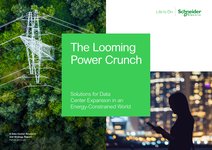
Solutions for data center expansion in an energy-constrained world
Recycling of Li-ion batteries is important from an environmental and economic perspective.
Exploring attitudes and trends in 2024
Explore reference designs providing data center operators the guidance to streamline and accelerate deployment of high-density AI clusters
Finding business cases and opportunities at the Edge
We define what BESS is, describe trends driving adoption, and explain its components, functions, use cases, and architecture considerations.
Adding energy storage to improve cost, resiliency, and sustainability.
Prefabricated modular data centers offer many advantages over traditionally built data centers
A quantitative TCO analysis of the two architectures
A follow-up guide to our Guide to Environmental Sustainability Metrics for Data Centers
A survey report based on research conducted by DCD looking at trends within sustainability