
Bloom energy, a global leader in power solutions, released a critical mid-year update to the comprehensive 2025 Data Center Power Report launched earlier this year, which revealed that data centers are adopting onsite power as a primary energy source. Data centers are likely to continue to struggle with the timely availability of electricity, according to the new report, which carries major implications for the future of the AI industry.
Today’s mid-year update shows that securing electricity for data centers is likely to take much longer than anticipated, and that power availability is now the leading factor in site selection. The report offers a timely lens into what matters most to the leaders shaping the future of the AI industry in America, including:
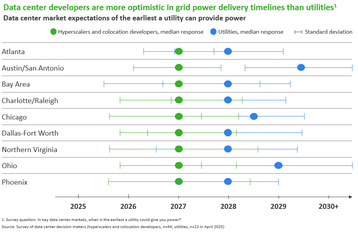
- Data center developers are underestimating time to power: Utility providers report significantly longer timelines to deliver power in key US markets, up to 2 years longer than what hyperscalers and colocation providers expect.
- Power access is a leading factor in data center site selection: 84 percent of respondents ranked availability of power among their top three considerations.
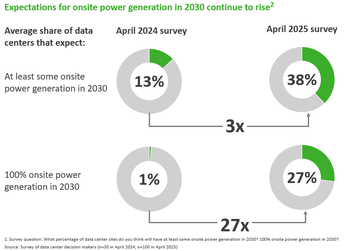
- On-site power is increasingly critical: In 2030, 38 percent of facilities are expected to use some onsite generation for primary power, up from 13 percent a year ago. Notably, 27 percent of facilities expect to be fully powered by on-site generation by 2030, a 27x increase from just 1 percent last year.
- AI is driving larger, more power-intensive data centers: The median data center size is expected to grow by nearly 115 percent, from approximately 175MW today to about 375MW over the next 10 years.
- Reducing carbon emissions is a lower but lasting priority: 95 percent of those surveyed affirmed that sustainability and carbon reduction targets are still in place, even if the path to achieving those goals may not be linear.


"Decisions around where data centers get built have shifted dramatically over the last six months, with access to power now playing the most significant role in location scouting," said Aman Joshi, Bloom Energy's chief commercial officer.
"The grid can't keep pace with AI demands, so the industry is taking control with on-site power generation. When you control your power, you control your timeline, and immediate access to energy is what separates viable projects from stalled ones.”
According to the survey, operators are looking beyond legacy power generation to solutions that offer fast deployment timelines, low emissions, and the ability to handle intense and fluctuating AI workloads, all while meeting the industry’s uncompromising reliability standards and cost requirements.
The latest report is based on data collected from April 2024 to April 2025, which surveyed approximately 100 decision-makers across the entire data center power ecosystem, reflecting perspectives from hyperscalers, colocation developers, utilities, and GPU service providers. A copy of the mid-year Bloom Energy Data Center Power report is available here.
For more information, visit www.BloomEnergy.com
More from Bloom Energy
-

Sponsored Five fuel cell myths that don’t hold up in today’s data center market
Fuel cells are being used today, and will be used tomorrow, as primary power for data centers that can’t wait for the grid
-
Bloom extends fuel cell supply agreement with Equinix
Signs carbon capture partnership with Chart Industries
-
Bloom Energy secures 1GW fuel cell supply deal with AEP
AEP has placed an initial order for 100MW of cells, with an expansion order expected in 2025
Comments