

The hyperscale data center industry has become exceptionally good at building at speed. Campus-scale facilities are now delivered at volumes and velocities that would have been unimaginable a decade ago. Standardized designs, modular construction strategies, and globally replicable delivery models have transformed how capacity is deployed. Multi-region rollouts are no longer rare; they are embedded in the operating model of the sector.
Industry forecasts indicate hyperscale capacity could double within the next four years, driven by sustained cloud growth and accelerating AI demand. Power densities are rising. Capital continues to flow. Construction capability has industrialized.
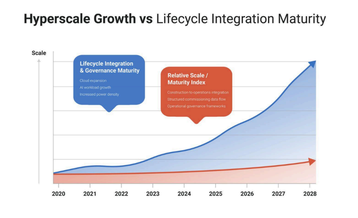
Yet while the physical delivery model has evolved rapidly, another layer has not matured at the same pace: the transition from construction and commissioning into long-term operations.
This transition has traditionally been treated as a phased handover – a shift in responsibility from project delivery teams to operational teams once systems are energized and validated. At smaller scales, that model has been sufficient. In today’s hyperscale environment, it is increasingly strained.
Construction teams optimize for milestone delivery. Commissioning teams focus on energization and performance validation. Operations teams prioritise uptime, resilience, and lifecycle stability. Each discipline performs effectively within its domain. The challenge is not competence; it is continuity.
Asset data captured during installation does not always integrate seamlessly into commissioning systems. Commissioning validation records do not consistently translate into structured operational governance platforms. Isolation documentation, test results, and asset traceability often remain distributed across multiple systems or static documentation packages.
What once felt like manageable administrative gaps becomes structural when multiplied across campus-scale infrastructure.
Hyperscale has fundamentally changed the risk profile of delivery. Modern facilities are more integrated and interdependent than ever before. AI workloads are increasing load volatility. Electrical and mechanical systems are tightly coupled with digital monitoring and control layers.
Commissioning itself has evolved into a multi-phase, data-intensive discipline extending from early design review through integrated systems testing and operational readiness validation. Industry guidance increasingly positions commissioning as a lifecycle safeguard rather than a final checkpoint.
However, despite this evolution in technical complexity, the transition model in many environments still resembles a linear sequence: build, commission, hand over.
The infrastructure has evolved. The lifecycle integration model often has not.
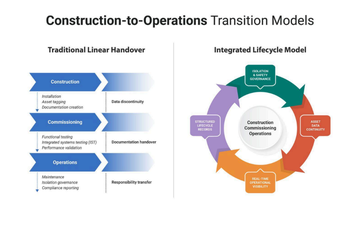
In mission-critical environments, continuity of information is as important as continuity of power. Gaps between design intent, build execution, commissioning validation, and operational governance introduce latent risk. These risks rarely manifest as immediate failure. Instead, they reduce transparency.
Reduced transparency slows fault diagnostics. It complicates isolation governance and compliance reporting. It creates friction during live interventions and long-term maintenance planning. Small discontinuities – incomplete asset traceability, fragmented documentation, inconsistent data transfer – accumulate over time. Under operational stress, those gaps magnify.
Acceleration has also compressed institutional memory. Hyperscale programmes now run concurrently across multiple geographies. Commissioning specialists move rapidly between projects. New talent enters the sector to meet growing demand. This expansion is necessary and positive, but it reduces reliance on long-standing programme familiarity.
Where lifecycle systems are not fully integrated, organizations compensate through informal coordination. Knowledge resides in individuals rather than in structured frameworks. That model works – until scale outpaces memory.
As construction complexity increases, so too must lifecycle governance. Hyperscale projects now require coordination of thousands of concurrent activities across electrical, mechanical, digital, and commissioning disciplines. If construction has required industrialization to keep pace with demand, lifecycle integration requires the same structural evolution.
The organizations that treat construction, commissioning, and operations as a single, integrated control architecture – rather than sequential phases – will be better positioned to scale without increasing systemic exposure. Structured data continuity, digital traceability, and operational readiness embedded from early design stages are moving from best practice to baseline expectation.
Hyperscale growth will continue. AI-driven demand, sovereign infrastructure strategies, and global digital transformation ensure sustained expansion. The industry has demonstrated extraordinary capability in compressing schedules, replicating design standards, and scaling global supply chains.
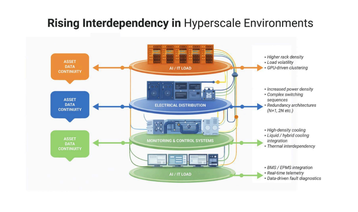


The next test is more subtle. It is whether operational integration can mature at the same rate as physical infrastructure.
The coming decade will not be defined solely by megawatts delivered or speed to energization. It will be defined by how coherently organisations transition assets from installation through commissioning into structured, real-time operational governance.
In mission-critical infrastructure, redundancy protects hardware. Lifecycle continuity protects performance. When speed outpaces structure, risk becomes cumulative.
The next phase of hyperscale leadership will belong to those who close the transition gap.
Comments