

The Middle East is building fast: hyperscale campuses are going up across the UAE, Saudi Arabia, and beyond, driven by sovereign ambition, AI investment, and a genuine recognition that digital infrastructure is the new oil. Governments are competing for cloud regions, capacity is expanding at a pace, and the region looks like a digital success story in the making.
High-performance, AI-ready data centers are the lifeblood of the modern Middle Eastern economy. What if what sits underneath the shiny veneer of success told a radically different story?
The infrastructure being built is concentrated, climate-exposed, and increasingly in the crosshairs of a turbulent geopolitical environment that has deteriorated significantly in recent years.
Why is the question of resilience being treated as a secondary problem? How this infrastructure holds up when stress is applied, whether by a cyberattack, a physical strike, an extreme weather event, or some combination of all three, should be the first thing we tackle at every turn.
The threat environment
Iran has made repeated, explicit threats against data centers operated by American tech companies across the region. Microsoft, Google, Oracle and others have significant cloud infrastructure in the Gulf, and those assets are understood targets. In March 2026, Iranian drones and missiles struck three Amazon Web Services data centers in the UAE and Bahrain, forcing them offline and triggering outages across banking, payments, delivery apps, and enterprise software throughout the region. The IRGC has released lists of dozens of tech targets, and the current ceasefire is fragile. How long before disaster strikes again?
The climate dimension compounds the problem. The Middle East is already one of the world’s hottest inhabited regions, and temperatures are rising at roughly twice the global average rate. Data centers require enormous cooling energy, and the energy and water demands of large compute clusters are increasingly hard to meet reliably.
A heat event that stresses regional power grids simultaneously stresses the data centers that depend on them. Even partial degradation, whether a localized outage, a successful cyberattack on a single major facility, or an extended period of extreme heat, cascades across the interconnected digital systems that now underpin banking, logistics, healthcare, and government services. The irony of an economy built entirely on interconnected digital infrastructure is that there is no analogue fallback: when the infrastructure goes down, everything built on top of it goes down with it.
The structural problem
The current architecture of Middle Eastern digital infrastructure shares its main vulnerability with most first-generation buildouts of critical systems: it concentrates risk rather than distributing it. A small number of very large facilities, often in close geographic proximity, serve as the effective backbone of regional digital services. That model is legible, fundable, and easy to photograph for press releases, but it is incredibly brittle when conditions become adversarial.
Spreading compute across geographically diverse, independently powered, independently cooled nodes makes it harder to take down the whole system through a single point of failure. That distributed systems are more resilient than centralized ones is foundational to how the Internet was originally designed. The challenge requires different capital allocation, different site selection logic, and a willingness to optimize for survivability rather than pure unit economics.
What a resilient architecture looks like
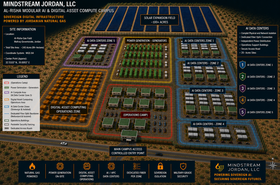
More durable digital infrastructure does not require abandoning large-scale facilities, but complementing them with a different kind of deployment. Smaller, modular compute nodes closer to where data is generated and consumed address several vulnerabilities at once: they eliminate single points of failure; they are faster to power independently, easier to cool, and less dependent on regional grid infrastructure; Edge IT also enables the lower-latency services Gulf economies are developing.
Distributed hardware alone is not enough. The orchestration layer matters as much as the physical layout. Kubernetes, the open standard for containerized workloads, is what allows AI applications to run as portable units scheduled across heterogeneous nodes, rebalanced automatically when one fails, and federated across geographically separate clusters. Without orchestration, a network of distributed sites is just a collection of isolated computers. With it, those sites become a fault-tolerant system that keeps running when individual components do not.
The market is already moving in this direction. A major listed AI cloud provider just committed roughly $625 million to fold Kubernetes-based orchestration into its stack, including a platform built to manage AI workloads across bare metal, virtual machines, and Kubernetes environments. That price tag tells you what the industry has concluded: orchestration is no longer optional. It is the difference between a fragile array of facilities and one that survives the loss of any single component. Gulf operators building greenfield can design this layer in from day one rather than retrofit around legacy estates.
The region also needs more investment in renewable generation, on-site storage, and alternative cooling. Cybersecurity posture needs to be assessed against the actual threat environment, not a generic enterprise baseline.
Sovereign governments have the capital and institutional will to design with resilience from the start, rather than retrofit after an incident. I urge them to act before a cascading failure hits systems that hundreds of millions of people and trillions of dollars of economic activity depend on.
The window to build this correctly is still open, but it will not stay open indefinitely.

Comments