

Texas is now one of the major centers of the global data center conversation for one reason: power.
But the industry is starting to talk about “power” in the abstract, as if it’s a commodity that can be reserved with a land contract or a place in line.
The reality is more uncomfortable. The constraint is not potential megawatts on a site. The constraint is actual time-to-power with signed agreements.
The clearest signal is sitting in plain sight: ERCOT’s large-load interconnection pipeline has expanded to roughly 200GW+ of requested load, an eye-catching figure that has been widely reported and discussed across the market in late 2025 (and that ERCOT has addressed in system planning materials). See the ERCOT system planning update and the reporting/analysis that put this “large load queue” explosion in context, including CNBC.
This demand is seeking a path and many of the potential sites will never become a real energized facility on a real timeline.
For the buyers that matter aka hyperscalers, AI labs, neoclouds, semiconductor-adjacent workloads, etc. and enterprises that are racing to build capacity, this isn’t a theoretical issue. It is the difference between hitting a product window/ development pipeline and missing it by years.
The market is splitting into two camps
Texas is still one of the best places in the US to build digital infrastructure. The draw is obvious: scale, business momentum, the complete ecosystem in places like Austin, and a gravitational pull of capital and talent that is hard to replicate.
But the power story has changed. Grid operators have a responsibility to preserve reliability, and large-load interconnection scrutiny is rising accordingly. ERCOT has even announced internal moves to better support the fast-changing large-load environment (see ERCOT’s announcement) and additional context from ERCOT’s leadership communications.
In this environment, the market is splitting into two camps:
Camp 1: “Planned MW.”
Projects with acreage, announcements, and aspirational power dates that depend on the queue clearing.
Camp 2: “Committed MW.”
Projects with realistic, contractable power paths that align with how customers actually plan deployments.
Only the second camp is relevant for customers making decisions today.
Because most buyers are not solving for “a site someday.” They are solving for “a go-live date” tied to product launches, model training cycles, capacity commitments, or supply-chain-driven deadlines.
And that is why the phrase “available power” has become dangerously misleading. What matters is deliverable power on a near-term schedule.
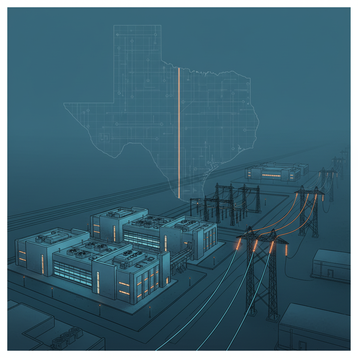

The Central Texas catalyst: AI meets semiconductors
Nowhere is the time-to-power gap more obvious than Central Texas.
The Samsung Taylor investment has helped accelerate a broader semiconductor and advanced manufacturing narrative in the Austin region (coupled with a substantial fiber build-out including the long-haul fiber network along I-35), one that pulls in adjacent compute demand, deepens the ecosystem (Tesla, Apple, Oracle, Cloudflare, Dell, Nvidia, UT, etc.), and drives additional infrastructure development to support some of the fastest-growing cities in the US.
That regional momentum is one reason Central Texas is attracting intense attention from data center developers and users. But that same momentum also means the market is no longer forgiving. Timelines are expanding while interconnection complexities are increasing.
In practical terms, many developers are now quietly offering dates that drift into the 2028–2030+ range as the queue deepens and studies take longer than initially expected due to the massive queue. That may still be acceptable for some long-horizon infrastructure strategies. It is not acceptable for a large portion of demand.
A simple thesis: Time-to-power is the product
Blueprint Data Centers’ Texas strategy was built around a simple thesis: time-to-power is the product.
In Central Texas, Blueprint Data Centers is developing two greater Austin‑area projects, Taylor and Georgetown, that together provide 85MW of committed capacity via Oncor with power targeted across 2026, within a much larger pipeline of a mix of utility interconnection and behind the meter developments. Industry outlets such as CRN and Digital Infra Network have already highlighted Blueprint’s plan to bring our initial 85MW of capacity online in the Austin area by end 2026 / early 2027, underscoring the market’s focus on near‑term, executable power.
The sites themselves are frequently discussed in the context of the region’s buildout:
- Taylor: A planned ~60MW campus anchored by approved economic incentives and listed as a key development on the City of Taylor’s official project portal.
- Georgetown: The companion site completing the 85MW platform, widely covered in local press and supported by secured tax incentives and development agreements with the city.
Those details matter, but the bigger point is strategic: the platform was designed to be something buyers can plan on.
In a state where the queue is measured in hundreds of gigawatts, the only credible promise is the one tied to an executable path.
Why execution is the differentiator (not marketing)
Texas is full of smart developers and serious capital. But ambition doesn’t energize transformers. Friction between utility coordination, procurement, and construction is where timelines break.
We combine the project discipline of the energy sector, where CEO Yaerid Jacob managed billion-dollar oil, gas, and power infrastructure projects that had zero tolerance for schedule failure, with the commercial and operational DNA of the data center industry’s largest platforms.
Alongside Yaerid, our leadership includes the former COO of QTS Data Centers, the founder of Iron Mountain’s data center division, the Co-founder of DC BLOX & GIGA Data Centers, and CCO Samarth Maira, who has scaled commercial operations across global markets. This is not a management list; it is a convergence of power know-how and data center operations, giving us the specific ability to synchronize complex grid delivery with customer-ready infrastructure on an accountable timeline.
The question the market needs to start asking
For years, the default customer question was: “How many megawatts can the site support?”
That question is no longer enough.
A better set of questions now looks like this:
- What year is the site actually scheduled to energize and what works are the precursors (upgrades, etc.) to get there?
- Which parts of the timeline depend on queue outcomes vs. executed commitments?
- Does the developer have the operational, procurement, and delivery infrastructure to hit the date-or just the optimism to announce it?
Texas will remain a powerhouse market. But as the queue grows, the amount of capacity that can realistically be delivered in the near term is shrinking, not expanding.
The developers that matter in this cycle are the ones that treat time-to-power as a deliverable, not a slogan.
Blueprint’s Taylor and Georgetown campuses are being built for that reality, so that the companies building the cloud, AI and semiconductor future in Texas can plan, deploy, and scale on schedules that match the moment.
Comments