

It’s no secret that AI workloads are pushing rack power densities higher from tens of kilowatts, through hundreds, and onto thousands at megawatt scale. Legacy architecture is starting to realize physical and efficiency limits.
To respond, manufacturers pairing with hyperscale operators are discussing and advancing a new 800Vdc architecture, up from the traditional smaller voltage backbone of 48Vdc/400Vac. I have been asked constantly over the last six months what I think about this new idea for battery deployment and how it can help. To provide an opinion, it’s important to understand the tradeoffs, both positive and negative, and let operators decide if this new concept is a benefit to adopt.
Why is 800Vdc a thing now?
Physics advantages
As is well known to anyone with experience working in electricity, when you raise voltage, this lowers current for a given power output, which means you can reduce copper mass and resistive losses (I²R). A recent post by AB Power shows a great real-world example: “Delivering 400 kW at 48V requires ~8,000A; at 800V, it’s ~500A—a ~94 percent reduction, making high‑density racks feasible in practice.”
Efficiency improvements
By using higher voltage infrastructure, power path efficiencies can be realized. Some estimates show up to a five percent reduction in copper usage per rack, as noted from a recent white paper published by Alpha and Omega Semiconductors.
Infrastructure changes
The large players in the ecosystem, like Nvidia, are already collaborating with hyperscalers on this high-voltage distribution, which includes BMS, relays, sensors, power converters, and others. It’s only natural that this will drive innovation into the entire data center market and force others in the industry to innovate and adapt.
The case for 800Vdc batteries
Lower current
Many white papers and technical publications on this subject today from companies such as Texas Instruments, Alpha and Omega Semiconductors, and others show the benefits of having lower current. High voltage slashes current, which in turn eases mechanical constraints, inherently reducing cost and installation complexity.
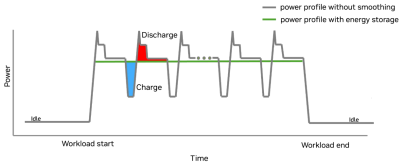
With reduced mechanical constraints such as copper and larger gauge wiring, improvement in airflow around busbars and cabling, which translates to more effective passive and active cooling systems. AI learning power loads for batteries are mirroring similar demand-response applications seen in large-scale front-of-meter utility power applications, with multiple micro-cycling several times per event. Lower current loads on the batteries can mean a potentially longer service life of deployment for electrochemistry that can support micro cycling.

Higher efficiency
Having reduced I²R losses and fewer conversion stages in power can improve facility‑level efficiency by up to five percent in emerging HVDC topologies. This is according to a recent blog post made by Nvidia that highlights many of the power efficiencies. This means an operator can not only provide power at higher levels but also do so smarter and utilize more of the gains once lost in conversion. In terms of batteries, any efficiency gain means higher capacity levels of energy available, which can make the difference in a power blip or outage.
Scalability
With all the higher power requirements, the distribution of that power will require new levels of design to make server racks, PDUs, GPUs, and batteries more compact and stackable to deploy in the hundreds of racks. Using higher voltage with reduced mechanical stress means a smaller footprint can be achieved. For batteries, this means smaller footprints at higher power densities where possible.
Future-state alignment
So many different technological advancements in power design, from ultracapacitors, solid state transformers, DC-DC converters, and many others means the designers are doing all they can to simplify power paths. A recent article by Data Center Frontier highlights these advancements and how this is possible. Batteries are following a similar trend with regard to emerging options like solid-state lithium-ion, sodium-ion, high-power-density VRLA, and fuel cells.
The case against 800Vdc batteries
More safety needed
Higher voltage directly increases the severity, likelihood, and complexity of several hazards. Greater risk of electrical shock hazard, risk of arc flash higher than AC, greater thermal runaway intensity, increased complexity of safe work procedures, including more advanced lockout/tagout procedures, higher levels of battery risk assessment, and more levels of certification and training will be required. IEEE and NFPA are still working on standards to be compatible with these new, ever-changing standards.
Immature market
800Vdc is still a theoretical deployment narrative with several announcements made and deployments expected to start rolling out this year and next (Nvidia announced it will start rolling out this power architecture in 2027). It will take battery manufacturers time to catch up and develop systems that are compatible. This means a limited supply chain, longer lead times, and harder-to-obtain components, putting further strain on power availability and backup.
Higher costs
With an immature market and unknown technology deployed in practice, this means higher costs are guaranteed for upfront capital requirements. New devices mean higher levels of training; this means organizational costs for not only new products, but skill development will naturally need to increase.
Legacy integration challenge
Most of the landscape of data center power architecture is based around 120-480Vac three-phase and anywhere from 12V – 600Vdc. Components, including UPS, GPU, PDU, batteries, and many others, are mainly built around those ranges. Integration of higher voltage will mean answering the age-old retrofit question of how to future-proof my data center for higher power. It is already an immense challenge for brownfield installations and will only get more complicated for greenfield installations.
The ecological consideration
Energy use
In a recent fact sheet published by AAAS (American Association for Advancement of Science), US data centers consumed ~4.4 percent of U.S. electricity in 2023 and are projected to reach 6.7–12 percent by 2028, largely driven by AI workloads. While power efficiency gains are meaningful, this may be overtaken by absolute load growth without parallel decarbonization and demand management from all sources.
The environmental impact isn’t limited to energy use through electricity and copper, however. As these footprints increase, efficiency gains grow, and more component usage becomes the norm, a holistic approach must be taken. While using higher voltage levels does provide efficiency gains on power usage, other factors outside this scope, such as water use, local noise/air impacts, siting pressures, and community effects, rise with scale; battery manufacturing, resource extraction, and end‑of‑life recycling remain essential sustainability questions that data centers are partially responsible for helping support. MIT published an interesting new article worth reading about this impact and how we can all contribute to operating more sustainably.
My advice for data center operators
800Vdc is not a miracle cure for the underlying problems, which are power availability. While this new architecture is a natural advancement, it will allow data centers to use power more effectively and will most likely result in widespread adoption to some degree; it’s sort of a kicking-the-can-down-the-road approach. It helps put a Band-Aid on the larger problem of power availability. The footprint growth isn’t going to slow anytime soon, and the AI demand is continuing to grow. How we generate more clean energy sources to support the infrastructure build-out should be the top priority, even if it is a much more challenging problem to solve.
Do what makes sense
Not all data centers are created equal. Use a higher voltage architecture where it’s needed most. AI-dense racks for learning loads and large-scale power clusters are a start. The hyperscalers will perfect this adaptation and see if it makes sense across the board. Using traditional AC and DC voltage topologies is still widely considered acceptable, even with the increasing power load requirements. There are many efficiency gains being researched as we speak at these lower voltage levels.
The bottom line is a typical battery manufacturer's answer, “It depends”. The argument can be made both for and against. 800Vdc can lower power losses and materials, but sustained environmental progress depends on clean power procurement, responsible battery supply chains, and holistic resource planning alongside HVDC efficiency gains.
More from CSB
-

Sponsored Balancing battery safety and sustainability: Why it’s a non-negotiable priority for data centers
Battery safety is a cornerstone of data center reliability and resilience. The time to act is now
-
Sponsored Installing data center power equipment: Perspectives from the front lines of the AI global transformation
Key installation partners and OEM companies share their thoughts on what it will take to accelerate the global rollout of AI technology
-
Sponsored Bridging challenges in data center battery deployments
Three lessons learned from a renewable energy industry veteran
Comments