

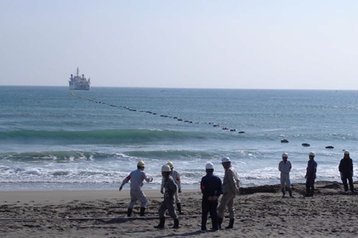
For decades, cable landing stations (CLS) served as essential yet straightforward gateways, connecting undersea fiber-optic cables to terrestrial networks. Their primary function was to receive signals from submarine cables, convert them, and relay data inland.
This model is now evolving. With the surge in global data traffic, expansion of cloud services, and the increasing demand for low-latency connectivity driven by AI, CLS are being redefined. Instead of merely acting as interconnection points, they are becoming foundational to an integrated global network infrastructure, enabling the seamless exchange of data across subsea and terrestrial environments. Their expanded role supports the rise of high-performance computing, multi-cloud architectures, and mission-critical applications that require rapid, reliable connectivity.
The strategic importance of CLS location
The placement of CLS has always been a critical decision, but the considerations driving site selection are changing. Historically, these stations were built where undersea cables naturally landed, often near major population centers. While proximity to urban hubs still plays a role, additional factors are now influencing where CLS are developed.
One major shift is the need for greater energy availability. The rapid expansion of AI and high-performance computing (HPC) is putting pressure on power grids, making energy a defining factor in choosing CLS locations. Traditional data center hubs are experiencing power constraints, leading operators to explore alternative sites with more reliable electricity supplies.
Another factor is redundancy and resilience. Network operators seek locations with multiple backhaul options, ideally with three or more fiber providers to ensure failover capacity. However, in some regions, this level of redundancy remains difficult to achieve. To address this, new CLS hubs are being developed outside of legacy markets. Strategic expansions into locations like Myrtle Beach and Virginia Beach are unlocking additional connectivity corridors, providing enterprises and hyperscalers with diverse and resilient routing options.
Additionally, geopolitical considerations and regulatory oversight are playing a growing role in CLS site selection. Governments are imposing stricter scrutiny on subsea cable projects, particularly those with international ownership. National security concerns, data sovereignty regulations, and environmental assessments are all extending project timelines, making it critical for developers to plan far in advance.
Breaking away from traditional CLS models
Traditionally, CLS ownership - where a single operator controls access - has been a barrier to competition. The industry is now shifting toward open and neutral CLS models, allowing multiple network providers to share infrastructure rather than being confined to proprietary systems.
This transition benefits both cable operators and enterprises. Open CLS models foster competition, reduce costs, and enable more dynamic interconnection options. Instead of being limited to one provider’s data center ecosystem, cable owners can distribute network capacity across multiple facilities.
However, this move toward openness presents challenges. Some regulators express concerns about decentralizing CLS infrastructure, citing security and operational oversight issues. With more operators accessing these facilities, ensuring compliance with security requirements while maintaining network flexibility will be critical to long-term stability and resilience.
The impact of emerging technologies on CLS design
The evolution of CLS is also driven by advancements in technology. A notable development is the rise of multi-core fiber systems, which significantly increase submarine cable capacity but also introduce new challenges. These advanced systems require more power, enhanced cooling, and robust infrastructure, all of which impact CLS design.
Energy consumption is a pressing concern. Estimates suggest that next-generation subsea cables could double the power requirements of CLS facilities. This increase affects electrical infrastructure and necessitates improved heat dissipation and cooling systems to manage higher thermal loads.
Beyond power considerations, AI is influencing how CLS are managed and maintained. Predictive analytics and automation assist operators in optimizing network performance, detecting faults before they cause outages, and dynamically allocating capacity based on real-time traffic demands. At the same time, AI-driven automation is streamlining network operations, allowing CLS to function with greater efficiency while reducing the need for manual intervention in monitoring and troubleshooting.
Navigating regulatory and environmental complexities
As the role of CLS continues to become more integral to digital infrastructure, regulatory processes are becoming increasingly complex. Securing permits for new landing station developments can take years, involving environmental impact assessments, national security reviews, and coastal protection regulations.
Data sovereignty is an emerging concern, with some governments implementing stricter rules on cross-border data transmission. This trend could compel CLS operators to reconsider how traffic is routed and stored, potentially increasing operational costs and limiting flexibility.
Given these challenges, developers and investors must adopt a long-term approach to site selection and permitting. Engaging with regulators early, conducting comprehensive feasibility studies, and anticipating potential legal obstacles are essential steps to ensure project viability. To mitigate risks and avoid unexpected roadblocks, collaboration with local authorities and environmental stakeholders during the initial planning phase is becoming a critical best practice.
Redefining CLS for the future of global connectivity
Looking ahead, CLS will continue to evolve into multi-functional, resilient, and highly interconnected infrastructure nodes. Their transformation will be driven by:
- The growing need for intelligent automation and AI-driven network optimization
- A shift toward hybrid CLS models that integrate terrestrial fiber, satellite, and cloud networks
- An emphasis on energy efficiency and sustainable power solutions
Unlike previous iterations of CLS, which primarily served as interconnection points, the next generation of facilities will be characterized by dynamic scalability, strategic redundancy, and adaptive infrastructure. As AI, hyperscale cloud, and emerging network technologies continue to reshape global connectivity, the role of CLS will expand, ensuring they remain vital components of a rapidly evolving digital ecosystem



Comments