

Right now, everyone building AI data centers is focused on two things: getting enough GPUs and getting enough power. You can have the chips allocated and the megawatts locked up and still struggle to get your site energized if you can’t find enough electricians to wire it.
A large data center site needs hundreds of electricians on site for months at a time. The challenge of finding that much talent is already stalling builds, with 90 percent of data center operators reporting that staffing shortages are a critical constraint.
I've spent the last few years building data center sites, and this constraint keeps showing up. This labor shortage is only getting worse as the buildout speeds up. That led me to the real question: how can we build around it instead of through it?
How many electricians does it take to build a data center?
How many electricians does a site need? Take a 40MW site, for example. Built the conventional way, that project needs somewhere between 400 and 500 electricians on site, working for months.
In a traditional build, almost everything happens in the field. The power gear, the cooling, and the wiring that ties it all together are all assembled and connected on site, by hand, after the equipment shows up.
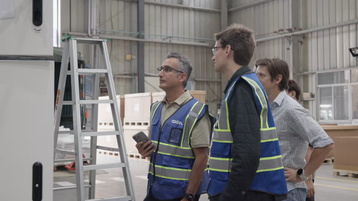

The labor needs to scale with the size of the build. If you’re planning a bigger site with more megawatts, you’ll also need more electricians. Now multiply that by what's actually going on out there. Sites are breaking ground all over the country at the same time, and every one of them needs its own small army of electricians for months.
They're all hiring from the same pool of skilled trades, in the same regions, on the same timelines. Large projects are paying handsome sums to attract electricians to new regions, and even that often isn’t enough.
The result is that there aren’t enough electricians to go around. If it hasn’t interrupted one of your project timelines yet, it will soon.
The ‘why’ behind the shortage
Let’s talk about why you can’t simply hire your way out of this problem. Even with an unlimited staff budget, there aren’t enough electricians available.
- The Bureau of Labor Statistics projects roughly 81,000 electrician openings a year through 2034, much of it replacing a workforce that's retiring.
- About 20,000 electricians retire each year, and nearly a third of the union workforce is between 50 and 70.
- An apprenticeship runs four to five years, so supply can't spin up to meet demand.
Other data centers are your biggest competition when it comes to hiring, but they aren’t the only ones. EV charging, grid upgrades, and housing are all bidding for the same crews. There isn’t enough skilled labor out there, and as the existing workforce retires, that problem is only going to get worse.
So the question changes. It stops being "how do I staff a 400-electrician build" and becomes "how do I build a site that doesn't need 400 electricians in the first place."
Working around the shortage
If hiring more electricians isn’t possible, the only solution is needing fewer of them. The only way to accomplish that is to stop building the entire data center in the field.
A modular data center system does most of the building, testing, and commissioning in the factory. This approach uses smaller crews to build the same modules repeatedly in a controlled space, rather than managing on-site connections and integrations. All that is left to do on site is connecting a few power and cooling points, drastically reducing the amount of field labor needed.
The headcount difference isn't small. In the builds I've been part of, a 40MW site that would traditionally need 400 to 500 electricians can be done with something closer to 30 to 40 on site, because most of the wiring already happened off-site.
Factory labor also scales in a way a jobsite crew never will. On site, every project re-solves the same problems from zero, with whoever you could hire in that region that month. With a pre-engineered, factory-built data center, you build the same thing the same way every time, allowing your team to get better and faster over time instead of starting over on each site.
Building this way can mean giving up some design flexibility you'd have if you wired everything custom in the field. But for most AI deployments, where the whole point is getting GPUs online as quickly as possible, trading a little flexibility for months of schedule and a crew you can actually staff isn't a hard call.
Fewer workers, working better
Scheduling and staffing isn’t the only benefit to using fewer electricians in your data center build. The fewer workers you have on-site, the safer and easier your build process becomes.
A traditional jobsite crowds hundreds of trades into the same space, all working at once and often on top of each other. That's hard to coordinate and harder to keep safe.
When most of the wiring has already happened in a controlled factory, the crew that remains on site has room to work carefully in a cleaner, better-controlled environment. Fewer people competing for the same space means fewer mistakes, higher-quality work, and a safer site all around.
This approach is also a smarter use of the people themselves. An electrician takes four to five years to train, which makes skilled trades one of the most valuable resources on any project. That talent is wasted when it’s spread thin across dozens of chaotic jobsites. Concentrating that talent in factories lets skilled workers do what they do best; building more of the infrastructure the country is counting on.
The future of AI data center construction
The AI race isn't going to be won by whoever lines up the most GPUs or the most megawatts. Plenty of operators will have both and still be standing in a field, waiting on labor. The operators who win will be the ones who can actually get sites built.
The takeaway is straightforward: You don't beat a labor shortage by hiring harder. You beat it by needing less labor on site in the first place. In a data center build, that means moving the work off the job site and into a factory, where it can be done faster, with fewer people.
You're not going to hire your way through this. The sooner you build for that reality, the sooner you can get your sites online.
If you want to see how the team at Giga is building modular data sites with fewer electricians than ever, check out our GigaBase system or schedule a call with our team.
Comments