

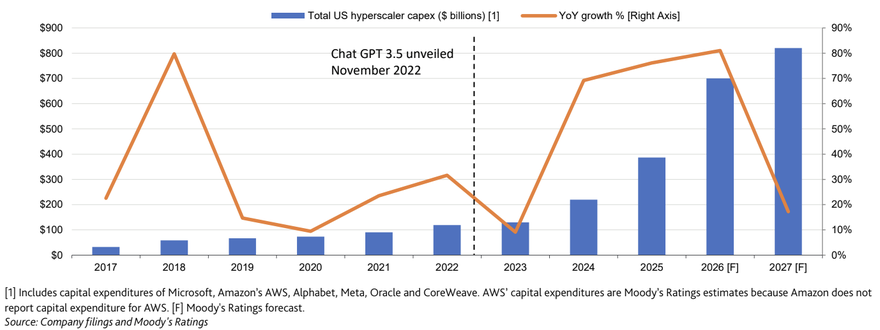
Rapid AI advancement and increasing adoption are generating robust demand for computing capacity and pushing US data center hyperscalers to invest heavily. We expect total capital expenditures for the six US hyperscalers – Microsoft Corp. (Aaa Stable), Amazon.com, Inc.'s (A1 Stable) Amazon Web Services (AWS), Meta Platforms, Inc (Aa3 Stable), Alphabet Inc. (Aa2 Stable), Oracle Corporation (Baa2 Negative), and CoreWeave, Inc. (Ba3 Stable) – to increase to $700 billion this year, nearly 6x their 2022 spending. The investments are accelerating revenue growth, but eroding historically strong free cash flow of these tech giants and prompting higher borrowing.
Hyperscaler capex soaring and on a multiyear growth trajectory. We expect capital spending to increase 81 percent to about $700 billion this year, nearly 6x the level in 2022, the year ChatGPT was introduced. Next year, we believe capex will grow further, to $820 billion, with potential for upward revisions. These investments are driving a surge of growth across the data center supply chain, including semiconductors, IT hardware, power generation, construction, and cooling equipment.
Spending level unprecedented, but AI demand continues to outpace supply. The entire industry remains capacity-constrained because demand for computing capacity to train new AI models and support exploding growth in inferencing1 and agentic applications exceeds supply. The lack of readily available electricity for data centers and the time it takes to build them will constrain AI capacity, which we expect will lag demand through 2027.
Long payback period on AI investments clouds investor sentiment. The gap is widening between how hyperscalers and some investors view these companies’ AI investments, with bond spreads increasing and median equity prices declining. Hyperscalers perceive underinvestment in AI as an existential threat, while some investors
worry that aggressive spending could lead to overbuilding and weaker returns. The large upfront capital spending required to meet AI demand is putting pressure on credit metrics. While debate about returns will likely persist, emerging revenue growth and backlog conversion trends should allay some concerns about these investments.
Higher capital intensity, debt levels could lead to a reassessment of creditworthiness if strong profit growth fails to materialize. The era of AI buildout has increased capital intensity for leading technology companies. These companies long operated with solid profitability and lower capex, which afforded them plenty of financial flexibility. We believe this dynamic has changed for good and is affecting credit, prompting us to lower our outlook on two of these companies. The risks will increase if strong profit growth from these investments fails to materialize.
Hyperscaler capital spending soaring and on a multiyear growth trajectory
Rapid technological advancements in AI and its growing adoption are driving robust demand for AI computing capacity. The US hyperscalers will continue to shoulder most of the global investments in AI, given their substantial advantages in scale, distribution, and technological capabilities, and capacity to invest. We expect total capital expenditures for the Microsoft, AWS, Alphabet, Meta Platforms, Oracle, and CoreWeave to increase 81 percent to about $700 billion this year. That is nearly 6x from its level in 2022, the year Chat GPT was introduced, ushering in the AI era. Next year, we expect capex by these hyperscalers to grow a further 17 percent, with a high likelihood for upward revisions as visibility into build-out plans increases.
Elevated capital spending by hyperscalers is driving a surge in investment and growth across the datacenter supply chain, including semiconductors, IT hardware, power generation, construction, and cooling equipment (see Exhibit 1). These investments are supporting an unprecedented growth in generative AI software and services, a market that did not exist before 2022. OpenAI and Anthropic combined were generating about $30 billion in annualized revenue run rate at year-end 2025 and there is a vibrant ecosystem of venture capital-funded AI natives that are growing rapidly, benefiting from AI infrastructure spending.

The unprecedented scale of spending by hyperscalers increases concerns about industry overcapacity and uncertain returns on these AI investments. The highest-rated hyperscalers had robust financial profiles before they ramped up AI infrastructure spending, but risks are increasing. High capex in 2025 eroded their historically strong free cash flow and drove significant debt issuance by Amazon, Alphabet, Oracle, and Meta. We believe that capital intensity will remain elevated for an extended period and the impact on credit metrics will be
exacerbated by the lag in profit from AI investments and by greater reliance on debt or, in some cases, lower cash balances. The share repurchase capacity of Alphabet and Meta will be limited in 2026 without additional debt.
Capital spending by US hyperscalers likely to climb to $820 billion next year
We expect capital expenditures for US hyperscalers to increase from $387 billion last year to $700 billion this year, and climb further in 2027 (see Exhibit 2). These six companies will represent about 40 percent of the total projected capital spending of S&P 500 companies in 2026, based on FactSet consensus estimates.
Scale of spending is unprecedented, but AI demand substantially exceeds supply
The scale of capital spending is unprecedented, but so is demand, which continues to meaningfully outpace supply despite significant growth in computing capacity. Compute requirements to train new generations of AI models continue to consume a large share of installed AI capacity and are increasing as models scale and improve output quality. In recent months, demand for capacity to serve inference requests surged with the growing adoption of generative AI and agentic AI applications. The leading AI model companies, OpenAI and Anthropic, as well as all US hyperscalers, remain capacity constrained.
Microsoft must balance competing demands for its AI capacity among its own AI-powered products, such as Copilot, internal R&D efforts, and third-party customers. The company said that capacity constraints limited Azure’s growth and that, with sufficient capacity, Azure's revenue growth would have been at least two percentage points higher than the 38 percent constant-urrency growth reported for the December quarter.
The lack of readily available electricity to power data centers, along with the time required to build them amid labor shortages and permitting requirements, will constrain AI infrastructure capacity, which we expect will again lag demand in 2027.
Long payback period on AI investments clouds investor sentiment
There is a growing gap between how hyperscalers and some investors view the companies’ AI investments. Over the last six months through February, median spreads on medium-term bonds issued by investment-grade hyperscalers increased by 10 basis points, while median equity prices declined by 12 percent. Hyperscalers view underinvestment in AI as an existential threat to their businesses and a once in-a-generation opportunity, whereas some investors worry that aggressive spending could lead to overbuilding and diminished returns.
AI data centers and IT equipment require substantially higher investment than data centers for traditional computing purposes. The capital-intensive nature of AI, combined with the upfront investments required before any revenue is realized, creates a significant challenge. For a greenfield, self-built data center, it would likely take 12 to 24 months between initial capital outflows and revenue generation. The payback period on hyperscalers’ AI data center investments can extend for several years and varies widely depending on factors such as the mix of AI workloads, customer prepayments, the nature of AI services offered, the type of AI accelerators and networking technologies deployed, the useful life and utilization rates of AI accelerators, and the cost of funding. The rapid growth in capex across hyperscalers overwhelms returns on prior, smaller investments, making it difficult to clearly assess the financial benefits of these investments.
The risks of not investing aggressively or of being late are simply too great for technology companies. Microsoft and Oracle were late to pivot their software businesses to the cloud, allowing AWS to establish a lead of several years in cloud computing services.
We strongly believe AI investments are a strategic imperative for investment-grade US hyperscalers. Microsoft, Alphabet, Meta, Amazon, and Oracle have many businesses that will benefit from AI or face disruption from it. These companies have large global customer bases to which they can distribute AI-enhanced products and services, as well as new AI-powered offerings.
Microsoft has the second-largest cloud infrastructure business and is the largest software company. Its Azure cloud business is a beneficiary of growing AI demand by third-party customers and it both needs to defend its software portfolio as well as capitalize on the opportunity to leverage AI to enhance the value of its products.
Alphabet owns the Gemini proprietary frontier AI models and users of its Google Search platform conduct more than 5 trillion searches annually. Its Gemini app had over 750 million monthly active users at the end of 2025 and it has a highly successful internal AI accelerator chip program.
Amazon’s AWS is the largest cloud services provider and online retailer. It is leveraging generative AI for its own business across its retail, advertising, and digital services ecosystems. Amazon estimated that about 300 million of its customers used its agentic shopping assistant Rufus in 2025 and customer who use Rufus are 60 percent more likely to complete a purchase.
Meta had more than 2 billion daily active users of Facebook and WhatsApp and nearly 2 billion daily users of Instagram at the end of 2025.
Oracle has one of the strongest portfolios of mission-critical enterprise software applications and is the second-largest enterprise software company, accordingly to IDC. Its ambitious plans to scale AI cloud services are evident in the company’s contracted backlog, which soared to $523 billion at November 2025.
CoreWeave has scaled rapidly as a specialized AI cloud services provider with a blue-chip customer base. As of Dec. 31, 2025, CoreWeave operated data centers with over 850 megawatts of active power and total contracted power capacity of about 3.1 gigawatts.
Debate about returns will linger, but emerging trends allay concerns about large investments
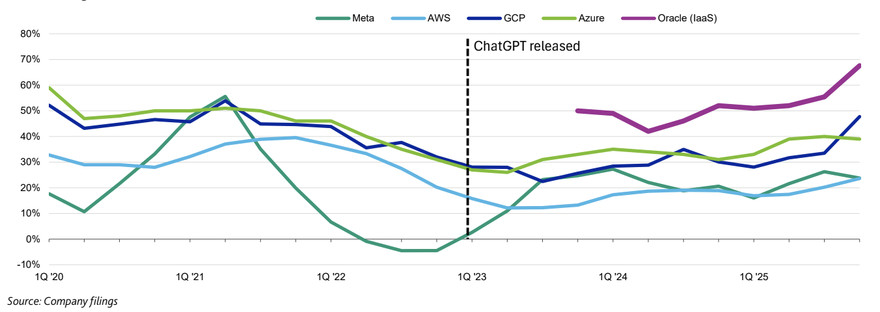
Revenue growth rates for the leading US hyperscalers have accelerated since early 2023, driven by an improved macroeconomic environment and, in 2025, by incremental contributions from AI. These growth rates are not directly comparable because of large differences in the markets the companies serve and their relative scale; for example, Meta does not have a third-party cloud services business. Nevertheless, median growth rates for Meta and the four leading cloud services providers – AWS, Alphabet’s Google Cloud Platform (GCP), Microsoft’s Azure, and Oracle’s Infrastructure as a Service (IaaS) business – increased from 26 percent at the end of 2023 to 39 percent at year-end 2025 (see Exhibit 3). We expect revenue growth to accelerate further as more capacity comes online and for the third-party cloud services providers, contracted backlogs are converted into revenue. The combined annualized revenue of AWS, Azure, GCP, and Oracle’s IaaS has nearly doubled over the past three years to $350 billion as of Q4 2025, with each growing at rates above 20 percent.
There is currently no disclosure from any of these companies that delineates the revenue and profit contributions from AI investments. This partly reflects the difficulties of quantifying AI revenue attributable to AI products, as AI can be embedded in premium offerings, drive greater usage of non-AI products and services, improve operating efficiencies, or increase consumption of cloud services.
However, the benefits of AI investments are becoming evident in key performance indicators across hyperscalers. Google Search reached its highest usage level in Q4 2025, aided by AI Overviews and AI Mode, now powered by its Gemini 3 model. According to Alphabet, in the US, daily AI Mode queries per user doubled since launch in May/June 2025, with users engaging in longer sessions.
Meta attributed its 23 percent constant-currency revenue growth in Q4 2025 to strong contributions from AI-driven improvements in ad ranking, delivery, and conversion.
AWS’s growth accelerated to 24 percent year over year in Q4 2025 — its fastest pace in 13 quarters — driven by core cloud services as well as AI offerings. This growth rate is notable given AWS’s $142 billion annualized revenue run rate. AWS estimates its Amazon Bedrock platform for building generative AI applications and agents is a “multibillion-dollar” run-rate business.
Growing revenue backlogs, OpenAI and Anthropic’s access to funding mitigate risks
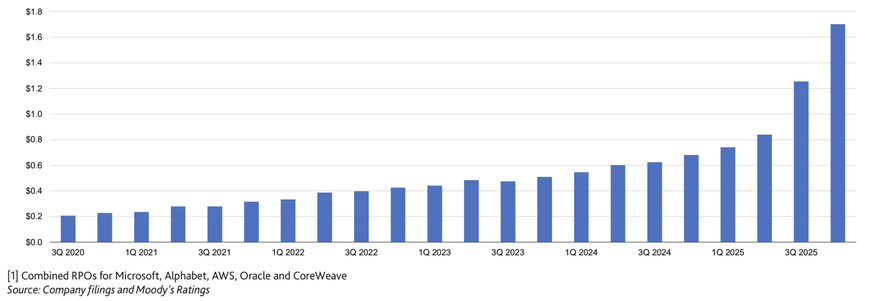
Hyperscalers are increasing spending in response to strong demand signals. Contracted revenue backlog, as measured by remaining performance obligations (RPOs), is growing rapidly. The backlog of AWS, Microsoft, Alphabet, Oracle, and CoreWeave — which provide third-party cloud services — increased to $1.7 trillion at the end of 2025, up a staggering 150 percent year over year (see Exhibit 4). Growth in recent quarters was driven largely by contracts with OpenAI and Anthropic. The risk associated with a high concentration of backlog tied to these loss-making AI leaders is tempered by their ability to raise prodigious amounts of capital from private markets. We also believe these companies’ unit costs to serve inference requests have improved substantially over the past 12 to 24 months, which supports their ability to raise substantial funding. If OpenAI or Anthropic were to go public, it would further alleviate counterparty risk for hyperscalers, as both companies would gain access to a more diversified pool of capital and investors will have greater visibility into their business strategies and paths to profitability.
Visibility from contracted backlog also helps hyperscalers plan data center buildouts and reduces the risks associated with rapid advancements in accelerator chips and networking technologies. The scarcity of accelerator chips relative to demand is supporting prices for older products. But the market value of industry leader NVIDIA’s past-generation products is also supported by the company’s continued support for older products and by software enhancements that improve efficiency. Risks to hyperscalers’ technology investments are mitigated by the increasing diversity of AI workloads, ranging from low-value, free consumer services to highly monetizable enterprise and application use cases. This enables hyperscalers to match leading-edge infrastructure with workloads that offer the highest economic returns, while utilizing older generation technology for lower-value AI services.
Capital-intensive AI spending weighs on profitability but efficiency gains protect operating margins
Among these data center giants, only Microsoft discloses gross margins for its Azure cloud business, which provide a window into the dilutive effects of increasing investments in capital-intensive AI infrastructure. Azure’s gross margin deteriorated about five percentage points by December 2025 from the peak two or three years earlier. However, all hyperscalers pivoted quickly to protect operating margins by sharply cutting spending on other speculative projects, limiting head count growth, and driving strong operating efficiencies — including from AI usage — to support operating margins (see Exhibit 5). Similar to their revenues, operating margins across companies are not directly comparable because of their differences in markets they serve and relative scale.
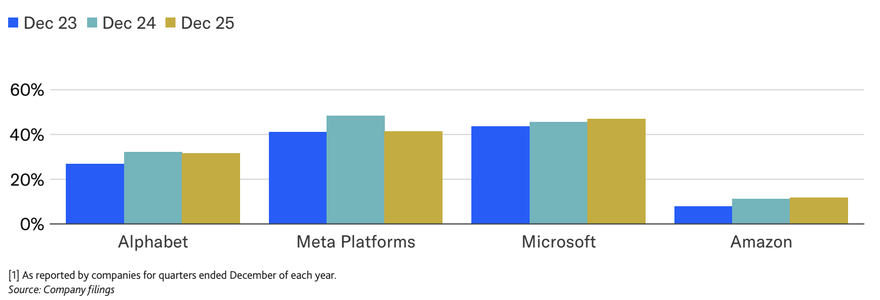
Microsoft, Meta, Alphabet and Amazon added nearly $500 billion in revenue (a 44 percent increase) over the last three years, based on respective fiscal year ends, while aggregate head count increased only about 2 percent. The efficiencies underscore the digital nature of their businesses, which offers substantial flexibility to monitor unit economics and balance investments between growth and profitability targets.
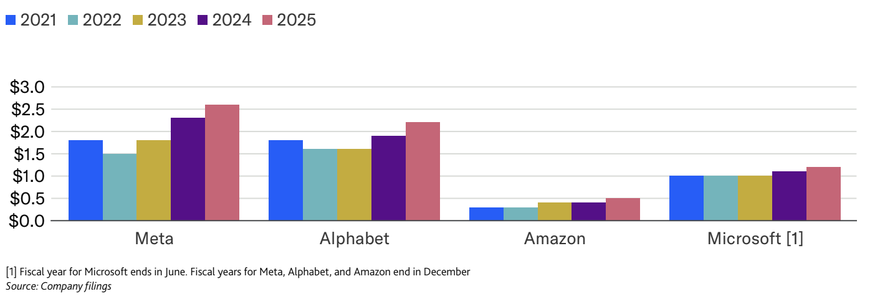
Higher capital intensity could lead to a reassessment of creditworthiness, if strong profit growth does not materialize
The era of AI build out has raised capital intensity of the leading technology companies, which historically operated with generally low capital expenditures (compared to their revenue) and generated robust profit. In turn, that allowed them to operate with low debt (or no debt in the case of Alphabet and Meta for an extended period), strong cash positions, and flexibility to deploy capital toward large
acquisitions or shareholder returns. We believe this dynamic has changed for good. Average capex to revenue ratio for the investment grade hyperscalers is projected to increase to 47 percent in 2026, up more than 3x since 2022. There is a potential for a multiyear investment phase given the robust demand for AI infrastructure as advancements in AI and its declining unit costs drive greater adoption across use cases.
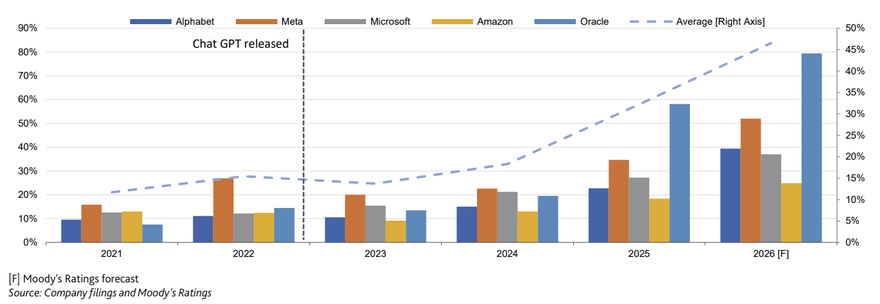
We expect Microsoft, Alphabet, Meta and AWS to account for 86 percent of the total projected capital expenditures for our cohort of hyperscalers. These companies have exceptional scale and strong credit metrics, and we expect their revenue growth to accelerate with AI investments. They have the capacity to make large investments given their robust cash flow from operations and cash balances, strong growth profile and access to capital markets.
The four largest hyperscalers still demonstrate strong credit metrics at this stage of the AI investment cycle (see Exhibits 8, 9 & 10), but credit metrics could weaken if capital expenditures continue to grow faster than profit. All hyperscalers will see sharply reduced free cash flow in 2026.
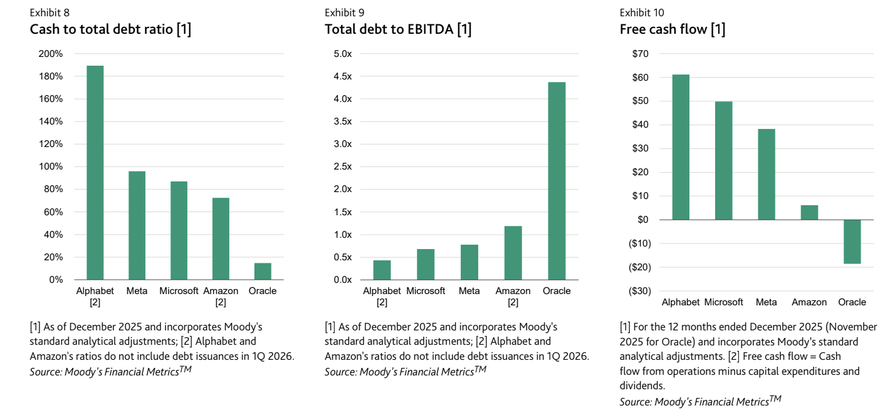
The effect on credit is starting to appear. We changed Oracle’s ratings outlook to negative in July 2025, reflecting the uncertainty and risks associated with the rapid pace of spending and commitments required to build out its AI infrastructure business, evolving AI business models and technologies and significant counterparty risk with OpenAI, which we believe is Oracle's largest AI Infrastructure customer. We changed Amazon’s outlook from positive to stable in February 2026 as sharply higher capital spending will turn free cash flow negative and debt is increasing. Amazon plans to accelerate its capital spending by over 50 percent to about $200 billion, as it embarks on a major investment cycle, and plans a $50 billion investment in OpenAI. We expect Amazon’s external funding needs will lead to increased debt levels and put pressure on credit quality in the medium-term with Retained Cash Flow (RCF) to Debt coming closer to our 50 percent threshold for the A1 rating at the end of 2026 with RCF/Debt approaching mid 50 percent versus 87 percent at the end of December 2025.
For Microsoft, Alphabet and Meta, we expect sharply lower or negative free cash flow over the next two years as they fund staggering capital spending. Alphabet, Amazon, and Meta also recently issued debt, despite their significant cash balances. Further increases in capex would likely necessitate more borrowing or diminishing cash balances, which would weaken credit metrics, although their substantial EBITDA limits any significant effects on their financial leverage. Given the companies’ strong growth profiles and profitability, we expect them to maintain low leverage — though up from exceptionally modest levels. A large portion of data center expansion is through leases. Total operating and finance lease liabilities for Microsoft, Alphabet, Meta, Amazon, and Oracle had increased 50 percent between 2023 and 2025, and leases yet to commence had increased by more than 4x to $662 billion (undiscounted) over this period.
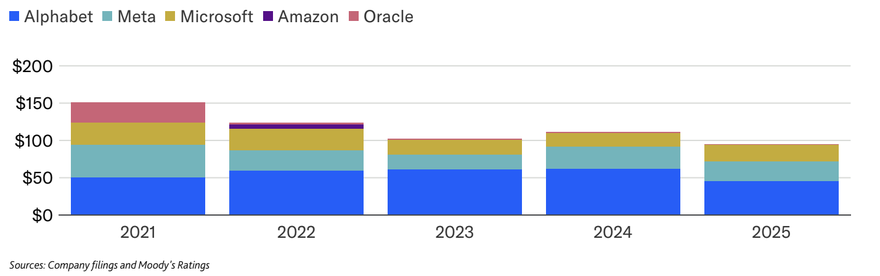
We believe capital intensity will remain high for an extended period. This will put pressure on the companies to increase debt, reduce cash balances, and limit share buybacks (see Exhibit 11). To the extent AI infrastructure investments are offset by reduced outlays for share repurchases, relative to previous levels, the effects on credit will be muted. We would view AI investments as credit positive, so long as there is a clear evidence they produce accelerating growth and increasing profitability.
In 2025, Oracle was the only investment-grade company among the hyperscalers with negative free cash flow (after dividends). This year, we expect all hyperscalers, except Microsoft, will generate modestly positive to negative free cash flow. In 2021 and 2022, Microsoft, Meta and Alphabet’s aggregate share repurchases represented 83 percent and 97 percent, respectively, of their free cash flow in 2021 and 2022, before AI capex surged. That share fell to 60 percent in 2025 and we project more limited buybacks in 2026.


Comments