

India’s data center super cycle
India is entering an unprecedented data center boom. With the nation’s digital economy projected to reach $1 trillion by 2030, the demand for hyperscale-ready, secure, and sustainable infrastructure has surged.
But the story is no longer written only in Delhi’s corridors of power. Interestingly, this growth is being shaped at the state level, where progressive policies, infrastructure incentives, and regulatory relaxations are redefining the rules of DC site selection.
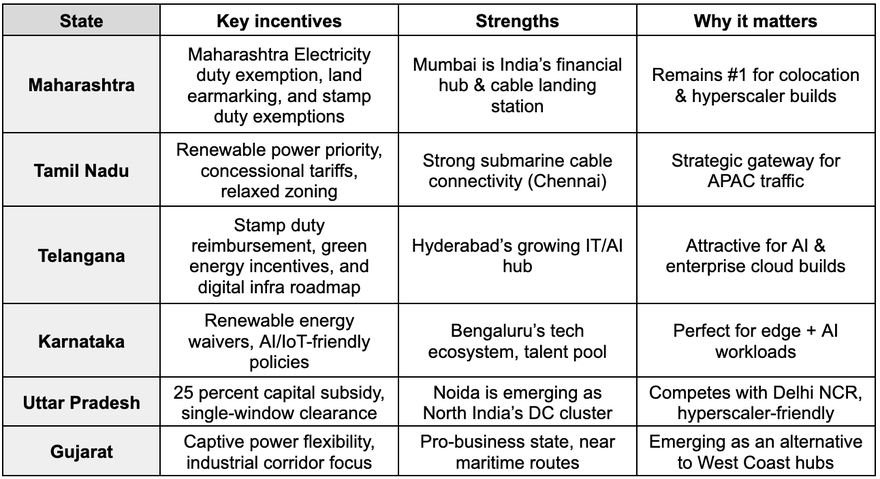
States like Maharashtra, Tamil Nadu, Telangana, Karnataka, Gujarat, and Uttar Pradesh have moved beyond broad digital policies to dedicated state-level data center policies.
For hyperscalers, colocation players, and infra investors eyeing India, it’s no longer just about metro connectivity or land costs. It’s about which state gives you the fastest go-live with the highest long-term ROI.
Why do state governments now hold the power?
Until recently, data center expansion in India was shaped largely by two factors: proximity to metros (Mumbai, Chennai, Delhi) and availability of submarine cable landing stations. Today, the competitive equation has changed.
States are now offering:
- Capex subsidies to lower upfront investment costs.
- Green power incentives to align with ESG mandates.
- Relaxed approvals and clearances to cut red tape.
- Special industrial zones earmarked for data center parks.
This matters because hyperscalers are highly sensitive to cost, sustainability, and speed-to-market. States that solve for these factors attract billions in FDI, while those that lag risk being bypassed.
Policies driving hyperscale growth: State-level advantage
Let’s break down how progressive states are incentivizing data center growth:
1. Capex and investment subsidies
Maharashtra: Up to 60 percent exemption on electricity duty for 15 years, and stamp duty exemptions.
Uttar Pradesh: Capital subsidies designed to attract large hyperscale facilities.
Telangana: 100 percent reimbursement of stamp duty and registration fees on land.
Why it matters: Hyperscale campuses are capex-heavy. Subsidies directly improve ROI on billion-dollar greenfield builds.
2. Reliable power supply and tariff benefits
Tamil Nadu: Dedicated power feeders and concessional tariffs.
Maharashtra: 24×7 assured supply through state DISCOMs.
Gujarat: Flexibility for captive power plants and open-access incentives.
Why it matters: Power makes up 40–50 percent of OPEX in hyperscale operations. States that guarantee reliable, affordable energy win.
3. Green energy and ESG alignment
Karnataka: Waivers on cross-subsidy surcharge for renewable sourcing.
Tamil Nadu: Priority allotment of renewable power.
Telangana: Extra benefits for data centers sourcing >50 percent power from green energy.
Why it matters: With hyperscalers pledging 100 percent renewable operations by 2030, green power access is mission-critical.
4. Speed-to-market through faster clearances
Uttar Pradesh: Single-window clearance system for DC projects.
Maharashtra: Earmarked land zones for faster allocation.
Tamil Nadu: Relaxed zoning and development norms for quicker build cycles.
Why it matters: Hyperscale decisions are global. States that reduce approval cycles from years to months win investments.

Recent investments: Following the money
In the past 24 months, multi-billion-dollar commitments have flowed into Mumbai, Chennai, Hyderabad, Noida, and Bengaluru.
From Microsoft’s $3B AI and cloud expansion to AWS’s $8.2B investment in Maharashtra, global giants are validating what states already know – the future of data centers in India is decided locally.
The trend is clear: states that align incentives with execution speed are redrawing India’s hyperscale map.
Beyond policy: Challenges to execution
While policies are progressive, hyperscalers still face:
- Execution gaps between policy announcements and delivery.
- Power distribution constraints in high-demand hubs.
- Land acquisition hurdles near metro corridors.
The winners will be states that not only announce policies but also deliver steel in the ground and power at scale.
What hyperscalers should demand
Choosing a state is no longer just about land or fiber. It’s about:
- Subsidies that reduce billions in upfront costs.
- Renewable sourcing to meet global ESG mandates.
- Approval speed to match global board expectations.
- Scalability for future AI and HPC workloads that demand dense power corridors.
Conclusion: The new map of India’s digital future
India’s hyperscale growth story is no longer shaped by national policy alone – it is accelerated by progressive states like Maharashtra, Tamil Nadu, Telangana, Karnataka, Uttar Pradesh, and Gujarat.
For hyperscalers, aligning site selection with state-level strategy is now mission-critical.
At CtrlS, we go beyond incentives – partnering with states to translate policy into execution. With hyperscale campuses that are AI-ready, ESG-aligned, and built on a proven land-to-live cycle, we enable hyperscalers to achieve faster go-live, lower TCO, and sustainable growth in India’s digital future.
More from CtrlS Datacenters
-

Sponsored The unspoken truth about designing data centers in India
Designing data centers in India is a test of resilience, creativity, negotiation, and chaos management. And if you’re not adapting to the local truths, you’re already behind
-
-

Sponsored Could nuclear power be the answer to data center sustainability?
It’s not a question of if nuclear will play a role in powering the future of digital infrastructure, but how fast we can overcome the barriers to make it happen
Comments