
As AI workloads drive higher rack densities, power consumption, and rapidly evolving thermal loads, cooling efficiency has become a critical factor in both operating cost and infrastructure performance. Traditional cooling architectures are designed to protect against worst-case conditions, often requiring lower coolant temperatures, higher fan power, and greater chiller utilization.
This provides important thermal headroom, but can be inefficient in AI infrastructure, where GPUs, high-bandwidth memory (HBM), and high-speed networking create localized thermal demands that change instantly with workload.
Precision thermal control changes this model. Working alongside air and liquid cooling systems, it adds real-time, component-level temperature management. Rather than requiring an entire server, rack, or cooling loop to operate around the needs of a small number of temperature-sensitive components, thermal demand can be addressed directly where it occurs. This reduces the burden on facility cooling, enables higher coolant temperatures, and improves overall system efficiency.
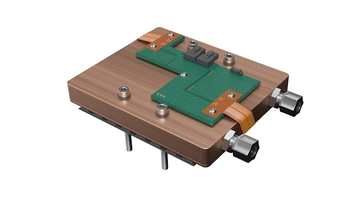
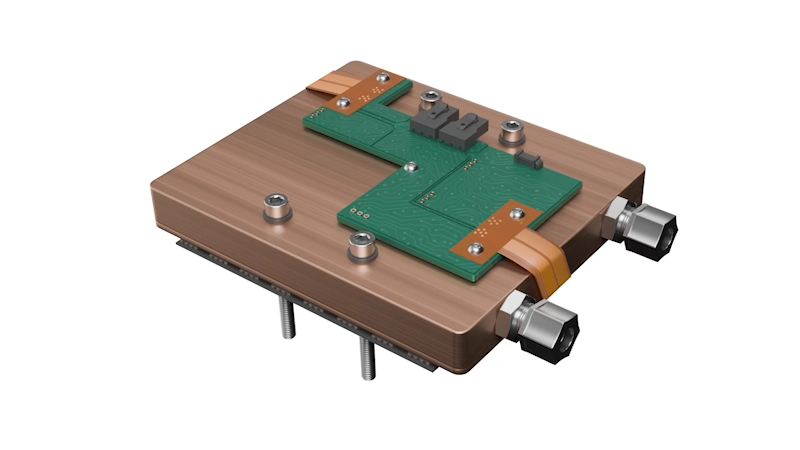
The Phononic Thermal Control System brings this capability directly to the node, enabling supply water temperatures of up to 50°C (122°F) while maintaining full performance and avoiding thermal throttling. Modeling indicates total data center energy savings of up to 14 percent, inclusive of the power consumed by the Thermal Control Systems themselves.
(For further data on Thermal Control Systems please visit www.phononic.com or read more about them here on DCD.)
As power availability increasingly constrains AI infrastructure growth, these savings can translate directly into additional capacity for productive compute without increasing total facility power demand.
Higher supply water temperatures extend these benefits to water consumption. Reducing the need for chilled-water production and evaporative heat rejection can significantly decrease cooling-tower makeup water, with modeled savings approaching one million gallons per day for a typical large-scale AI data center. In suitable climates and facility architectures, higher operating temperatures can also enable chiller-less or near-chiller-less operation for significant portions of the year, improving both power usage effectiveness (PUE) and water usage effectiveness (WUE).
The hidden energy cost of overcooling at the node level
Phononic's thermoelectric technology uses solid state thermoelectric coolers (TECs) to manage localized thermal demands at GPUs and HBM, switch ASICs, optical engines, voltage regulators, and other temperature-sensitive components. Millisecond-scale response allows cooling to continuously adapt to changing workload and thermal conditions.
This response time is important because AI workloads can create rapid thermal transients that occur much faster than traditional cooling infrastructure can react. Liquid loops and facility cooling systems typically respond on the order of seconds or longer, while thermoelectric devices can respond in milliseconds, up to 600X faster. This allows temperature to be managed locally as conditions change, helping maintain optimal operating conditions and avoid thermal throttling.
Rather than lowering coolant temperatures or increasing cooling across an entire system to protect a localized hotspot, precision thermal control addresses the thermal demand directly at the component. This allows the broader air and liquid cooling infrastructure to operate more efficiently. For GPU HBM applications, Phononic's Thermal Control System can deliver up to a 0.15 improvement in PUE, and when deployed across the data center can lower total data center energy requirements by as much as 14 percent.
Eliminating thermal inefficiencies in GPU and HBM architectures
Modern AI accelerators present a unique thermal challenge: compute dies and HBM stacks can have very different thermal requirements, yet traditional cooling architectures typically manage them within a common thermal envelope. The needs of the most temperature-sensitive component can therefore drive cooling conditions for the entire system. This can cause HBM to operate above its optimal temperature, compute dies to be cooled more aggressively than necessary, or system coolant temperatures to be lowered.
Phononic's Thermal Control System addresses this imbalance through independent, component-level temperature control. Working in tandem with primary air or liquid cooling, thermoelectric cooling is applied locally to maintain temperature-sensitive components within their optimal operating ranges. This reduces the cooling burden on the broader system while enabling HBM to sustain higher bandwidth and power levels without thermal throttling.
Bulk cooling removes heat from the system; precision thermal control manages temperature where it matters most.
From thermal management to thermal orchestration
The opportunity expands as precision thermal control is deployed across nodes and connected through a common control architecture.
Phononic's Intelligent Thermal Fabric combines TEC hardware with real-time telemetry, analytics, and software-defined controls to create an intelligent thermal layer across AI infrastructure. Component-level thermal conditions can be continuously monitored, and cooling adjusted based on actual demand, extending the benefits of precision control beyond an individual device.
This creates several additional opportunities for efficiency and performance:
Real-time thermal telemetry
Continuous visibility into component-level temperatures provides a more accurate picture of thermal conditions across the system. Developing hotspots and changes in thermal behavior can be identified before they impact performance, enabling cooling resources to respond proactively.
Workload-responsive cooling
As AI workloads move through a cluster, thermal demand moves with them. Software-defined thermal controls can adapt to those changing conditions, directing cooling where it is needed rather than maintaining the entire infrastructure for peak thermal demand.
Cooling matched to thermal demand
Traditional cooling infrastructure must maintain sufficient capacity and thermal headroom to accommodate changing and worst-case conditions. Millisecond-response thermoelectric control adds the ability to match localized cooling more closely to actual component demand, reducing unnecessary cooling energy while maintaining thermal headroom.
Improved infrastructure utilization
Greater visibility and tighter temperature control allow operators to manage equipment closer to optimal operating conditions while protecting against throttling and reliability concerns. The result is greater compute output from the same power and cooling infrastructure.
Facility-level energy impact
The cumulative impact extends beyond individual components and servers. Deploying Phononic's Thermal Control Systems across the data center can deliver modeled facility-wide energy savings of up to 14 percent while extending device longevity by as much as 5X. Longer component life can further contribute to sustainability goals by reducing replacement frequency, maintenance activity, and the embodied carbon associated with replacement equipment.
Precision thermal control can also increase effective chip thermal capacity by up to 20% without requiring major changes to system architecture or server form factors. By addressing thermal constraints at the component level, operators can increase infrastructure utilization, defer or reduce facility upgrades, and support increasingly demanding AI workloads within constrained power and cooling resources.
The future of data center energy efficiency
The next generation of data center efficiency requires more than larger cooling systems or colder coolant. Air and liquid cooling will remain essential for removing heat, but increasingly dense and dynamic AI systems require greater control at the component level.
Precision thermal control provides that capability. Combined with real-time telemetry and software-defined control, it enables higher coolant temperatures, reduces energy and water consumption, and increases the productive AI compute that can be delivered from every megawatt.
At scale, the Intelligent Thermal Fabric extends this capability across AI infrastructure, creating a coordinated thermal control layer that works in tandem with existing cooling systems.
Cooling remains essential infrastructure. Thermal control makes it intelligent.
About Phononic
Phononic is the preeminent leader in dynamic thermal control for data centers, transforming thermal management from a passive utility into a strategic infrastructure advantage. Deployed across every major hyperscaler today, Phononic delivers dynamic, solid state thermal control solutions for networking, GPUs, and AI data centers that respond in milliseconds to changing workloads and system demands.
By delivering thermal control exactly where and when it is needed, Phononic’s solutions reduce overprovisioning, unlock higher system performance, improve energy efficiency, extend equipment life, and maximize ROI.
Learn more at phononic.com
Comments