

With an estimated $2.8 trillion flowing into US data center infrastructure by 2030, competition for viable sites has never been more intense. Power availability is widely understood as a defining constraint. But it is one of several dimensions that determine whether a project actually reaches construction, and teams that validate these dimensions sequentially rather than in parallel are paying the price.
In Q2 2025, $98 billion of data center investment was blocked or delayed, more than all previous quarters since 2023 combined. Twenty-five projects were canceled due to local opposition that year alone, quadrupling from the prior year. Major proposals in Virginia and elsewhere were withdrawn or tied up in litigation. The pattern is consistent: community opposition, environmental constraints, and permitting complexity are killing projects that might otherwise have moved forward.
Five dimensions of development risk
These three categories alone account for the majority of recent project failures. But the full picture of site viability spans five dimensions, each of which can be fatal to a project.
Power remains the most visible constraint. Can the grid deliver the load this project requires? What will interconnection cost, and how long will it take? These are threshold questions, but as we will see, answering them is not a single step. It is a progressive funnel of validation.
Regulatory requirements vary dramatically between jurisdictions. Permitting pathways, regulatory frameworks, and survey requirements can differ so significantly that developers unfamiliar with the local landscape routinely discover disqualifying constraints after capital is already committed.
Critical infrastructure goes beyond power. Aviation restrictions, fiber connectivity, gas pipeline access, transportation routes, and water availability each play a role in determining whether a site can actually support data center construction and operations.
Environmental constraints and protected resources can quietly disqualify a site. Protected areas, geotechnical conditions, hazardous materials exposure, species assessments, cultural resources, and water resources each carry the potential to trigger lengthy review processes or block development outright.
Sentiment and regional development has become one of the most consequential risk dimensions. Local anti-data-center groups are now active in at least 24 US states, driven by political and institutional dynamics, regional competition for development, labor market conditions, incentive structures, and broader community sentiment. This opposition is bipartisan, locally organized, and increasingly effective.
None of these risks exists in isolation, and none can be safely deferred. The question is not which one to check first, but how to assess all of them continuously as a project advances. However, given the limited availability of power, it has naturally been seen as the gatekeeper dimension for the past two years, the first thing every team evaluates. But even within power, a binary pass/fail mindset creates problems.
Within power: A funnel, not a gate
Treating power readiness as a single gate, where either a site has capacity or it does not, misses the progressive nature of what power validation actually requires.
The most effective approach treats power as a funnel with three stages of increasing fidelity.
It begins with siting: foundational grid intelligence that maps transmission voltage classes, substation locations, and proximity to key infrastructure. The goal is to rapidly eliminate regions where fundamental gaps will block progress, regardless of how attractive the land may be. With the right tools, developers can screen entire states in an afternoon rather than weeks of manual desktop research.
Next comes early qualification, where the focus shifts to power economics and available capacity. Locational marginal pricing reveals the delivered cost of electricity at specific grid nodes, while transmission capacity heatmaps show estimated available megawatts across substations and corridors. Together, these layers help developers identify where both cost and physical capacity align before investing in site control. Heatmaps do not replace formal interconnection studies, but they dramatically narrow the search space.
The funnel culminates in power validation through ISO-grade power flow studies. These models show how withdrawing power at a specific point of interconnection affects the broader transmission system under normal and contingency conditions. Paces has launched the industry’s first automated Off-Cycle Case Updates, which update stale transmission planning models with the latest proposed and approved grid upgrades so your power flow study reflects the grid as utility planners see it now, not as it looked months ago. Moving through this validation before committing to formal applications prevents costly re-studies and abandoned filings.
Each stage answers a progressively more specific question: Where can you connect? What will it cost, and is capacity available? What will interconnection actually require?
Parallel diligence across all risk dimensions
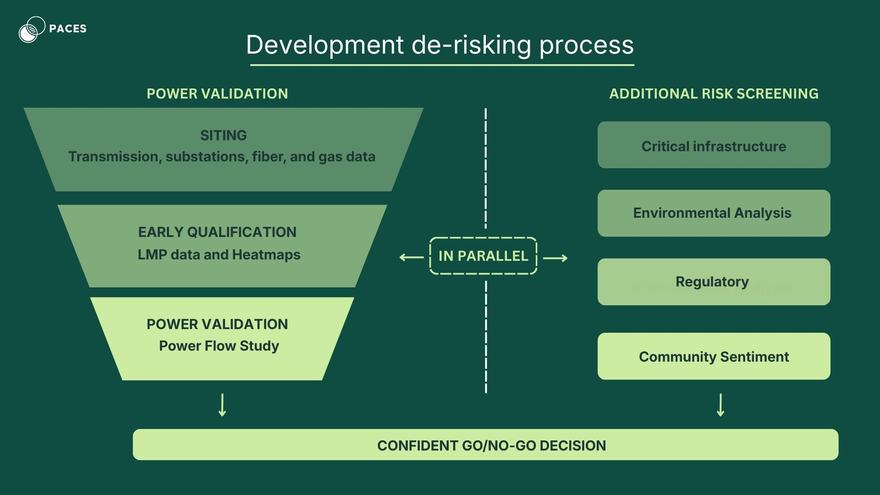

The critical shift is running this power funnel alongside regulatory, critical infrastructure, environmental, and sentiment screening, not before it and not after it. The developers moving fastest right now are assessing all five risk dimensions in parallel, so that fatal flaws in any category surface before capital is deployed.
Most of the data needed to screen these risks already exists in public records, environmental databases, zoning maps, and local ordinances. The challenge has been synthesizing it into an actionable signal fast enough to change a decision. As grid capacity data narrows the geographic search, environmental layers, permitting complexity scores, and community risk indicators can be applied to the same sites at the same time. With AI tools + human validation, developers can now access the key risk insights they need before pursuing a site. The shortlist that emerges is validated across all five dimensions, and sites with fatal flaws in any category are eliminated before anyone signs a letter of intent.
The cost of waiting
In a market where viable sites are being locked up quickly, the team that can move from identification to confident commitment in weeks rather than months will secure better positions. Every cycle of parallel diligence that eliminates a non-viable site early is time and capital redirected to a site that will actually reach construction.
The $98B in blocked projects from Q2 2025 reflects what happens when development risks beyond power are ignored. The teams that are building more and building faster are the ones treating power, regulatory, critical infrastructure, environmental, and sentiment
and regional development risk as a single integrated assessment: run in parallel, deepened continuously, and resolved before commitment.
A detailed breakdown of the power development funnel and the full-stack risk framework is available in Kyle Baranko’s two-part series: Part 1: The power development funnel and Part 2: Power-ready isn’t shovel-ready. Check out Paces for more information.
Comments