

Hyperscale data centers are facing a power challenge unlike anything the industry has seen before. AI-driven workloads are not only increasing total energy demand, but also fundamentally changing how that demand behaves.
Power consumption can ramp up or down almost instantaneously, creating swings of hundreds of megawatts in seconds. For operators, this introduces a level of volatility that traditional power architectures were never designed to handle.
At the same time, the pressure to incorporate renewable energy – particularly solar – is accelerating. Operators are being asked to deliver capacity faster, maintain uptime, and meet aggressive sustainability targets while operating within constrained and evolving energy markets.
Solar is essential, but not sufficient
Solar energy has become a cornerstone of long-term data center strategy. It offers compelling economics and supports decarbonization goals. In many regions, it is also one of the fastest paths to new generation capacity.
But solar comes with inherent limitations. Its output fluctuates based on weather, time of day, and seasonal conditions. At hyperscale, that variability becomes more than an inconvenience, as it introduces operational uncertainty that is difficult to reconcile with always-on compute environments.
There is also a growing systems challenge. Modern solar sites generate vast volumes of operational data, often spanning hundreds of thousands of data points. Extracting value from that data and translating it into real-time operational decisions requires far more than traditional monitoring tools. It requires an architecture capable of continuously interpreting and acting on changing conditions. Solar is necessary but on its own, it cannot deliver the firm capacity data centers require.
Energy storage as the stabilizing layer
Battery energy storage systems (BESS) are increasingly filling that gap. Where batteries were once limited to short-duration backup, they are now being deployed as active, real-time components of the power system. They provide the responsiveness needed to manage both sides of the equation: smoothing fluctuations in renewable generation and absorbing volatility in AI-driven load.
At scale, BESS enables:
- Rapid response to load spikes from high-density compute
- Stabilization of intermittent solar output
- Instantaneous backup capabilities without reliance on traditional generators
- Optimization of energy usage through peak shaving and load shifting
BESS systems can be continuously adjusted to balance supply and demand, dynamically charging and discharging based on operating conditions. In this context, storage goes beyond being an asset to becoming a control mechanism. Storage turns variability into something that can be managed, but only if it is managed correctly.
The challenge of integration
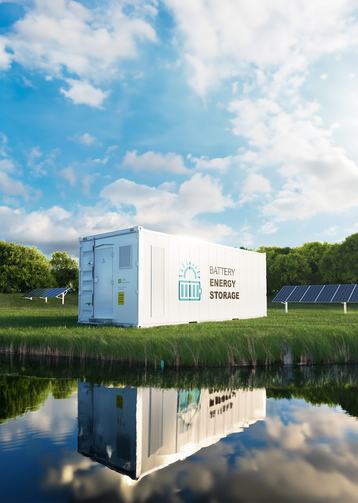

As solar and storage deployments expand, a new challenge emerges: integration.
Each system – solar arrays, battery platforms, inverters, grid interconnections – introduces its own controls, interfaces, and data streams. At hyperscale, this quickly leads to fragmented environments where visibility is limited and coordination becomes difficult.
The scale of the data problem alone is significant. Battery systems can generate millions of data points across a single installation, dramatically increasing the complexity of real-time decision-making. Without a unified approach, operators are left managing disconnected systems that were never designed to work together.
This results in operational friction:
- Delayed or suboptimal energy dispatch
- Inconsistent system behavior across assets
- Increased commissioning and troubleshooting challenges
- Reduced ability to respond dynamically to changing conditions.
In fragmented environments, even basic questions around system ownership and control responsibility can become unclear, slowing troubleshooting efforts and increasing risk during commissioning and live operations.
This mirrors what has already been observed in large-scale energy storage projects: complexity does not increase linearly. Instead, it compounds when systems are not fully integrated.
The role of a unified control architecture
To address this, leading data center operators are prioritizing a different foundation: a unified, industrial-grade control architecture that spans the entire power ecosystem.
Rather than layering multiple point solutions together, this approach establishes a single control environment that integrates generation, storage, and load into one cohesive system. It brings deterministic plant-level automation that has been proven in critical power generation environments into the data center energy stack, ensuring predictable, high-speed system response under dynamic conditions.
This kind of architecture enables:
- Centralized visibility across solar, storage, and other generation such as gas
- Real-time coordination of energy flows across all assets
- Seamless transitions between operating modes as conditions change
- Automated response to fluctuations in both supply and demand
- Deterministic control response, ensuring consistent and predictable system behavior even under rapidly changing load and generation conditions.
It also provides a structured way to manage the enormous volume of data generated across these systems, turning raw inputs into actionable intelligence. For example, integrated platforms can:
- Forecast solar production and load demand simultaneously
- Optimize battery charge and discharge cycles in real time
- Maintain power quality for sensitive computational resources
- Coordinate energy dispatch across multiple sources without manual intervention
- Simulate different operating scenarios to improve planning and resilience.
This level of orchestration is essential. Without it, solar and storage remain isolated assets. With it, they become part of a responsive, adaptive energy system.
Enabling a new operating model
When solar and storage are combined within a unified control framework, data centers begin to operate differently.
Instead of acting as static consumers of electricity, they become dynamic energy systems that are capable of sensing, responding, and adapting in real time. Storage absorbs variability from both AI workloads and renewable generation. Solar contributes scalable, low-cost power. Integration ensures that these resources work together seamlessly.
Moveover, by being a flexible grid resource whether behind or in front of the meter, current or future grid interconnection lead times can be minimized in many markets. The combination of solar and storage addresses the number one issue for data centers: speed to power.
Early deployments using integrated automation and control architectures are demonstrating improvements in reliability, operational efficiency, and energy flexibility, particularly in environments where multiple generation sources must operate as a coordinated system. In some cases, these data centers are even evolving into active participants in the broader energy ecosystem, supporting grid stability rather than simply drawing from it.
The value of intelligent control
As data center power requirements continue to grow, it is clear that no single technology will solve the challenge. Solar and battery storage are critical pieces of the puzzle. But their success depends on how effectively they are integrated, controlled, and operationalized.
The next generation of data centers will be defined not just by how much power they can access, but by how intelligently they can manage it. Operators that invest in unified, software-driven control architectures will be best positioned to deliver the reliability, efficiency, and flexibility required in the AI era.
Comments