

A data center infrastructure management (DCIM) migration is a uniquely complex operation that, if mismanaged, can destabilize the systems that keep operations running. Legacy platforms, often siloed, outdated, and poorly documented, make the process even more difficult. A structured, strategic plan is therefore critical to not only maintaining organizational confidence and uptime during a legacy migration but also to realizing the objectives that were established at the outset.
What are the three core DCIM Migration failure points?
A collision between legacy systems’ constraints with demanding timeframes and a lack of accountability can expose a range of risks that can undermine both the process and its outcomes:
- Data integrity crisis: Legacy DCIMs commonly store inconsistent, incomplete, and outdated records that might only be legible to people who long since left the organization. This can make extraction and mapping to modern systems prone to errors that can corrupt datasets and undermine confidence.
- Integration and workflow paralysis: Fragile, undocumented links to building management systems (BMS), IT service management (ITSM) platforms, and configuration management databases (CMDB) can easily be broken during migration. This can disrupt automated processes and cause teams to revert to time-consuming manual workarounds.
- Financial and strategic miscalculations: Poor planning can frequently lead to extended timeframes and budget overruns, resulting in the need for specialized consultants to troubleshoot the legacy environment. Further to this, transferring potentially sensitive data without a secure plan can lead to compliance violations and audit failure.
Taken together, these challenges can lead to a more prolonged, costly, and disruptive process that fails to deliver the operational improvements it set out to achieve.
How should operators rethink their approach to DCIM migration?
Accounting for these risks requires a shift in strategy as much as in technology. Specifically, success depends on two key priorities. The first is universality, which means building a single, federated, and vendor-agnostic dataset that draws information together across domains, breaks down silos, and supports consistent workflows. This unified foundation is critical to providing the clarity and continuity needed to guide every subsequent stage of the migration.
The second is intelligence, which involves consolidating data in a way that enables analytics and AI to forecast capacity needs, identify emerging risks, and automate routine tasks. This proactive capability moves infrastructure management beyond day-to-day maintenance, instead establishing a far more forward-looking approach that underpins predictive planning and preventative maintenance.
In what way does UIIM translate strategy into migration outcomes?
As the name suggests, universality and intelligence underpin universal intelligent infrastructure management (UIIM), an evolution of DCIM that provides a practical means to plan, implement, and operate data center environments across the full infrastructure stack. By allowing operators to unify infrastructure layers to optimize resources and strengthen operational control, UIIM allows for the alignment of each migration stage with a specific risk mitigation outcome:
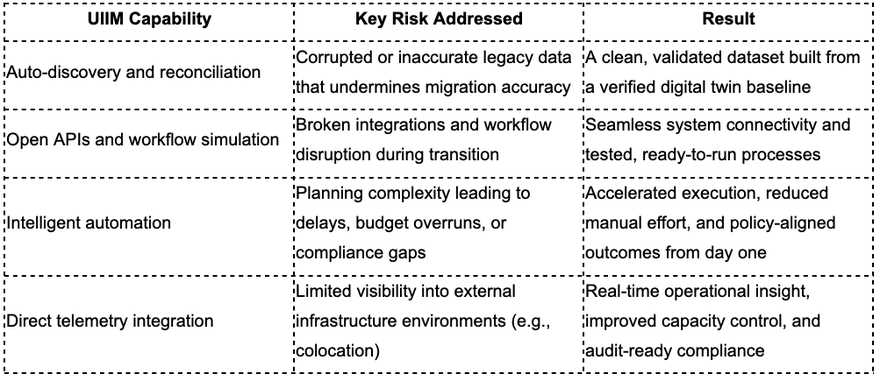

In this way, the combined principles of universality and intelligence make UIIM adaptable to different circumstances. In on-premises environments, for instance, where addressing a deep-seated data fragmentation between siloed IT and Facilities teams is often the primary challenge, Intelligent automation helps replace fragmented processes with far more streamlined operations that seamlessly connect BMS, power, and service silos. In colocation settings, meanwhile, where insight into shared infrastructure for planning and compliance is often lacking, direct telemetry integration provides real-time data for proactive capacity management, billing accuracy, and audit readiness.
How does UIIM shape the long-term value of a DCIM migration?
A DCIM migration is ultimately an investment in future capability. By applying UIIM principles, operators can ensure maximum return on investment through the universal consolidation of data and the embedding of predictive intelligence for more automated workflows. Collectively, these capabilities mitigate costly project failures, lower ongoing operational expenditure, and defer capital expenditure by maximizing capacity value. As such, UIIM provides a strategic foundation for continuous optimization and long-term operational resilience, enabling sustained performance and competitive advantage in an increasingly complex, data-intensive landscape.
More from RiT Tech
-

Sponsored How can universal intelligent infrastructure management (UIIM) mitigate data center migration risks?
Given the complexity and risk of a full data center migration, strategic planning, meticulous asset and capacity management, and smart use of technology are essential to maintaining operational effectiveness
-
Sponsored 2024: The year DCIM (UIIM) embraced AI and sustainability
Revisiting Jeff Safovich's predictions for data center infrastructure management in 2024 and how they have materialized
-

Sponsored How AI is changing the way we manage data centers
In this DCD>Talks episode, Jeff Safovich of RiT Tech shares how AI and UIIM are making data center management smarter, more efficient, and ready for the future
Comments