

There is a surprising correlation between the US data center industry and the National Football League. Specifically, secondary data center (Tier II) markets are experiencing growth in both data center competitiveness and NFL team success.
Primary (Tier I) markets, such as Dallas, New York, and Chicago, have long been traditional locations for data centers. However, in 2025, Tier II cities such as Phoenix, Denver, Minneapolis, and Atlanta are emerging as leaders in delivering stronger data infrastructure, and, coincidentally, NFL team winning records. So, if there's any insight to be gained, it's that the hot NFL teams and the prime spots for data centers are coinciding.
What's happening in data center markets
Locations such as Northern Virginia, Silicon Valley, Dallas, and Chicago, with their superior fiber connectivity, rich ecosystems, and scalability, have long been the industry's choice for data centers. Lately, however, these markets have become cost-prohibitive.
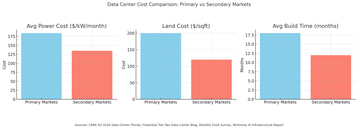
Rising energy costs, grid limitations, and real estate scarcity are changing the data center game. Build times for markets like Dallas and Northern Virginia have increased (up to 18 months), and land costs are skyrocketing (over $200/sqft), according to CBRE's H2 2024 Data Center Trends report. Furthermore, capacity demand is outpacing grid readiness, particularly in areas such as Loudoun County, VA.
Compared to Tier 1 markets, Tier 2 markets have newer infrastructure, faster build times (as short as 12 months), and lower land and power costs. In cities like Phoenix, Denver, Minneapolis, and Atlanta, the average power rate is about $135/kW/month, compared to $184 in primary markets. Flexential, McKinsey, and Deloitte all point to these locations as rising stars.
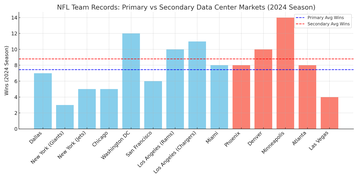
For fun, let's look at 2024 NFL team records from these same markets:
Tier I teams
● Dallas Cowboys: 7 wins
● New York Giants: 3 wins
● New York Jets: 5 wins
● Chicago Bears: 5 wins
Tier II teams
● Minnesota Vikings: 14 wins
● Denver Broncos: 10 wins
● Phoenix Cardinals: 8 wins
● Atlanta Falcons: 8 wins
For what it's worth, these Tier II teams are outperforming the Tier I teams.
Average wins:
● Tier 1 Teams: 7.8
● Tier 2 Teams: 8.8
It could be something in the water. Or maybe this winning is reflective of broader infrastructure, affordability, and development trends. If your city's NFL team knows how to win with smart strategy and balanced execution, then perhaps it's no coincidence that its data center market follows the same trends.
Energy and fiber infrastructure
Tier I markets are currently having difficulties addressing strained energy grids. The McKinsey AI Infrastructure Report notes that many Tier I grids require significant reinforcements. Timelines of three to 10 years to approve new capacity are standard.
However, Tier II markets are offering hybrid power models (renewables, batteries, and gas) as well as high-speed fiber expansion. Hillsboro, Oregon, Denver, and Atlanta are experiencing hyperscaler investment and Internet exchange (IX) growth, with less red tape and lower energy costs.
With cost per kW, land rates, and permitting delays all conspiring to make things difficult in Tier I markets, developers risk exceeding salary caps. This is why we're currently seeing CIOs and CTOs searching for absolute value, looking at Tier II locations.
Not making the Tier II list, but still noteworthy, is Pennsylvania, home to the Philadelphia Eagles, who posted another competitive season. Pennsylvania is quickly emerging as an AI datacenter hotspot propelled in part by CoreWeave’s plans to invest up to $6 billion in a new AI facility, starting with 100MW and scalable to 300 MW.
In addition to CoreWeave, Amazon has committed to investing $20bn to expand its data center in Pennsylvania. These investments underscore that even outside our highlighted Tier II cities, new markets are rapidly rising and worth keeping an eye on.
Overcoming the odds?
So what do Tier 2 NFL teams and secondary data center markets have in common?
● They're outperforming expectations.
● They're cost-effective powerhouses.
● They build for the future, not just the now.
If 2025 was the year these Tier II markets proved their case, then 2026 is the year they move from backup players to starters. With AI workloads accelerating and grid constraints hardening, operators no longer have the luxury of waiting on legacy metros to catch up. Power certainty, speed to deployment, and execution discipline are now the deciding factors—and this next wave of data center growth is delivering on all three.
As the industry heads into the Super Bowl of compute demand, the strongest teams aren’t betting on brand-name locations. They’re building where fundamentals win games: available power, scalable land, pragmatic permitting, and infrastructure that can keep pace with next-generation workloads.
For data center builders making site decisions in 2026, the question is no longer whether Tier II players can compete with Tier I players, it’s how long tenants are willing to wait. In today’s environment winning strategies are defined less by geography and more by readiness—and increasingly, readiness lies outside the strained grid locations.



Comments