![P1560174[7353] (1)](https://media.datacenterdynamics.com/media/images/P15601747353_1.33feb594.fill-180x180.jpg)

The global race for data center capacity has reached a fever pitch. For years, site selection was governed by a familiar triad of physical constraints: secured land, high-capacity fiber, and power availability.
We treat these as hard engineering limits. We have become proficient at modeling them with connectivity due diligence and power flow studies.
Yet, a fourth, more volatile constraint is quietly stalling projects that are otherwise technically perfect: the revocation of the social license to operate.
As the industry scales to meet AI’s voracious appetite, we must face the uncomfortable reality of a community that is increasingly in opposition of data center deployment. This is a capacity bottleneck that no amount of engineering-grade hardware – or administrative paperwork – can solve.
Moving sentiment from PR to project lead time
Historically, developers have viewed community sentiment through the lens of damage control – a soft factor to be managed after the land is under contract. This 'decide-announce-defend' model is a relic of an era with lower land scarcity and less public scrutiny.
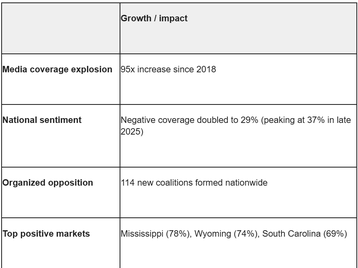
Today, community friction has evolved from a nuisance into a definitive project lead time concern. Recent analysis of data center community sentiment suggests that social opposition has become a leading driver of zoning reversals and multi-year litigation cycles.
In the AI arms race, a site that is technically ready in 2025 but socially blocked until 2027 is a compromised asset. By reframing sentiment as a lead-time risk, we can quantify the cost of friction in the same way we quantify the cost of a substation upgrade.
How to model social license as an engineering constraint
If we accept that sentiment is a measurable risk, the question is no longer about 'outreach' programs, but data integration. Thus, the challenge has shifted from basic outreach to deep data integration, where social factors are treated as core project inputs.
In this evolved model, site evaluation integrates three distinct layers of intelligence:
- Environmental and social overlays: Traditional physical constraints – like topography and utility proximity – are synthesized with unstructured data from municipal records and historical opposition patterns.
- Strategic alignment: The focus shifts to identifying regions where mission-critical infrastructure naturally aligns with local zoning history and economic priorities.
- Acoustic and resource optimization: High-fidelity sentiment data allows for the anticipation of regional triggers long before a project enters the public record
Developers who treat community sentiment with the same rigor as an N-1 contingency study, ensure projects are built on a foundation of local consensus rather than just a favorable deed.
Engineering symbiosis: Can we build facilities the public actually wants?
The media often pits data centers against communities, citing noise pollution and water consumption as primary flashpoints. However, this friction is often a byproduct of poor site selection. Forcing a hyperscale facility into a region with a deep-seated history of anti-industrial sentiment is a choice for maximum resistance.
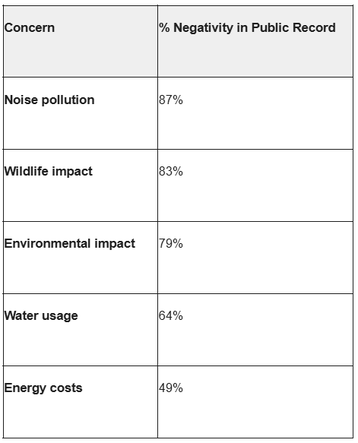


The proactive path forward involves identifying regions where the industry is welcomed for its economic contributions. Instead of "winning" a fight, developers should select sites where the project aligns with local priorities and workforce capabilities.
As our study highlights, transparency is the industry's greatest asset. When developers lead with data – showing how a facility will impact or benefit local infrastructure – the fear of the unknown evaporates.
We’re not aiming to be just a good neighbor, but to ensure that a multi-million dollar investment isn't neutralized by a single town hall vote.
Transparency is primary driver for community alignment
Data centers are not built by brute force but through surgical site selection that accounts for every technical, administrative, and now, social constraint.
We can’t blame red tape for project delays. Often, that tape is a signal we missed because we weren't looking at the right data. Instead, we have to treat local communities as stakeholders in the engineering process.
This transition requires a change in mindset: moving from asking "Can we build here?" to "Should we build here, and will they let us stay?"
Power and fiber will always be the heart of the data center. But without the social license to operate, you’re just building a stranded investment.
Comments